BIOCHEMISTRY - L. Stryer - 1984
VOLUME 1
PART I. CONFORMATION AND DYNAMICS
CHAPTER 4. HEMOGLOBIN: AN ALLOSTERIC PROTEIN
QUESTIONS AND PROBLEMS
1. How will each of the following factors affect the affinity of Hemoglobin A for oxygen in vitro:
a) an increase in pH from 7.2 to 7.4;
b) an increase in pCO2 from 10 to 40 torr;
c) an increase in [BPG] from 2 • 10-4 to 8 • 10-4 M;
d) dissociation of α2β2 into monomeric subunits?
2. How will the following conditions affect the number of H+ ions bound by hemoglobin A in vitro:
a) an increase in pO2 from 20 to 100 torr (at constant pH and pCO2);
b) reaction of hemoglobin with an excess of cyanate (at constant pH)?
3. The erythrocytes of birds and turtles contain a regulatory compound different from BPG. This compound is also capable of lowering the oxygen affinity of human hemoglobin stripped of BPG. Which of the following substances is likely to be the most effective in this capacity:
a) glucose-6-phosphate;
b) Inositol hexaphosphate;
c) HPO42-;
d) malonate;
e) Arginine;
f) lactate?
4. The oxygen dissociation curve for hemoglobin is described to a good approximation by the following empirically derived equation, where n = 2.8. The derivation of this equation was described in Section 4.2.
Class="center">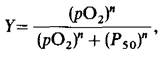
a) The amount of oxygen transported is proportional to the difference in fractional saturation ΔY. Calculate ΔY for a hemoglobin molecule traveling from the Lungs to active Muscle. Assume P50 = 26 torr, Plung = 100 torr, Pmuscle = 20 torr.
b) Suppose that oxygen binding by hemoglobin is noncooperative, while P50 remains 26 torr. What would ΔY be for such a noncooperative oxygen carrier?
5. The pK of an acid depends in part on its local environment. What effect will the following factors have on the pK of a glutamic acid side chain?
a) close proximity to the Lysine side chain;
b) close proximity to the C-terminal carboxyl group of the protein;
c) transfer of a glutamic acid side chain from the protein surface to the internal nonpolar region?
6. The oxygen affinity of hindered iron Porphyrins with various bases in the fifth coordination position was measured. With 1-methylimidazole, P50 was found to be 0.49 torr, whereas with 1,2-dimethylimidazole, it was 38 torr. Why does one additional methyl group decrease the oxygen affinity so drastically?
7. METABOLISM/2.html">THE CONCEPT OF binding lies at The Heart of understanding many biochemical processes. Consider protein P, which is capable of binding substances A and B either together or separately:
The dissociation constants for these equilibrium processes are defined as follows:
a) Suppose that KA = 5 • 10-4 M, KB = 10-3 M, KBA = 10-5 M. Can the fourth dissociation constant KAB be calculated from these data? If so, what is its value?
b) How does A affect the binding of B? How does B affect the binding of A?
8. The binding of carbon monoxide to hemoglobin forms CO-hemoglobin. Crystals of CO-hemoglobin are isomorphous with oxyhemoglobin crystals. Each heme in hemoglobin can bind one carbon monoxide molecule, but cannot bind CO and O2 simultaneously. The binding affinity for CO is approximately 200 times higher than that for O2. As a result, inhaling air containing 0.1% CO for 1 hour causes roughly half of the Hemes in hemoglobin to bind CO, which frequently leads to a fatal outcome. In 1935, Haldane and Priestley posed (and partially resolved) an interesting question:
"If the action of CO were solely to reduce the oxygen-carrying capacity of hemoglobin without affecting its other properties, the symptoms of Carbon monoxide poisoning would be difficult to explain in light of existing data. As we have just seen, when Blood is half-saturated with carbon monoxide, a patient is practically hopeless; on the other hand, if a person's hemoglobin content is simply halved due to anemia, such a patient can continue to work normally."
How can this apparent paradox be explained?
9. Protein P is capable of reversibly
binding a low-molecular-weight compound L. The dissociation constant K for the equilibrium process
P + L ⇄ PL
is
Protein P transports this compound from a region of high concentration [LA] to a region of low concentration [LB]. Assume that the concentration of compound L in free form remains constant. Protein P cycles between A and B.
a) Let [LA] = 10-4 M and [LB] = 10-6 M. At what value of K will The transport of L be maximal? To solve this problem, set up an equation for ΔY, i.e., The change in the saturation fraction of the Ligand-binding site upon transition from A to B. Next, express K in terms of ΔY.
b) Consider the transport of oxygen by hemoglobin in a similar manner. At what value of P50 will ΔY be maximal? Assume that the oxygen pressure in the lungs is 100 torr, and in tissue capillaries, 20 torr. Compare your obtained value of P50 with the physiological value of 26 torr.
Last update: 06/08/2026
Editorial and Educational Adaptation: This material has been compiled based on the primary/original source text. The project team performed an editorial review, corrected technical inaccuracies, structured sections, and adapted the content for an educational format.
What was processed:
- elimination of formatting defects (OCR errors, structural breaks, corrupted characters);
- editorial organization of content;
- standardization of terminology in accordance with academic sources;
- verification of factual statements against the original source text.
All mentions of the author, publication year, and origin of the primary text have been preserved in accordance with the source.