BIOCHEMISTRY - L. Stryer - 1984
VOLUME 1
PART I. CONFORMATION AND DYNAMICS
APPENDIX. CONCEPTS OF ACIDITY AND BASICITY
Ionization of water
Water dissociates into a hydronium ion (H3O+) and a hydroxyl ion (OH-). For simplicity, the hydronium ion is denoted as a hydrogen ion (H+), and then the water dissociation process at equilibrium takes the form H2O ⇄ H+ (OH-.
The Equilibrium Constant Kp of this process is
Class="center">
where the quantities in square brackets are expressed in molar concentrations. Since the concentration of water (55.5 M) changes very little during ionization, equation (1) can be simplified:
KH2O = [H +] [OH-], (2)
where KH2O is the ion product of water. At 25°C
KH2O = 1.0 • 10-14.
It is important to note the inversely proportional relationship between the concentrations of H+ and OH- ions. If the H+ concentration increases, the OH- concentration decreases, and vice versa. For example, if [H+] = 10-2 M, then [OH-] = 10-12 M.
Definition of acids and bases
An acid acts as a proton donor, and a base acts as a proton acceptor.
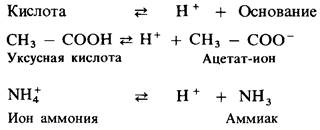
The ionization of an acid produces its corresponding (conjugate) base, and conversely, the protonation of a base produces the corresponding acid. Thus, acetic acid and the acetate ion form a conjugate acid-base pair.
Definition of pH and pK values
The pH of a solution is a measure of its hydrogen ion concentration. The pH value is defined by the relation

Let us represent the ionization process of a weak acid at equilibrium:
HA ⇄ H+ + A-.
The apparent equilibrium constant K of the ionization process is expressed by the equation

From this, the pK of an acid can be defined as

It follows from equation (4) that the pK of an acid is the pH at which the acid is half-dissociated.
The Henderson-Hasselbalch Equation
What is the relationship between the pH value and The ratio of acid to base in a solution? The desired formula can be derived from equation (4). Let us perform the following transformation:

Taking the logarithm of this expression, we get:

Substituting pH for lg 1/[H+] and pK for lg 1/K respectively, we obtain

This final expression is widely known as the Henderson-Hasselbalch equation.
Equation (8) can be used to calculate the pH of a solution if the molecular ratios of A- and HA, as well as the pK of the acid, are known.
Suppose we have a 0.1 M solution of acetic acid containing 0.2 M acetate ions. The pK of acetic acid is 4.8. Consequently, the pH of the solution will be

Similarly, the pK of an acid can be calculated if the ratio of the molar concentrations of A-!!! and HA and the pH of the solution are known.
Buffer Capacity
A conjugate acid-base pair (such as the acetic acid-acetate ion pair discussed above) possesses an important property: it resists Changes in the pH of a solution. In other words, it acts as a buffer. Let us imagine that OH- is added to a solution of acetic acid (HA):

The plot of the solution's pH against The amount of added OH- ions is called The titration curve (Fig. 2.49). Note that the curve has an inflection point at pH 4.8, which corresponds to the pK of acetic acid. Near this pH value, relatively large amounts of added OH- ions cause only a negligible change in pH. In general, weak acids exhibit their best buffering properties in the vicinity of their pK values.
Table 2.3. pK values of Some Amino Acids
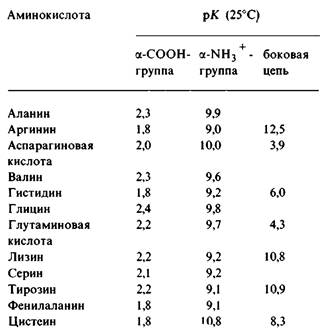
Fig. 2.49. Titration curve of acetic acid
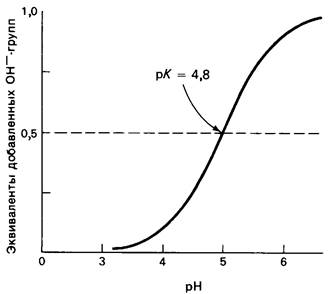
pK Values of Amino Acids
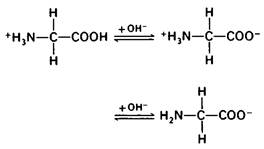
In amino acids like Glycine, two groups can ionize: the a!!!-carboxyl group and the protonated a-amino group. They can be titrated by adding a base (Fig. 2.50). The pK of the α-COOH group is 2.3, and the pK of the α-NH3 group is 9.6. Other Amino Acids have approximately similar pK values for these groups. In some amino acids, notably aspartic acid, the side chain can also ionize. The pK values of ionizable amino acid side chains range from 3.9 (aspartic acid) to 12.5 (Arginine).
Fig. 2.50. Titration of ionizable groups of an amino acid
Last update: 06/08/2026
Editorial and Educational Adaptation: This material has been compiled based on the primary/original source text. The project team performed an editorial review, corrected technical inaccuracies, structured sections, and adapted the content for an educational format.
What was processed:
- elimination of formatting defects (OCR errors, structural breaks, corrupted characters);
- editorial organization of content;
- standardization of terminology in accordance with academic sources;
- verification of factual statements against the original source text.
All mentions of the author, publication year, and origin of the primary text have been preserved in accordance with the source.