Protein Chemistry: Structure, Properties, and Research Methods - Shendryk, A.N. 2022
Methods for Experimental Investigation of Protein Structure
Electron Impact Mass Spectrometry
Fragmentation of Primary Peptide Molecular Ions
The fragmentation of electron impact-induced primary molecular ions of permethylated acetyl Peptides is mainly driven by the Cleavage of C-N amide bonds, with the charge being retained on the carbonyl-containing ion (fragment or cleavage product). This corresponds to the b-ion (see scheme). This decomposition pathway often proceeds in a two-step process involving the loss of CO and The formation of aldimine fragments (c-ions).
The fragment ions resulting from this process directly characterize the Amino Acid Sequence of the peptide. The mass differences between consecutive fragment ions correspond to the mass values of the respective amino acid residues.
The Mechanism of the primary molecular ion fragmentation process is illustrated below:
Class="center">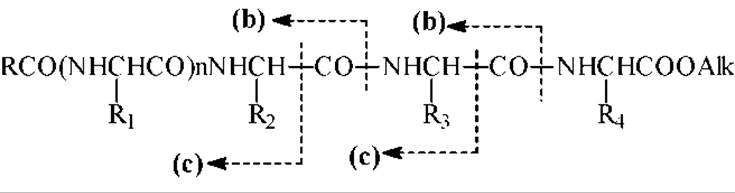
To decipher the mass spectrum of a peptide, one first identifies the peak corresponding to the N-terminal amino acid ion, whose mass-to-charge ratio falls within the range of m/z = 114–257. Next, the mass differences between adjacent fragment ion peaks are calculated. Using the table of modified amino acid residue masses (see below), one determines which specific amino acid was cleaved from the fragment ion during the fragmentation process. Let us examine this with a specific example. Suppose we have a peptide A-B-C-D, where A, B, C, and D are modified amino acid residues. Upon electron impact (EI) and subsequent fragmentation, the following ions are formed: A+, AB+, ABC+, ABCD+. Based on the mass values provided in the table below, The amino acid sequence is reconstructed from the experimental mass spectrum.
Amino Acids with R-groups of the general formula CH2X, where X contains double bonds, are prone to EI-induced C-N bond cleavage accompanied by hydrogen atom migration:
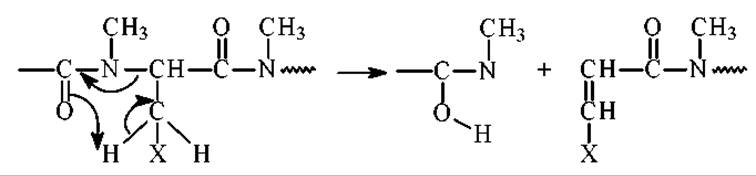
This type of cleavage is characteristic of peptides containing aspartic acid, asparagine, phenylalanine, Histidine, Tyrosine, and Tryptophan residues. The fragmentation yields novel peptides.
Table. Masses of N-terminal and other amino acid (a.a.) residues in the EI mass spectra of acetylated permethyl peptides
A.a. |
Mass of N-term. a.a. |
Mass of a.a. residue |
A.a. |
Mass of N-term. a.a. |
Mass of a.a. residue |
Gly |
114 |
71 |
Met |
188 |
145 |
Ala |
128 |
85 |
Asn |
199 |
156 |
Pro |
140 |
97 |
Glu |
200 |
157 |
Val |
156 |
113 |
Phe |
204 |
161 |
Ser |
158 |
115 |
His |
208 |
165 |
Leu |
170 |
127 |
Gln |
213 |
170 |
|
Thr |
172 |
129 |
227 |
184 |
|
Cys |
174 |
131 |
Tyr |
234 |
191 |
Asp |
186 |
143 |
Lys |
241 |
198 |
Tryptophan Trp |
257 |
214 |
Leucine and isoleucine residues are indistinguishable in the mass spectrum.
The amino acid sequence in these peptides begins with the residue of the amino acid where the C-N bond cleavage occurred. The masses of the N-terminal peptide ions formed via the cleavage of non-peptide C-N bonds are listed in the table below.
Masses of N-terminal ions formed by the cleavage of non-peptide C-N bonds in peptides
A.a. ion |
Mass |
A.a. ion |
Mass |
Asp, Asp |
113 |
His, His |
135 |
Asn, Asn |
126 |
Tyr, Tyr |
161 |
Phe, Phe |
131 |
Trp, Trp |
184 |
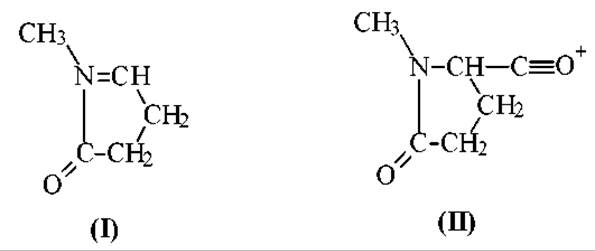
Glutamic Acid and Glutamine residues, regardless of their position in the peptide chain, readily undergo cyclization to form N-terminal pyrrolidone-carboxylic acid ions. This cyclization gives rise to ion (I) in the spectrum
with a mass number of 98. The corresponding N-terminal ion (II) at m/z = 126 is either entirely absent from the spectrum or appears as a low-intensity peak:
The side-chain fragmentation of Certain amino acid residues proceeds via specific pathways, which facilitates the interpretation of peptide mass spectra. For instance, the side chains of Serine and threonine are prone to the elimination of an ethanol molecule. Threonine is characterized by the loss of the entire side chain (via C-C bond cleavage with or without hydrogen atom migration). Methionine tends to eliminate a CH3SH molecule (m/z = 48) or its entire side chain.
Last update: 06/08/2026
Editorial and Educational Adaptation: This material has been compiled based on the primary/original source text. The project team performed an editorial review, corrected technical inaccuracies, structured sections, and adapted the content for an educational format.
What was processed:
- elimination of formatting defects (OCR errors, structural breaks, corrupted characters);
- editorial organization of content;
- standardization of terminology in accordance with academic sources;
- verification of factual statements against the original source text.
All mentions of the author, publication year, and origin of the primary text have been preserved in accordance with the source.