Pharmacognosy with the Basics of Plant Biochemistry - Kovalyov V. M. 2004
Special Part
Phenolic Compounds
Medicinal plants and raw materials containing furanochromones
VISNAGA FRUITS — FRUCTUS VISNAGAE DAUCOIDES (FRUCTUS AMMI VISNAGAE)
Toothpick weed — Visnaga daucoides Gaertn, syn. Ammi visnaga (L) Lam, fam. Apiaceae
Toothpick weed, visnaga; the name comes from visnaga— the Italian name of the plant, Greek daucos — carrot, eidos — similar or like. The plant is a biennial, herbaceous, highly branched, up to 1 m tall, with a taproot. The stem is erect, round, and faintly ribbed. Leaves are alternate, bi- to tripinnatisect into linear-lanceolate segments. Flowers are small, white, unpleasant-smelling, arranged in compound umbels up to 10 cm in diameter. Fruits are ovoid cremocarps that split into two mericarps. They are flattened on the ventral side, convex on the dorsal side; pointed at one end, with five longitudinal, slightly protruding Ribs. The length of a mature mericarp is 2-2.5 mm, thickness 1 mm. The color is grayish-white, ribs are light, unripe fruits are greenish.
Distribution. Native to the Mediterranean region. Grows in Central Asia, North Africa, Southern Europe, and Azerbaijan. Cultivated in Ukraine, Moldova, and the North Caucasus.
Class="center">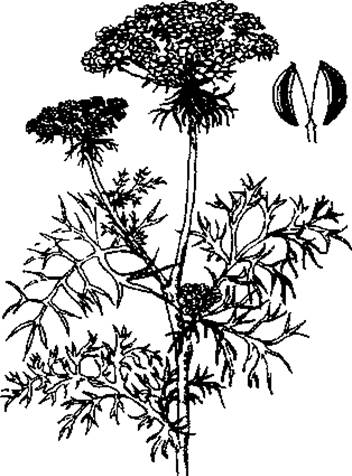
Harvesting. The raw material is harvested during the period of mass browning and curling of the umbels. It is mowed, dried in windrows, threshed, and cleaned. Dried in the open air. Stored in a dry, well-ventilated area. A mixture of fruits with chaff, *Visnaga daucoides mixtio fructum cum palea*, is also used. The chaff consists of parts of flowers, pedicels, umbel rays, crushed leaves, and stems. The fruit content must be at least 50%.
Chemical composition of the raw material. The amount of Chromones is at least 0.8%. All PARTS OF THE plant contain: the pyranocoumarin visnadin, Flavonoids, as well as furanochromones khellin (2.5%), visnagin, kellinin, amiol, khellione, etc. The fruits contain essential oil (0.2%) and fatty oil (20%).
Biological activity and application. Visnaga daucoides is used to produce total preparation avisane, khellin, as well as combined products — kelatrine, kelaverine, vicaline, mareline, and phytolite.
Avisan exhibits spasmolytic and relaxing effects on the Ureter Muscles. It is prescribed for ureteral spasms and Renal Colic. Khellin exhibits spasmolytic and mild sedative effects. It is used for chronic coronary insufficiency, Atherosclerotic Cardiosclerosis, bronchospasm, chronic angina pectoris (for attack Prevention), and intestinal and gastric spasms.
DILL FRUITS — FRUCTUS ANETHI GRAVEOLENTIS
Dill — Anethum graveolens L., fam. Apiaceae
Garden dill; the name comes from the Latinized Greek name for dill — *anethon*; Lat. *graveolens* — very fragrant.
An annual herbaceous plant with a bluish bloom, 40-100 cm tall. The stem is erect, round, striated, and branched. Leaves are alternate, ovoid, bi- to tripinnatisect, with linear thread-like ultimate segments; lower leaves are petiolate, upper leaves are sessile, with white-margined sheaths and reduced blades. Flowers are small, bisexual, yellow, in compound 20-50-rayed umbels, without an involucre. It blooms in May–August. Fruits are flattened brown schizocarps that split into two mericarps, 3-5 mm long and 2-3 mm thick, oval, with five ribs on the outer side, the outer ones extended into wide wings, greenish-gray in color, with a characteristic aromatic odor and spicy taste.
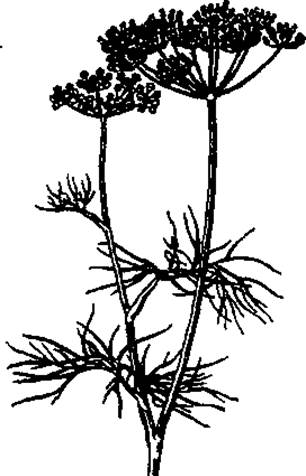
Distribution. Cultivated as a spice and condiment plant, sometimes escaping cultivation and growing as a weed. Native to Persia and Eastern India.
Harvesting. Fruits are harvested when half of them are ripe: whole plants with fruits are plucked or cut, tied into small sheaves and left to ripen, and then threshed. If necessary, the fruits are further dried.
Chemical composition of raw material. The fruits contain the furanochromones visnagin and khellin, the pyranocoumarin visnadin, and flavonoids (kaempferol, isorhamnetin, quercetin), as well as essential and fatty oils.
Biological activity and application. Dill fruits were used to produce anetin, a preparation with a spasmolytic effect; it was used for the Treatment and prevention of chronic coronary insufficiency and asthma. In the form of an infusion and as part of herbal mixtures, it is used as a diuretic and for gastrointestinal disorders.
WILD CARROT FRUITS — FRUCTUS DAUCI CAROTAE
Wild carrot — Daucus carota L., fam. Apiaceae
Wild carrot; the name comes from the Latinized Greek *daukos* — the name of various Apiaceae; *daio* — to burn, to warm; Lat. *carota* — a transliteration of Greek *karota* — carrot.
A biennial herbaceous plant. In the first year, it develops a basal rosette of pinnatisect leaves; In the second year, it flowers and fruits. Flowers are white, gathered in a compound umbel with 10-15 rays bearing umbellets. Fruits are ovoid schizocarps, splitting into separate mericarps about 3 mm long and about 1.5 mm wide. On the convex side of the mericarp, four primary ribs are clearly visible, bearing long prickles in a single row. On the concave side, two ribs protrude, bearing two rows of hairs. The color of the fruits is light brown; the ribs, prickles, and hairs have a grayish tint.
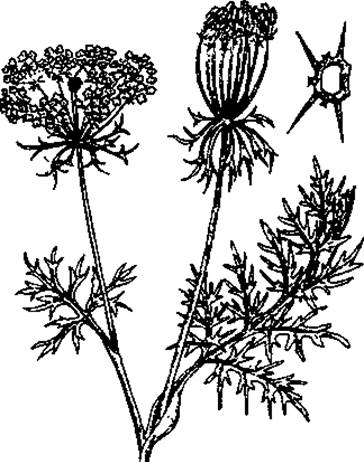
Distribution. Grows throughout Ukraine except for the high-altitude Regions of the Carpathians. It is a weed.
Harvesting. When 60-80% of the umbels turn brown, the plant is cut, dried, and the fruits are threshed and cleaned of impurities.
Chemical COMPOSITION OF THE raw material. The fruits contain coumarin derivatives: umbelliferone, esculetin, scopoletin, osthol; furanochromones: xanthotoxin, peucedanin; Tannins (0.2%), flavonoids, Alkaloids (1.4%), organic acids, sugars, over 20 Trace Elements, as well as essential and fatty oils.
Biological activity and application. The alcoholic seed extract is a component of the complex medication Urolesan, which exhibits spastic, anti-inflammatory, choleretic, diuretic, and litholytic effects.
Last update: 06/08/2026
Editorial and Educational Adaptation: This material has been compiled based on the primary/original source text. The project team performed an editorial review, corrected technical inaccuracies, structured sections, and adapted the content for an educational format.
What was processed:
- elimination of formatting defects (OCR errors, structural breaks, corrupted characters);
- editorial organization of content;
- standardization of terminology in accordance with academic sources;
- verification of factual statements against the original source text.
All mentions of the author, publication year, and origin of the primary text have been preserved in accordance with the source.