Biochemistry - Chemical Reactions in Living Cells, Volume 3 - D. Metzler 1980
Light in Biology
Photosynthesis
Reaction Centers and the Initial Stage of the Photochemical Process
One of the most intriguing questions in Photosynthesis research concerns The Nature of the initial stage of the photochemical process. Whether chlorophyll enters a singlet or triplet excited state during this process remains unknown. Be that as it may, it is generally believed that the excited chlorophyll (Chl*) subsequently transfers an electron to an acceptor—thereby converting it into a radical A•—and is itself oxidized into the radical cation Chl+:
Class="center">
According to the scheme shown in Fig. 13-18, the electron acceptor A is Q in Photosystem II and Z in Photosystem I. The oxidized chlorophyll (Chl+) immediately enters a subsequent reaction, accepting an electron from a suitable donor. In photosystem I, plastocyanin is considered the most likely candidate for this electron donor.
The photooxidation of chlorophyll, proceeding according to scheme (13-26), is accompanied by a decrease in the intensity of its main absorption band. However, because each reaction center is associated with A large number of light-harvesting chlorophyll molecules, this effect is relatively weak. The Study of this overall process was greatly facilitated by the ISOLATION OF PURE photochemical reaction centers from bacterial chromatophores (Ch. 1, Sec. A, 11). Despite minor variations in chemical composition, The properties of reaction centers isolated from several genera of Purple and green Bacteria are quite similar. These centers comprise three Proteins with molecular weights of 21,000, 24,000, and 28,000 in a 1:1:1 stoichiometric ratio [88], along with four bacteriochlorophyll molecules, two bacteriopheophytin molecules, a ubiquinone molecule, a non-heme iron atom, and a carotenoid (except in carotenoid-Biosynthesis-defective mutants). For instance, the reaction center of Rhodospirillum rubrum contains a single molecule of spirilloxanthin [89]. Furthermore, evidence based in part on data regarding exciton splitting [90] indicates that chlorophyll participates in the photochemical reaction as a dimer.
This hypothesis also extends to the chlorophyll found in the reaction centers of green plant METABOLISM/14.html">Chloroplasts [91]. Insights into the potential Structure of this dimer have been gained through X-ray crystallographic analysis of crystalline ethyl chlorophyllide a. In this lattice, the molecules are packed as a polymer, where the macrocycle rings of adjacent chlorophyll molecules are bridged by Water molecules, and the Mg2+ ions lie approximately 0.04 nm above the plane of the four pyrrole nitrogen atoms on the same side as the coordinatively bound water molecule [92]. It has been proposed that chlorophyll molecules form a symmetrical dimer in which both moieties are identically hydrated [93] or linked via OH, SH, or NH groups (Fig. 13-20, B).
Picosecond kinetic studies [94] on the bleaching of bacteriochlorophyll in isolated reaction centers have demonstrated that the initial photochemical oxidation of chlorophyll to Chl+ occurs within 10-10 s (0.1 ns). Consistent with this, the lifetime τ of the excited state of chlorophyll in photosystem I of chloroplasts is estimated to be 0.13 ns (compared to a lifetime τ0 of 19 ns for free chlorophyll in solution) [95]. The shortened lifetime τ in chloroplasts is attributed to rapid Electron transfer from chlorophyll to the acceptor. The excited-state lifetime of chlorophyll in photosystem II is approximately 10 times longer (1.5 ns)1) [95].
The bleaching of bacteriochlorophyll is accompanied by the appearance of an EPR signal with a g-value of 1.82, which is presumably due to the reduction of the primary acceptor, possibly a non-heme iron species [96]. Other evidence suggests that the acceptor is a quinone [97] (or ubiquinone in Rhodopseudomonas). A model reaction analogous to this process is the photo-reduction of benzoquinone coupled with the bleaching of chlorophyll in an alcohol solution [98]. The primary acceptor in photosystem I of chloroplasts appears to be a specialized Fe-S protein [99].
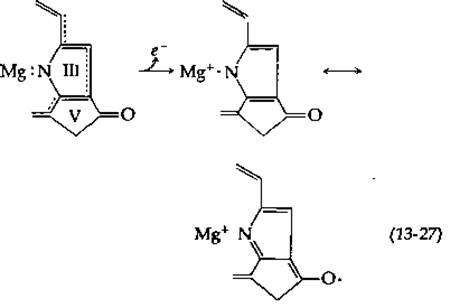
What is the Chemical Nature of Chl+? It has been suggested that the stabilization of the radical ion form generated by the removal of an electron from ring III [scheme (13-27)] involves the carbonyl group of the adjacent ring V. Note that in the Resonance structure depicted at the bottom, the conjugated double-bond system within the ring is disrupted, which likely accounts for the bleaching of the chromophore.
1) According to recent experiments performed on Chlorella chloroplasts [95a], the true lifetime of the excited state of chlorophyll is 0.6 ns rather than 0.13 ns.
Under certain conditions, chlorophyll can undergo photoreduction. It is hypothesized that The primary photochemical act in this process is an electron transfer either between two chlorophyll molecules within a dimer or (in bacteria) from a bacteriochlorophyll molecule to bacteriopheophytin.
Last update: 06/08/2026
Editorial and Educational Adaptation: This material has been compiled based on the primary/original source text. The project team performed an editorial review, corrected technical inaccuracies, structured sections, and adapted the content for an educational format.
What was processed:
- elimination of formatting defects (OCR errors, structural breaks, corrupted characters);
- editorial organization of content;
- standardization of terminology in accordance with academic sources;
- verification of factual statements against the original source text.
All mentions of the author, publication year, and origin of the primary text have been preserved in accordance with the source.