Biochemistry: The Chemical Reactions of Living Cells, Volume 2 - D. Metzler 1980
Biosynthesis: how new molecules are formed
Certain specific pathways of carbohydrate and lipid metabolism
Inositol and D-glucuronic acid
A compound related to Monosaccharides is myo-Inositol (hexaoxycyclohexane) [equation (12-3)]. This substance, which apparently occurs in all living Cells, can be formed from glucose-6-phosphate in accordance with equation (12-3).
Class="center">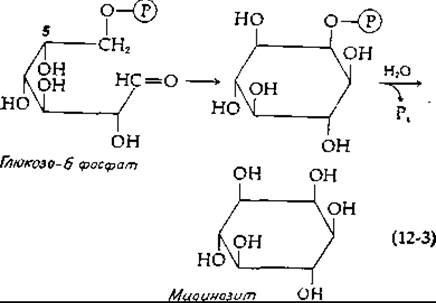
The cyclization process is accompanied by A change in configuration at the C-5 position, which should give the reader a clue to the possible reaction mechanism. In animals, the synthesis of myo-inositol occurs in extremely limited amounts, which is why this compound is sometimes classified as a vitamin. When myo-inositol is absent from the diet, mice grow poorly and suffer from partial alopecia. In rats, fatty Liver develops under these conditions; neutral fat droplets also accumulate in Yeast cells when myo-inositol is missing from the medium [4b]. This compound is essential for The formation of phosphoinositides (inositol-containing Phospholipids; Table 2-8).
In plants, inositol is part of galactinol [equation (12-11)], which appears to be a specific precursor of Cell wall Polysaccharides. Various phosphoric esters of inositol are found in nature. Seeds contain a large amount of hexaphosphate (phytic acid), usually in the form of the calcium salt or a mixed Ca2+Mg2+-salt known as phytin. The number of magnesium phytate granules present in the two apical cells of a 28-cell Mesozoa larva (Fig. 1-10, L) is so large that they make up to half the weight of the entire larva [4c]. Inositol pentaphosphate is an allosteric activator of Hemoglobin in birds (Chapter 4, Section D,6) [4d].
Bacteria have The ability to convert inositol into D-glucuronic acid (Fig. 12-2) with the aid of an oxygenase. Animals also possess free glucuronic acid, which undergoes crucial metabolic transformations. However, its origin in animal Tissues remains unclear. Possible pathways for its formation are shown in Fig. 12-2.
The reduction of glucuronic acid by NADH yields L-gulonic acid. Note that this is an aldonic acid formed by The oxidation of the aldehyde end of the sugar gulose. Since the carbon from the C-6 position of glucuronic acid is incorporated into the C-1 position in gulonic acid, the latter belongs to the L-sugars. Gulonic acid is readily converted into a cyclic lactone, from which L-ascorbic acid (Vitamin C) is formed via a two-stage process involving dehydrogenation and enolization (Fig. 12-2). This process occurs not only in plants, which synthesize abundant vitamin C, but also in most higher animals. However, humans, other primates, and guinea pigs lack the ability to carry out the dehydrogenation step. It could be said that both we and guinea pigs possess a corresponding genetic defect that forces us to consume relatively large amounts of plant foods to meet the body's requirement for ascorbic acid (Supplementary Material 10-J). Ascorbic acid is readily oxidized to dehydroascorbic acid, which can be hydrolyzed to yield L-diketogulonic acid. Upon decarboxylation and reduction, the latter gives L-xylulose—a compound also formed during the normal sequence of oxidation and decarboxylation reactions of L-gulonic acid (Fig. 12-2).
Here we encounter another interesting case of metabolic disorder, namely idiopathic pentosuria. In this condition, xylulose is not reduced to xylitol, resulting in large amounts of pentose being excreted in the urine, especially when the diet is high in glucuronic acid. This metabolic "defect" appears to be entirely harmless. The only inconvenience is that the high sugar content detected during urinalysis is sometimes mistakenly diagnosed as a sign of diabetes.
Concluding the Description of the reactions shown in Fig. 12-2, we note that the reduction of xylulose to xylitol, followed by the oxidation of the latter using NAD+, yields D-xylulose. This sugar is phosphorylated with the participation of ATP and then enters the regular Pentose Phosphate Pathway. Overall, the reaction sequence depicted in Fig. 12-2 serves two primary Functions: first, it provides a pathway for the degradation of glucuronic acid, albeit a rather complex one; second, in most species, these reactions provide for the synthesis of ascorbic acid as well as its breakdown (including in humans).

FIG. 12-2. Main Pathways of D-glucuronic acid METABOLISM.
Last update: 06/08/2026
Editorial and Educational Adaptation: This material has been compiled based on the primary/original source text. The project team performed an editorial review, corrected technical inaccuracies, structured sections, and adapted the content for an educational format.
What was processed:
- elimination of formatting defects (OCR errors, structural breaks, corrupted characters);
- editorial organization of content;
- standardization of terminology in accordance with academic sources;
- verification of factual statements against the original source text.
All mentions of the author, publication year, and origin of the primary text have been preserved in accordance with the source.