Biochemistry - Chemical Reactions in Living Cells, Volume 2 - D. Metzler 1980
Biosynthesis: How New Molecules Are Formed
Selected pathways of carbohydrate and lipid metabolism
Transformations of fructose-6-phosphate
The formation of D-glucosamine-6-phosphate occurs via the interaction of fructose-6-phosphate with glutamine [equation (12-4)].
Glutamine serves as one of the primary transport forms of bound ammonia in the Organism (Chap. 14, Sec. B). During the synthetic reactions depicted in equation (12-4), the amide bond in glutamine must at some point undergo hydrolytic Cleavage, releasing ammonia. Consider a mechanism in which this ammonia reacts with the carbonyl group of fructose-6-phosphate to form an imine (a Schiff base); the latter then undergoes a conversion analogous to that catalyzed by sugar isomerases, yielding D-glucosamine-6-phosphate as the reaction product. Subsequently, an N-acetyl group (from acetyl-CoA) is attached to it through the action of an acetyltransferase enzyme, forming N-acetylglucosamine-6-phosphate. The latter is isomerized to N-acetylglucosamine-1-phosphate, which is further converted into UDP-N-acetylglucosamine (UDP-GlcNAc) through reactions similar to those involved in the synthesis of UDP-Glc [equation (11-24)].
Class="center">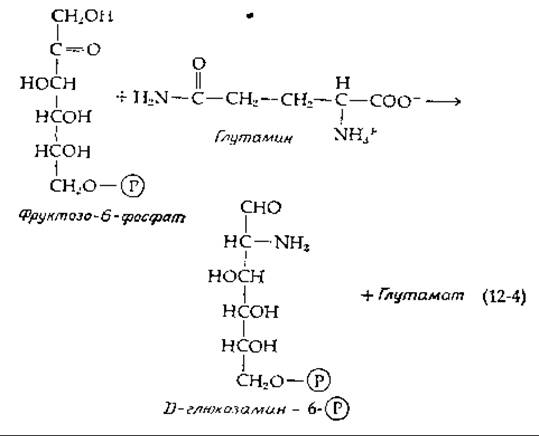
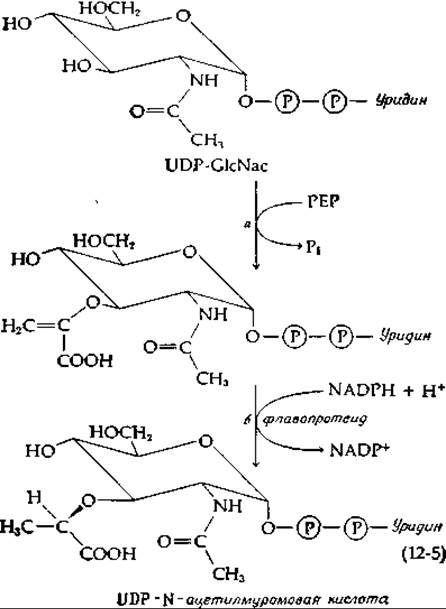
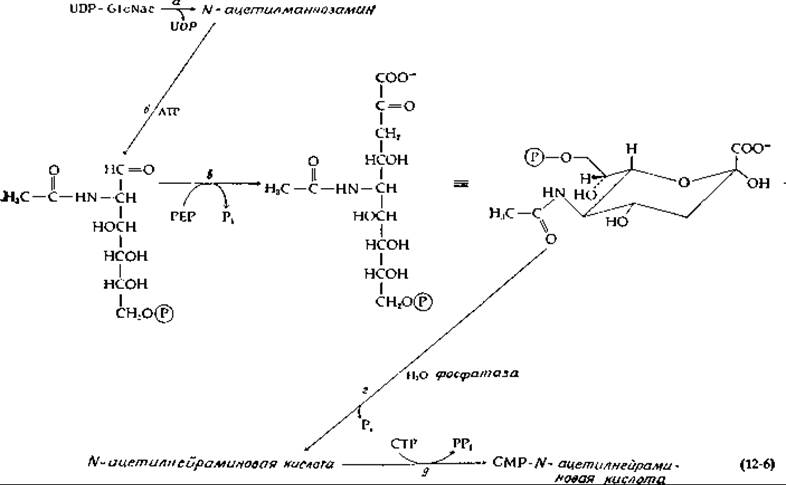
One of the products derived from UDP-GlcNAc is UDP-N-acetylmuramic acid [5]. The initial stage in the synthesis of this compound involves a rather unusual Substitution at the a-carbon atom of phosphoenolpyruvate (PEP) by the 3-OH group of the sugar [equation (12-5), step a]. This process results in the release of inorganic phosphate and the Formation of the enolpyruvate derivative of UDP-GlcNAc. This compound is then reduced in the presence of NADPH [equation (12-5), step b]. From the same intermediate, in the presence of a different enzyme (4-epimerase), a second sugar nucleotide is formed—UDP-N-acetylgalactosamine. The third intermediate of Biosynthesis is CMP-N-acetylneuraminic acid. The latter compound is synthesized via a more complex pathway, where the first step involves the epimerization of UDP-GlcNAc to UDP-ManNAc with the simultaneous release of UDP [equation (12-6)]. The reader should be able to describe The Mechanism of UDP elimination and Water addition. The question arises as to whether the activation of the reaction requires The oxidation of an adjacent hydroxyl group to a carbonyl group as an intermediate step. N-acetylmannosamine is phosphorylated at the 6-hydroxyl group [equation (12-6), step b]. As shown in equation (12-6), in step c, PEP is cleaved to release Pi and an enolate anion; the latter condenses with N-acetylmannosamine-6-phosphate (compare with the carboxylation reaction of PEP; [equation (7-79)]). The immediate product of this process is 9-phosphate-N-acetylneuraminic acid.
This compound is first dephosphorylated by the action of a phosphatase [equation (12-6), step d], and then activated by forming a CMP derivative via reaction with CTP [equation (12-6), step e]. Note that this activated monosaccharide has the distinct feature of forming a derivative with CMP rather than CDP. The lipopolysaccharides of Gram-negative Bacteria contain a nucleoside diphosphate derivative of L-glycero-D-manno-heptose (Fig. 5-11); this compound is formed through a 4-step process starting from sedoheptulose-7-phosphate [5a].
Last update: 06/08/2026
Editorial and Educational Adaptation: This material has been compiled based on the primary/original source text. The project team performed an editorial review, corrected technical inaccuracies, structured sections, and adapted the content for an educational format.
What was processed:
- elimination of formatting defects (OCR errors, structural breaks, corrupted characters);
- editorial organization of content;
- standardization of terminology in accordance with academic sources;
- verification of factual statements against the original source text.
All mentions of the author, publication year, and origin of the primary text have been preserved in accordance with the source.