Biochemistry - Chemical Reactions in Living Cells, Volume 2 - D. Metzler 1980
Biosynthesis: How New Molecules Are Formed
Selected pathways of carbohydrate and lipid metabolism
Synthesis of deoxysugars
Sugar METABOLISM frequently involves the dehydration of α,β-unsaturated carbonyl compounds. A classic example is the synthesis of 2-keto-3-deoxy sugar acid derivatives [Eq. (7-59)]. In certain instances, a carbonyl group is introduced via The oxidation of an OH group—a reaction whose apparent sole purpose is to create conditions favorable for subsequent dehydration. A case in point is The Biosynthesis of L-rhamnose from D-glucose, a multistep pathway [Eq. (12-7)] utilizing sugars linked to deoxythymidine diphosphate [5, 6]. The initial step entails introducing a carbonyl group into the carbohydrate moiety through oxidation. This is followed by dehydration [Eq. (12-7), reaction b], after which the newly formed double bond is reduced. The complex multienzyme system catalyzing steps a through c in Eq. (12-7) incorporates its own oxidizing agent (NAD+), which stores the reducing equivalents generated in step a and subsequently utilizes them to reduce the double bond in step c. Specific stages of this reaction sequence feature inversion at the C-3 position. A separate enzyme is required for the second reduction [Eq. (12-7), reaction d].
Class="center">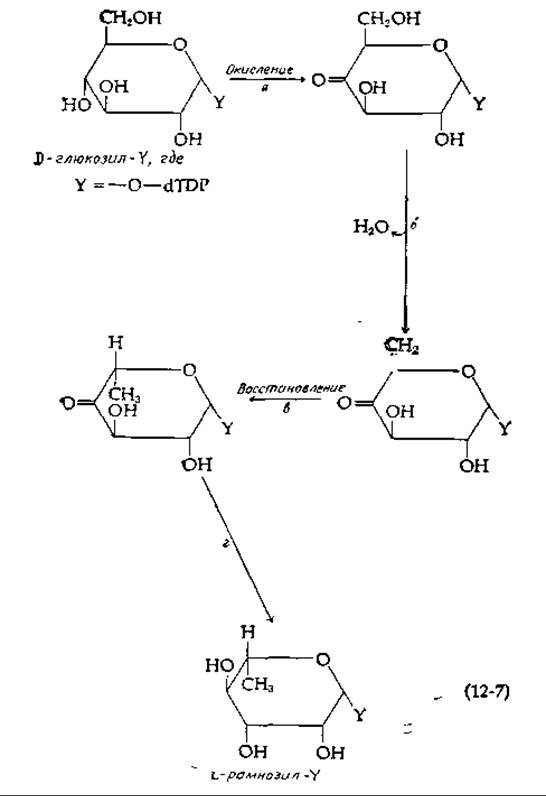
The biosynthesis of dideoxysugars, essential constituents of bacterial Cell-surface Polysaccharides, is discussed in Chapter 8, Section D.4.
Last update: 06/08/2026
Editorial and Educational Adaptation: This material has been compiled based on the primary/original source text. The project team performed an editorial review, corrected technical inaccuracies, structured sections, and adapted the content for an educational format.
What was processed:
- elimination of formatting defects (OCR errors, structural breaks, corrupted characters);
- editorial organization of content;
- standardization of terminology in accordance with academic sources;
- verification of factual statements against the original source text.
All mentions of the author, publication year, and origin of the primary text have been preserved in accordance with the source.