Biochemistry - The Chemical Reactions of Living Cells Volume 2 - D. Metzler 1980
Enzymes: Protein Catalysts of Cells
Enzyme Inhibition and Activation
Noncompetitive Inhibition and Activation
If an inhibitor binds not only to the free enzyme but also to the enzyme-substrate complex ES, the inhibition is referred to as non-competitive. In this case, the binding of S and I is not mutually exclusive, and both ligands can be simultaneously bound by the enzyme molecule. Why does such an inhibitor slow down the enzymatic reaction? In most cases, The Structure of the inhibitor differs from that of the substrate. This suggests that the inhibitor binds to an allosteric site—i.e., a site distinct from the substrate-binding site—and the suppression of enzyme activity is caused by a distortion of its three-dimensional structure resulting from inhibitor binding. This distortion can be transmitted to the Active Site, even though the inhibitor-binding site is distant from it. Furthermore, the bound inhibitor is capable of influencing the catalytic process by partially shielding the active site. Be that as it may, The conversion of the ESI complex proceeds more slowly than the catalytic breakdown of the ES complex yielding the product, or does not proceed at all.
Class="center">
FIG. 6-7. Plot of dependence on lg [S] for reactions proceeding in the presence of competitive or non-Competitive Inhibitors. I — in the absence of inhibitor; II — in the presence of a competitive inhibitor ([I]/K1=1); III — in the presence of a non-competitive inhibitor ([I]/K1=1).
The binding of a compound to an allosteric site sometimes leads not to the suppression of enzyme activity, but rather to its enhancement. A quantitative analysis of The kinetics of such activation is carried out in the same manner as in the case of inhibition. Allosteric inhibitors and activators are frequently considered together and termed modifiers or effectors. The General scheme of action for a modifier M is as follows [34]:

In this scheme, K1 and K2 represent the equilibrium constants for the reversible dissociation of M from the EM and ESM complexes, respectively, while KdS and KdS are the analogous constants for the dissociation of S from the ES and ESM complexes. Note that the dissociation constant for the equilibrium process ESM⇄EM+S is not an independent quantity and is related to the other equilibrium constants by the following expression:
KdS = KdSK2/K1 (6-48)
For simplicity, it is assumed that the steps involving the binding of S and M are at equilibrium (Section A, 10, g).
The competitive inhibition considered above corresponds to the situation where K2→∞ (and consequently, KdS→∞). In this case, M acts as an inhibitor, and no activation occurs. Non-competitive inhibition corresponds to the case where the ESM complex does not undergo catalytic conversion, i.e., k4=0. The equation for 1/v in this case takes the following form:

As seen from the equation, the term 1/Vmax is multiplied by a factor containing [I] and K2. Thus, a characteristic feature of non-competitive inhibition is a decrease in the maximum velocity compared to that in the absence of the inhibitor1). No matter how high the Substrate Concentration may be, it is impossible to completely prevent inhibition.
Fig. 6-8 shows the plots of 1/v versus 1/[S] for reactions proceeding in the absence and presence of an inhibitor. If K1 = K2 (the case of pure non-competitive inhibition), then in coordinates {1/[S]; 1/v} for various fixed inhibitor concentrations, we obtain straight lines intersecting at a point located on the abscissa axis, corresponding to a value of 1/[S] numerically equal to −1/KM. If, however, K1≠K2 (the case of partially competitive inhibition), the family of lines intersects at a point located in the region of negative values of 1/[S] and either above or below the abscissa axis depending on the ratio between the constants K1 and K2. Fig. 6-8 corresponds to the situation where K2=K1/2, meaning that M binds to the ES complex twice as strongly as to E.
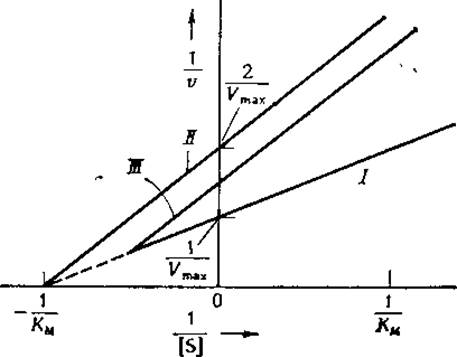
FIG. 6-8. Double-reciprocal plots for reactions proceeding in the presence of a non-competitive or partially competitive inhibitor. I — in the absence of inhibitor; II — in the presence of a non-competitive inhibitor ([І]/К2 = [I]/K1 = 1); III — in the presence of a partially competitive inhibitor ([І]/K2 = 0.5; [I]/K1 = 1).
From Fig. 6-7, it can be seen how the shape of the curve Changes in the presence of non-competitive and competitive inhibitors. The shift of the half-saturation point to the right reflects the inhibitor's ability to hinder substrate binding, while the decrease in maximum velocity in the case of non-competitive inhibition is due to the fact that the substrate is unable to completely displace the inhibitor from the enzyme complex even when its concentration is very high.
If the inhibitor binds exclusively to the ES complex and does not bind to E, i.e., K1 = ∞, the 1/v versus 1/[S] plots obtained at various fixed inhibitor concentrations are represented graphically by parallel lines. This case, commonly termed uncompetitive inhibition, is quite rare for single-substrate enzyme systems. However, the inhibition process in multi-substrate enzyme systems obeying ping-pong mechanisms is quite frequently characterized by a family of parallel lines in {1/[S]; 1/v} coordinates.
1) With KM remaining constant — Translator's Note.
If the rate constant k4 in scheme (6-47) is non-zero, either inhibition or activation may occur. When k3 = k4, the modifier either increases the apparent Michaelis constant (inhibition) or decreases it (activation). The maximum velocity remains unchanged. Monod et al. [35] refer to enzyme systems with such kinetic properties as K-systems. If, however, K1 = K2, then we are dealing with a true V-system. In the general case, the presence of a modifier leads to A change in both the apparent Michaelis constant and the apparent maximum velocity.
Many Enzymes are specifically activated by Metal Ions. Often, the metal ion is regarded as a second substrate that must bind alongside the first substrate for the catalytic process to take place. In other instances, the complex of an organic compound molecule with a metal ion is considered the "true substrate." For example, many enzymatic reactions proceed with the participation of the ATP–magnesium ion complex (Chapter 3, Section B, 5), and Enzymes can be viewed either as two-substrate (requiring Mg2+ and ATP4-) or single-substrate (binding MgATP2-).
Last update: 06/08/2026
Editorial and Educational Adaptation: This material has been compiled based on the primary/original source text. The project team performed an editorial review, corrected technical inaccuracies, structured sections, and adapted the content for an educational format.
What was processed:
- elimination of formatting defects (OCR errors, structural breaks, corrupted characters);
- editorial organization of content;
- standardization of terminology in accordance with academic sources;
- verification of factual statements against the original source text.
All mentions of the author, publication year, and origin of the primary text have been preserved in accordance with the source.