Biochemistry - The Chemical Reactions of Living Cells, Volume 2 - D. Metzler 1980
Coenzymes - specialized natural reagents
Flavin coenzymes
Reactions of reduced flavins with oxygen
In the absence of an enzyme, free dihydroriboflavin reacts with molecular oxygen (yielding hydrogen peroxide) within mere seconds, while with reduced flavin dehydrogenases, the reaction proceeds even faster. The intermediate compound appears to be a 4a-adduct [Equation (8-59)]:
Class="center">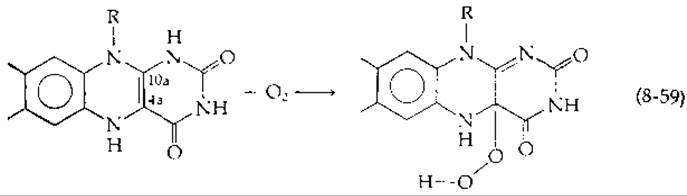
which can be detected spectrophotometrically in non-enzymatic processes [132, 133]. (Addition at other positions is also possible.) It has been suggested [134] that a cyclic peroxide is formed via The addition of O2 to carbon atoms 4a and 10a:

The formation of various products in many Reactions Catalyzed by different Flavoproteins could be explained by the presence of peroxy intermediates. For instance, the Cleavage of the adduct in reaction (8-59) via protonation of the internal oxygen atom could lead to the formation of H2O2 and oxidized flavin. Alternatively, the C—O bond could undergo homolytic cleavage to yield two radicals: a flavin radical and a peroxy radical ∙ O2Н. The latter can subsequently dissociate to form a superoxide anion radical:

Various metal-containing superoxide dismutases catalyze the following reaction:

During the spontaneous reoxidation of reduced flavin in the presence of superoxide dismutase, the reaction rate is significantly lower than in the absence of the enzyme. This observation indicates that the non-enzymatic reoxidation of reduced flavins proceeds via a radical mechanism involving the formation of a superoxide anion. A second step is required for the subsequent Conversion of the flavin radical into the fully oxidized form:

However, superoxide dismutases generally have little effect on flavin reoxidation in dehydrogenases. An exception is xanthine oxidase, which is a very potent producer of superoxide anions. Frid et al. [134a] proposed that an important function of xanthine oxidase is the synthesis of hydrogen peroxide and superoxide radicals utilized in coupled Biological Oxidation processes.
Another class of flavoproteins discussed in Chapter 10 (Section G, 2) comprises Monooxygenases or hydroxylases. In these Enzymes, reduced flavin facilitates the incorporation of one oxygen atom from an O2 molecule into the substrate, while the other oxygen atom is simultaneously converted into H2O. Formally, this reaction can be viewed as the cleavage of the oxygen-oxygen bond of the adduct in scheme (8-59), yielding OH+ from the terminal OH group.
Last update: 06/08/2026
Editorial and Educational Adaptation: This material has been compiled based on the primary/original source text. The project team performed an editorial review, corrected technical inaccuracies, structured sections, and adapted the content for an educational format.
What was processed:
- elimination of formatting defects (OCR errors, structural breaks, corrupted characters);
- editorial organization of content;
- standardization of terminology in accordance with academic sources;
- verification of factual statements against the original source text.
All mentions of the author, publication year, and origin of the primary text have been preserved in accordance with the source.