Biochemistry - The Chemical Reactions of Living Cells, Volume 2 - D. Metzler 1980
Coenzymes - specialized natural reagents
Flavin coenzymes
Metal-flavin complexes and metalloflavoproteins
The presence of Metal Ions in certain Flavoproteins [125a] indicates the direct attachment of metal ions to flavins. Although oxidized flavins do not readily bind most metal ions, they form red-colored complexes with Ag+ and Cu+ via proton dissociation from N-3 [126, 127]:
Class="center">
Flavin semiquinones (radicals) form more stable red complexes with many metals [128]. In this case as well, it is believed that the metal ion interacts with N-5 and the oxygen atom at C-4. If the same site is occupied by a metal ion exhibiting more than one oxidation state, electron transfer between the flavin and the substrate may be mediated by the metal atom.
The unusual flavoprotein xanthine oxidase catalyzes two reactions (8-56 and 8-57).
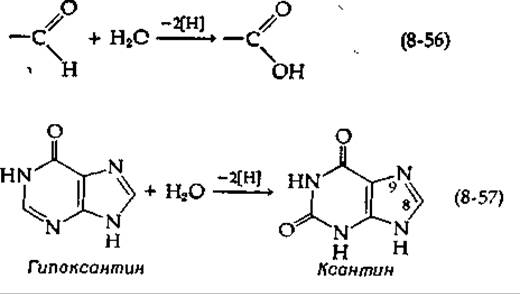
The closely related enzyme aldehyde oxidase carries out only reaction (8-56). Xanthine oxidase can also oxidize xanthine further by repeating the same type of oxidative process at positions 8 and 9 [see reaction (8-57)] to yield uric acid. Perhaps the most interesting property of xanthine oxidase is that, for each molecule of bound FAD, it contains a tightly bound molybdenum atom (Supplement 14-A) alongside four iron atoms. (The molecule is a dimer with a Molecular Weight of ~ 275,000, containing two FAD molecules, two Mo atoms, and eight Fe atoms.)
In fact, the first indication of The Role of molybdenum in METABOLISM was the discovery that dietary molybdenum deficiency leads to a decrease in xanthine oxidase activity in the Liver (the enzyme is also present in milk).
Reactions (8-56) and (8-57) are written as if xanthine oxidase were a dehydrogenase: Water first adds across a C — O or C=N bond at the site of oxidation, after which the adduct undergoes dehydrogenation. Such a mechanism fails to account for the requirement for Mo and Fe.
The detection of characteristic EPR signals of molybdenum during enzyme action indicates that Mo is indeed involved in catalysis [129, 129a]. The initial step of the enzymatic reaction may be the reduction of Mo(VI) to Mo(V). Hamilton proposed a mechanism [117] as shown in equation (8-58).

The adduct initially formed via The addition of a metal-coordinated hydroxyl group can be further oxidized by electron transfer through oxygen to two molybdenum atoms. Each of these could accept one electron to yield two Mo(V) atoms. These electrons can subsequently be transferred to flavins, protein-bound iron atoms, and O2 via a miniature Electron Transport Chain. Xanthine oxidase belongs to the group of flavin Enzymes containing tightly bound iron that is not coordinated to a heme core. It is a representative of the iron-sulfur Proteins discussed later in Chapter 10 (Section B). Xanthine oxidase and aldehyde oxidase also contain a persulfide group (—S—S-), which is essential for catalytic activity.
Flavin-containing iron-sulfur proteins include NADH dehydrogenase (Reaction d, Table 8-4) and succinate dehydrogenase [Reaction (8-49)]. Both of these mitochondrial enzymes likely transfer electrons, via bound iron atoms, to the cytochrome system of The electron transport chain (Chapter 10) [130a].
Some metalloflavoproteins contain heme groups (Chapter 10, Section B). An example is Yeast L-Lactate dehydrogenase, an enzyme also known as cytochrome b2. This protein is a tetramer with a molecular weight of ~ 235,000; each of its subunits consists of two distinct polypeptide chains, one molecule of riboflavin phosphate, and one heme [131]. In all likelihood, the flavin and heme are attached to different polypeptide chains, and the enzyme Functions as a typical dehydrogenase, with electrons being transferred from the reduced flavin through an iron atom to the bound heme. The ultimate electron acceptor is apparently cytochrome c.
Last update: 06/08/2026
Editorial and Educational Adaptation: This material has been compiled based on the primary/original source text. The project team performed an editorial review, corrected technical inaccuracies, structured sections, and adapted the content for an educational format.
What was processed:
- elimination of formatting defects (OCR errors, structural breaks, corrupted characters);
- editorial organization of content;
- standardization of terminology in accordance with academic sources;
- verification of factual statements against the original source text.
All mentions of the author, publication year, and origin of the primary text have been preserved in accordance with the source.