Biochemistry of Amino Acids - A. Meister 1961
Natural Amino Acids
Peptides and Related Compounds
Carnosine and Anserine
Class="center">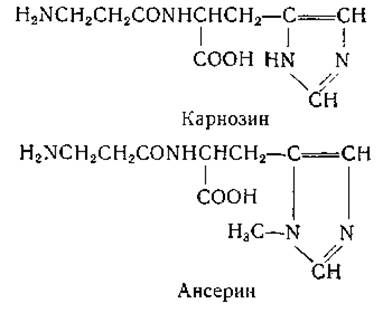
Carnosine was isolated from Muscle tissue by Gulevich and Amiradzhibi [386] in 1900; it was later established to have The Structure of β-alanyl-L-Histidine [387, 388]. Anserine, a 1-N-methyl derivative of carnosine, is also a constituent of vertebrate Muscles [389–391]. Although the presence of relatively large quantities of carnosine and anserine in muscles has been known for a long time, the Functions of these substances remain comparatively poorly understood.
Carnosine is hydrolyzed to yield β-Alanine and histidine under the action of an enzyme (carnosinase) found in The Liver and Kidneys of certain animals [392]. The ability of carnosine to support the growth of animals [393] and microorganisms [394] (acting in place of histidine) can be attributed to its preliminary Enzymatic Hydrolysis. Anserine, first isolated from goose muscle, was subsequently discovered in the muscles of many other animals.
Last update: 06/08/2026
Editorial and Educational Adaptation: This material has been compiled based on the primary/original source text. The project team performed an editorial review, corrected technical inaccuracies, structured sections, and adapted the content for an educational format.
What was processed:
- elimination of formatting defects (OCR errors, structural breaks, corrupted characters);
- editorial organization of content;
- standardization of terminology in accordance with academic sources;
- verification of factual statements against the original source text.
All mentions of the author, publication year, and origin of the primary text have been preserved in accordance with the source.