Human Biochemistry Volume 1 - Murray R. 1993
Structure and Functions of Proteins and Enzymes
Enzymes: Kinetics
The Role of Enzymes in Covalent Bond Cleavage and Formation
Most Chemical Reactions of biochemical interest involve the Cleavage or formation of covalent bonds. Let us consider, for example, the transfer reaction discussed in Chapter 7:
Class="center">D - G + A ⇄ A - G + D,
in which group G is transferred from a donor, D — G, to an acceptor, A. The overall reaction involves both the Cleavage of the D — G bond and The formation of a new A — G bond. However, if the transfer reaction is catalyzed by an enzyme, it is better written as follows:
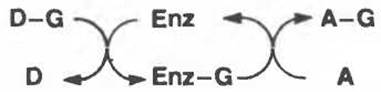
This representation highlights three important features of enzymatic group-transfer reactions.
1. Each half-reaction involves both bond cleavage and bond formation.
2. The enzyme acts as a full reactant, just like D — G and A.
3. While in the overall reaction the enzyme Functions as a catalyst (i.e., it is required only in trace amounts and is regenerated in its original state upon completion of the reaction), in each half-reaction the enzyme acts as a stoichiometric reactant (i.e., it reacts with other reactants in a 1:1 molar ratio).
Many other biochemical reactions can be viewed as special cases of transfer reactions in which either A, or D, or both reactants are absent. For example, an isomerization reaction (such as the interconversion of glucose-6-phosphate and glucose-1-phosphate) can be represented as a transfer reaction lacking both D and A:
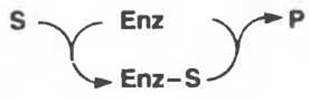
However, this representation fails to capture another key property of enzymatic reactions: the participation of two or more forms of the Enz — S complex in the overall reaction and the sequential progression of multiple reaction stages. To reflect this property, the transfer reaction can be depicted as follows:
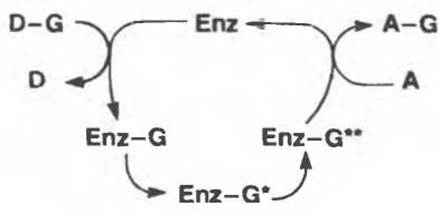
where Enz — G, Enz — G*, and Enz — G** are forms of the Enz — S complex that are formed sequentially during the course of the overall reaction.
From the foregoing Structure/133.html">Discussion, it is clear that for a reaction to take place, all participating reactants must approach each other closely enough for bond formation (or cleavage) to occur—that is, they must collide. In homogeneous solution chemistry, the concentration of reacting molecules in the absence of catalysts is considered uniform throughout the solution. In the presence of a catalyst, however, this condition no longer holds. To function effectively, a catalyst must possess specific binding sites on its surface for the reacting molecules. Such binding is a reversible process, although the equilibrium lies heavily in favor of complex formation. Qualitatively, this can be represented as follows:
Reactant + Catalyst ⇄ Reactant-catalyst complex.
The Stability of the complex formed by reactant R and catalyst C can be quantified using the dissociation constant of the R — C complex (Kd)
or the Equilibrium Constant of the reaction:
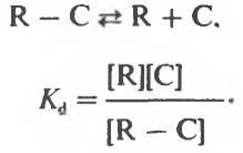
Thus, the stronger the R — C complex, the smaller the Kd.
This leads to an important consequence: the binding of a reactant to the catalyst results in a marked increase in the local concentration of the reactant compared to its concentration in the bulk solution.
Thus, we transition from the realm of homogeneous solution chemistry to that of heterogeneous solution chemistry.
If the catalyst of a bimolecular reaction (involving two reactants) binds both reactants, the local concentration of each reactant increases, with the magnitude of this increase depending on the affinity of the catalyst for that reactant (Kd). As we will see below, The rate of a bimolecular reaction
А + В → А — В
is proportional to the concentrations of both reactants, A and B; therefore, the binding of A and B to the catalyst can lead to an extraordinarily large (several thousand-fold) increase in the reaction rate.
One of the key factors enabling an enzyme to act as a catalyst is its ability to efficiently bind one or (more often) both reactants involved in a bimolecular reaction, leading to an increase in the local concentration of the reactants and, consequently, a local enhancement of the reaction rate. The fact that Enzymes are unusually efficient and highly selective compared to most non-protein catalysts requires further explanation. To understand these distinctive METABOLISM/8.html">Properties of Enzymes, we must introduce THE CONCEPT OF the active, or catalytic, site1.
1 In many manuals, The concepts of "Active Site" and "catalytic site" are treated as synonyms; however, some enzymes possess additional active sites intended for regulating enzyme activity that are not directly involved in the chemical transformations at various Stages of the catalytic process. Therefore, to avoid ambiguity, we use the term "catalytic site".
Last update: 06/08/2026
Editorial and Educational Adaptation: This material has been compiled based on the primary/original source text. The project team performed an editorial review, corrected technical inaccuracies, structured sections, and adapted the content for an educational format.
What was processed:
- elimination of formatting defects (OCR errors, structural breaks, corrupted characters);
- editorial organization of content;
- standardization of terminology in accordance with academic sources;
- verification of factual statements against the original source text.
All mentions of the author, publication year, and origin of the primary text have been preserved in accordance with the source.