Harper's Illustrated Biochemistry, Volume 1 - Murray R. 1993
Structure and Function of Proteins and Enzymes
Peptides
Methods for Peptide Separation
Chromatography and High-Voltage Electrophoresis
These Methods (Ch. 3) are applicable to the Separation of not only Amino Acids, but also low-molecular-weight Polypeptides.
Automated sequencing (Determination of the Amino Acid Sequence) employs large Peptides (30–100 residues). However, many denaturated high-molecular-weight polypeptides prove to be insoluble. This is because hydrophobic residues, previously buried inside the molecule, can become exposed upon Denaturation. In principle, such polypeptides can be dissolved in urea, alcohols, organic acids, and bases, but this limits the Prospects for subsequent peptide separation by Ion-exchange chromatography. Nevertheless, gel filtration of large hydrophobic peptides can be carried out in 1–4 M formic or acetic acid (Fig. 4.7).
Class="center">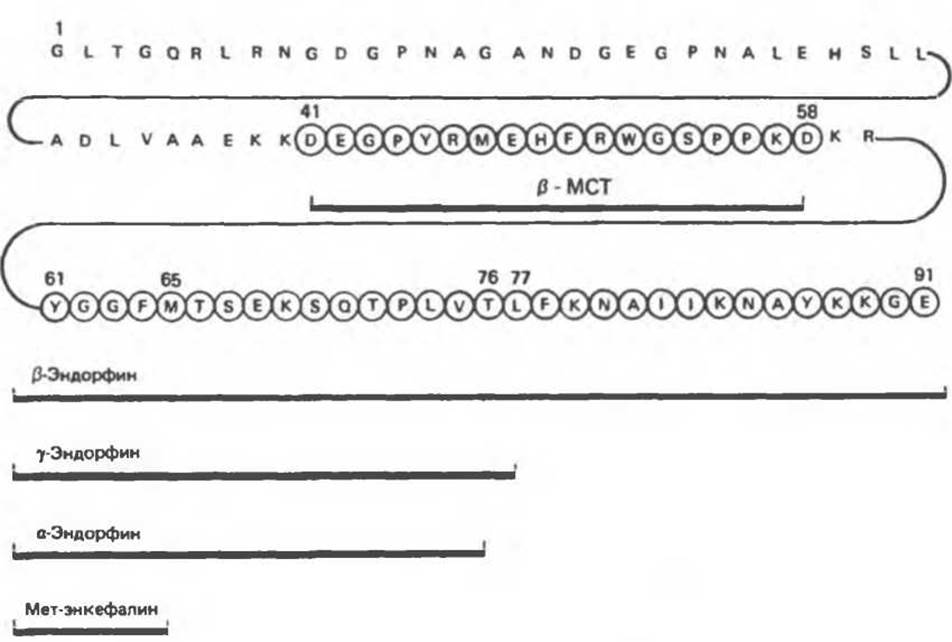
Fig. 4.6. Introduction/19.html">Primary Structure of ß-lipotropin. The fragment comprising residues 41–58 corresponds to the melanocyte-stimulating hormone (ß-MSH), whereas the fragment consisting of residues 61–91 includes the sequences of the specified endorphins.
High-Performance Reverse-Phase Column Liquid Chromatography
A powerful method for purifying high-molecular-weight nonpolar peptides is high-pressure liquid chromatography on nonpolar Materials using polar Solvents for elution. Fig. 4.8 illustrates the separation by this method of the same Cyanogen bromide fragments of human fetal globin that appeared in Fig. 4.7. By combining gel filtration and this method, complex mixtures of peptides obtained by partial proteolysis can be resolved. New stationary phases have been developed for the separation of large peptides.
High-Voltage Molecular Sieve Electrophoresis
This method simultaneously utilizes charge separation and a molecular sieve effect. Starch and agarose, as well as cross-linked acrylamide polymer (СН2 = CH∙СОNН2), are used as sieves. When electrophoresis is performed in polyacrylamide gel (PAGE), the protein solution is applied to buffer-saturated blocks of polyacrylamide cross-linked with methylenebisacrylamide ("bis") (cross-linking degree of 2–10%) or another analogous cross-linking agent. Staining is performed using Coomassie Brilliant Blue or Ag+ (polypeptides), ethidium bromide (polynucleotides), etc. Polyacrylamide gel electrophoresis under denaturing conditions is very widespread. The protein is heated and then subjected to electrophoresis in the presence of Denaturing Agents—urea or sodium dodecyl sulfate (SDS)—to create conditions favorable for the separation of molecules by size. SDS-PAGE is widely used to determine the Molecular Weight of protein subunits; the method is based on comparing their mobility with that of standard preparations of known molecular weight.
Last update: 06/08/2026
Editorial and Educational Adaptation: This material has been compiled based on the primary/original source text. The project team performed an editorial review, corrected technical inaccuracies, structured sections, and adapted the content for an educational format.
What was processed:
- elimination of formatting defects (OCR errors, structural breaks, corrupted characters);
- editorial organization of content;
- standardization of terminology in accordance with academic sources;
- verification of factual statements against the original source text.
All mentions of the author, publication year, and origin of the primary text have been preserved in accordance with the source.