Human Biochemistry, Volume 1 - Murray R. 1993
Bioenergetics and Metabolism of Carbohydrates and Lipids
Regulation of Lipid Metabolism and Energy Sources in Tissues
Regulation of Fatty Acid Biosynthesis (Lipogenesis) - Physiological Factors Regulating Lipogenesis
Like humans, many animals feed intermittently, which creates the need to store most of the energy obtained from food for use between meals. During Lipogenesis, glucose and its metabolic intermediates (Pyruvate, lactate, and acetyl-CoA) are converted into fat; this is the anabolic phase of the cycle. The main factor controlling The rate of lipogenesis is the nutritional status of the Organism and its Tissues. For example, a high rate of lipogenesis is observed in well-fed animals whose diet is rich in CARBOHYDRATES. The rate of lipogenesis decreases with a restricted calorie intake, a high-fat diet, or in cases of Insulin deficiency (as seen in Diabetes Mellitus). Under all these conditions, the level of free Fatty acids in Blood Plasma increases. The regulation of free fatty acid mobilization from Adipose tissue is discussed in Chapter 26.
There is an inverse relationship between hepatic lipogenesis and the concentration of free fatty acids in blood serum (Fig. 281.1). Strong inhibition of lipogenesis occurs when free fatty acid concentrations rise within the range of 0.3 – 0.8 μmol/ml of plasma, which is typical for the transition from the fed to the fasted state, when plasma free fatty acid levels increase. Dietary fats suppress hepatic lipogenesis, and if dietary fat content exceeds 10%, only a minor fraction of the ingested carbohydrates is converted into fat. The rate of lipogenesis increases when sucrose is consumed instead of glucose, because fructose bypasses the regulatory step of Glycolysis catalyzed by Phosphofructokinase (Fig. 21.2).
Class="center">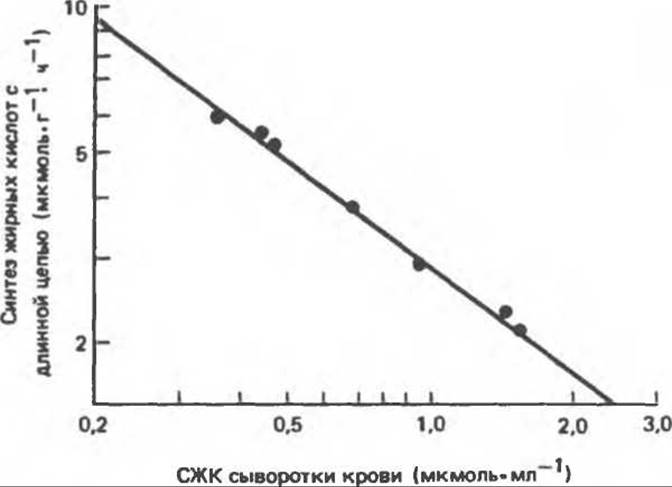
Fig. 28.1. Direct inhibition of hepatic lipogenesis by free fatty acids. The rate of lipogenesis was determined by the incorporation of 3H from 3H2O into long-chain fatty acids in the perfused rat Liver. FFA — free fatty acids. (Experiments performed in collaboration with D.L. Topping in the author's laboratory.)
Because There is a close correlation between The activity of the Pentose Phosphate Pathway, on the one hand, and the lipogenic pathway, on the other, it was initially hypothesized that the suppression of lipogenesis during fasting was caused by a shortage of NADPH generated by The pentose phosphate pathway. However, subsequent studies demonstrated that adding an NADPH-generating system to liver homogenates from fasted rats does not restore fatty acid synthesis.
Last update: 06/08/2026
Editorial and Educational Adaptation: This material has been compiled based on the primary/original source text. The project team performed an editorial review, corrected technical inaccuracies, structured sections, and adapted the content for an educational format.
What was processed:
- elimination of formatting defects (OCR errors, structural breaks, corrupted characters);
- editorial organization of content;
- standardization of terminology in accordance with academic sources;
- verification of factual statements against the original source text.
All mentions of the author, publication year, and origin of the primary text have been preserved in accordance with the source.