Principles of Biochemistry Volume 3 - A. Lehninger 1985
Molecular Mechanisms of Genetic Information Transmission
Protein Synthesis and Its Regulation
Operons also contain a promoter region
We have already seen that if lactose is present in the medium and glucose is absent, the inducer binds to the repressor, removing it from the operator and thereby allowing the lac genes to be transcribed and, consequently, the lac Proteins to be synthesized. Let us now assume that both lactose and glucose are present in the medium. Under these conditions, E. coli utilizes only glucose, ignoring lactose. Moreover, the Cells cease to synthesize lac proteins. The repression of lac Protein Synthesis by glucose is termed catabolite repression. E. coli cells are capable of sensing whether glucose is available through another regulatory mechanism that, together with the lac repressor and operator, controls the synthesis of lac Enzymes.
Class="center">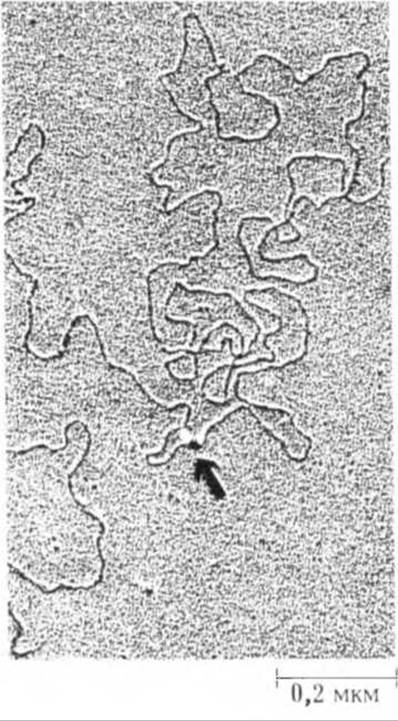
Fig. 29-26. Electron micrograph of an E. coli DNA region showing the lac repressor molecule (indicated by the arrow) bound to the lac operator.
In addition to the i Gene and the operator (o region), the DNA contains another specialized regulatory site—the promoter, or p region, located between the i gene and the operator (Fig. 29-27). The promoter, in turn, consists of two functionally distinct parts. Adjacent to the operator lies the "RNA polymerase entry site," that is, the region where initial binding of RNA polymerase occurs. The second part of the promoter is a specific binding site for another regulatory protein, catabolite activator protein (CAP). This part of the promoter region exerts control over the other part responsible for RNA polymerase binding. If glucose is absent from the medium, a complex is formed within The Cell between CAP and cyclic AMP (cAMP); this complex binds to the CAP site on the DNA and enables RNA polymerase to access the initial binding site. If the medium contains lactose, the o region is open because the operator cannot interact with the inducer-repressor complex.
Under these conditions, RNA polymerase moves from its initial binding site through the operator region and begins to transcribe the three lac genes. If, however, glucose is present in the medium, the cAMP concentration drops sharply, and the CAP-cAMP complex cannot form. In short, the CAP site ensures the availability of the RNA polymerase initial binding site only when complexed with cAMP. Therefore, when this complex fails to form, RNA polymerase cannot bind to the promoter region, and the lac genes are not transcribed. Thus, METABOLISM/31.html">Transcription of the lac genes is possible only in the absence of glucose; consequently, the lac Operon is under both positive (p region) and negative (o region) control.
The natural question arises: how does CAP sense the presence of glucose? The CAP molecule contains two binding domains—one, as noted above, for binding to the CAP site of the promoter, and the second for binding cAMP. Recall that cAMP serves as an intracellular second messenger for the action of A number of Hormones in vertebrate cells (Chap. 25). In E. coli, cAMP also acts as a messenger, but for a different purpose: it signals whether glucose is present in the growth medium. E. coli cells contain the enzyme adenylate cyclase (Sec. 25.5), which catalyzes The formation of cAMP from ATP; these cells also possess a phosphodiesterase that hydrolyzes cAMP, thereby inactivating it. When the glucose concentration is high and meets the cellular requirements, the intracellular concentration of cAMP is very low (Fig. 29-27). However, when the intracellular glucose concentration falls, the cAMP level rises due to an increase in adenylate cyclase activity and a decrease in phosphodiesterase activity (Sec. 25.9). The resulting cAMP interacts with CAP, and the CAP-cAMP complex, in turn, binds to the CAP site of the promoter. Only under these conditions can RNA polymerase attach to the initiation site and begin synthesizing mRNA from the lac genes (Fig. 29-27). For this reason, cAMP in Bacteria has been termed the "hunger signal."
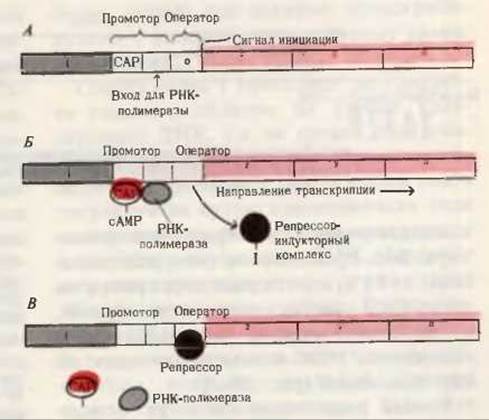
Fig. 29-27. A. Regulatory Regions of the lac operon. The promoter CAP site is capable of binding CAP only when complexed with cAMP. RNA polymerase can access the initial binding site only if the CAP site is occupied. The repressor interacts with the operator only in the absence of the inducer. B. The three structural genes z, y, and a of the lac operon are transcribed provided that glucose is absent from the medium and lactose is present. In this case, the operator is free of repressor, and the CAP-cAMP complex binds to the promoter, allowing RNA polymerase to reach the initial binding site, "step down" to the initiation codon, and begin transcribing the three structural genes. C. If glucose is abundant in the medium, cAMP is not formed, and CAP is therefore unable to bind to the promoter. Under these conditions, RNA polymerase cannot gain access to the promoter, and the lac genes are not transcribed.
The major portion of The nucleotide sequence of the E. coli lac operon has now been determined. The complete nucleotide sequence of the operator and promoter is known. The entire promoter consists of 85 nucleotide pairs, with the CAP site accounting for about 38 Base Pairs and the RNA polymerase initial binding site for about 40 base pairs (Fig. 29-28).
In Addition to a variety of operons with their regulatory genes, bacteria possess other mechanisms for regulating protein synthesis. Some of these do not operate on an "all-or-none" principle, but rather through gradual attenuation—that is, a reduction in the Rate of protein synthesis. Mechanisms sensitive to the concentration of ammonia or other nitrogen sources enable bacteria to adjust their protein machinery to austere environmental conditions. It is evident from the foregoing that bacteria possess highly sophisticated mechanisms for regulating the synthesis of their enzymes, allowing them to optimize their metabolism in accordance with THE PRINCIPLE OF maximal economy.
Last update: 06/08/2026
Editorial and Educational Adaptation: This material has been compiled based on the primary/original source text. The project team performed an editorial review, corrected technical inaccuracies, structured sections, and adapted the content for an educational format.
What was processed:
- elimination of formatting defects (OCR errors, structural breaks, corrupted characters);
- editorial organization of content;
- standardization of terminology in accordance with academic sources;
- verification of factual statements against the original source text.
All mentions of the author, publication year, and origin of the primary text have been preserved in accordance with the source.