Biochemistry - The Chemical Reactions of Living Cells, Volume 2 - D. Metzler 1980
Types of reactions catalyzed by enzymes
Addition and elimination reactions
Addition to a double bond conjugated with a carbonyl group (Type 2.B reactions)
When conjugated with a double bond, the polarization of the carbonyl group is transmitted to the position located two carbon atoms away along the chain:
Class="center">
Due to this effect, bases can add to the carbon–carbon double bond at the ß-position relative to the carbonyl group [step a in equation (7-41)].
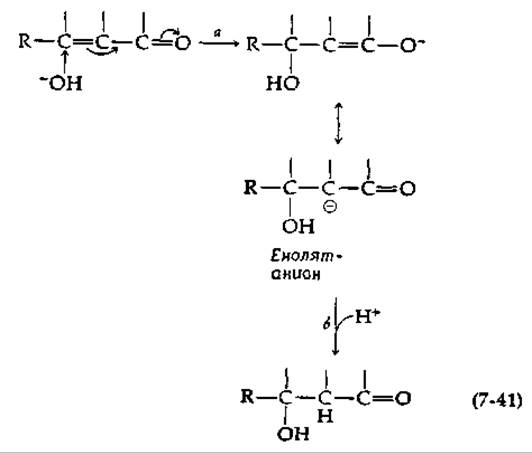
The addition of OH- leads to The formation of an enolate anion, in which the negative charge is delocalized by Resonance between the carbonyl oxygen and the carbon atom adjacent to the carbonyl group. Protonation of the enolate anion yields a stable product (step b).
The reverse of this addition reaction is also referred to as an elimination reaction.
A large number of enzymatic reactions are known that involve addition to a C = C bond conjugated with a carbonyl group (or reactions in which elimination occurs at the α,β-position relative to the carbonyl group). The fact that the nucleophilic group always adds at the ß-position suggests that the mechanism depicted in equation (7-41) plays a vital role. It should be noted that the appearance of a carbonyl group in metabolic pathways is frequently non-random: it facilitates elimination or addition reactions at adjacent carbon atoms. The carbonyl group may be formed by The oxidation of a hydroxyl group, or it may originate from a thioester formed via interaction with CoA or an acyl carrier protein (Chap. 8, Sec. B,3).
The addition of Water to trans-α,β-unsaturated CoA derivatives is catalyzed by mitochondrial enol-hydratase (crotonase) and represents a crucial step in Fatty acid oxidation [108, 109]:

In the bacterium Rhodospirillum rubrum, a similar enzyme catalyzes the dehydration of L-ß-hydroxybutyryl-CoA [i.e., the reverse of reaction (7-42)], leading to the Formation of the trans-unsaturated compound, crotonyl-CoA. A second enol-hydratase with opposite stereospecificity catalyzes the Hydration of crotonyl-CoA to D-ß-hydroxybutyryl-CoA [110]. Acting in concert, these two Enzymes effect the conversion of L-ß-hydroxybutyryl-CoA, derived from acetate units, into D-ß-hydroxybutyryl-CoA, which can subsequently be stored as a polymer, poly-D-β-hydroxybutyrate (Chap. 2, Sec. D,4).
Last update: 06/08/2026
Editorial and Educational Adaptation: This material has been compiled based on the primary/original source text. The project team performed an editorial review, corrected technical inaccuracies, structured sections, and adapted the content for an educational format.
What was processed:
- elimination of formatting defects (OCR errors, structural breaks, corrupted characters);
- editorial organization of content;
- standardization of terminology in accordance with academic sources;
- verification of factual statements against the original source text.
All mentions of the author, publication year, and origin of the primary text have been preserved in accordance with the source.