Biochemistry - Chemical Reactions in the Living Cell, Volume 2 - D. Metzler 1980
Types of Reactions Catalyzed by Enzymes
Addition and Elimination Reactions
Stereochemistry and Designation of Faces of Trigonal Carbon Atoms
Adducts formed As a result of nucleophilic addition to carbonyl groups are frequently asymmetric compounds. For instance, The addition of an amino group to the carbonyl group from the front leads to The formation of the carbinolamine in the S-configuration:
Class="center">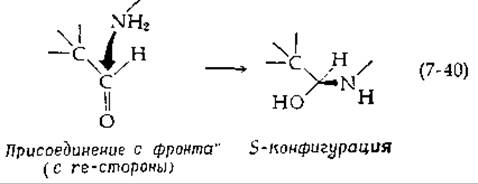
Addition of the amino group from the rear (i.e., from the side located behind the plane of the paper) yields the carbinolamine in the R-configuration. To describe these forms independently of the plane of the paper, Hanson proposed a systematic method for designating the faces of "trigonal atoms", such as the carbon atom of the C = O group [106, 107]. The trigonal atom is viewed from one side, as shown in the following scheme:

The three substituents at the carbon atom are designated in order of priority as a, b, and c, just as in the RS-system (Chapter 2, Section A,5). If The sequence of priority for groups a, b, and c runs clockwise, the face facing the reader is designated as the re (rectus) face; if counterclockwise, as the si (sinister) face. When determining priority, one typically relies on the atomic numbers of the first atoms in the three groups (as in the example above), but if necessary, additional atoms should be mentally attached to C and O, as described in Chapter 2. In the case of trigonal carbon, the atom mentally attached to carbon is completely ignored, whereas the atom attached to oxygen is used to establish priority:

Last update: 06/08/2026
Editorial and Educational Adaptation: This material has been compiled based on the primary/original source text. The project team performed an editorial review, corrected technical inaccuracies, structured sections, and adapted the content for an educational format.
What was processed:
- elimination of formatting defects (OCR errors, structural breaks, corrupted characters);
- editorial organization of content;
- standardization of terminology in accordance with academic sources;
- verification of factual statements against the original source text.
All mentions of the author, publication year, and origin of the primary text have been preserved in accordance with the source.