Principles of Biochemistry, Volume 2 - A. Lehninger 1985
Bioenergetics and Metabolism
Electron Transport, Oxidative Phosphorylation, and Regulation of ATP Synthesis
Pyridine nucleotides perform a collector function
Most electron pairs enter the Respiratory Chain through the action of dehydrogenases that use the Coenzymes NAD+ or NADP+ as electron acceptors (Fig. 17-6). This entire group is collectively referred to as NAD(P)-dependent dehydrogenases. We have already encountered some of its individual representatives when examining Glycolysis and The Citric Acid Cycle; however, many others exist as well. Some biologically important Reactions Catalyzed by such dehydrogenases are listed in Table 17-2. Dehydrogenases catalyze reversible reactions that can be generally written as follows:
Class="center">

Fig. 17-5. The complete set of electron carriers comprising the respiratory chain.
Complex I contains at least five different iron-sulfur centers. Complex II includes two different forms of cytochrome b (with distinct absorption maxima) and one iron-sulfur center, which differs from those found in Complex I. In addition to Cytochromes a and a3, Complex III contains two copper ions.
We do not yet know the exact sequence or the specific function of all these redox centers.
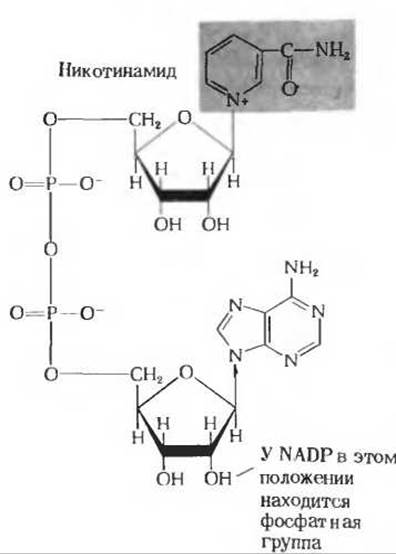
Fig. 17-6. Nicotinamide adenine dinucleotide (NAD) and nicotinamide adenine dinucleotide phosphate (NADP). A. Oxidized forms (NAD+ and NADP+). Nicotinamide (highlighted in red) is a B-group vitamin (Section 10.6); it is the part of the NAD molecule that participates in electron transport. B. Reduction of the nicotinamide ring of NAD+ by a substrate. Two reduction equivalents are transferred from the substrate (designated here as RCH2OH) to NAD+ in the form of a hydride ion (:H-). The second hydrogen atom removed from the substrate is released as an H+ ion.

The vast majority of such dehydrogenases contain NAD+ (Table 17-2). In some Enzymes, such as glucose-6-phosphate dehydrogenase (Section 16.13), NADP+ serves as the electron acceptor. Only a few, such as Glutamate dehydrogenase, are capable of interacting with both NAD+ and NADP+ (Table 17-2). Some pyridine-dependent dehydrogenases are localized in the Cytosol, others in the Cell/35.html">Mitochondria, and some are present in both compartments. Cytosolic dehydrogenases can interact exclusively with pyridine NUCLEOTIDES located in the cytosol; similarly, mitochondrial dehydrogenases generally interact only with the pyridine nucleotides of the mitochondrial matrix. The cytosolic and mitochondrial pools of NAD and NADP are separated by the mitochondrial membrane, which is impermeable to these coenzymes. We will return to this topic later.
Among the NAD-dependent dehydrogenases involved in Carbohydrate METABOLISM, the key roles are played by glyceraldehyde-3-phosphate dehydrogenase and Lactate dehydrogenase of the glycolytic system, which are localized in the cytosol, as well as Pyruvate dehydrogenase found in the mitochondria (Table 17-2). Three NAD-dependent dehydrogenases participate in the mitochondrial citric acid cycle: isocitrate dehydrogenase, α-ketoglutarate dehydrogenase, and malate dehydrogenase. Other important mitochondrial dehydrogenases include 3-hydroxyacyl-CoA dehydrogenase, which Functions in the Fatty acid oxidation cycle; β-hydroxybutyrate dehydrogenase (Chapter 18); and glutamate dehydrogenase, whose function is linked to Amino Acid Catabolism (Chapter 19).
Table 17-2. Some important reactions catalyzed by NAD(P)-dependent dehydrogenases
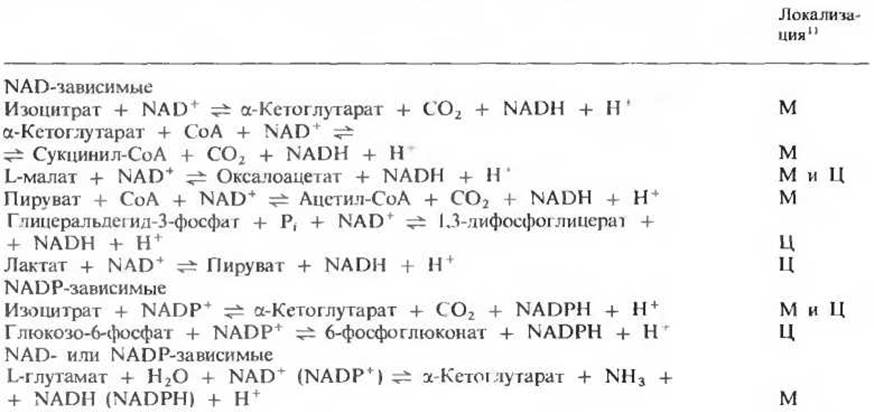
1) M, mitochondria; C, cytosol.
Pyridine-dependent dehydrogenases remove two hydrogen atoms from their substrates. One of these is transferred as a hydride ion (:H-) to NAD+ or NADP+, while the other is released into the medium as an H+ ion. Each hydride ion carries two reduction equivalents: one of these is added as a hydrogen atom to the fourth carbon atom of the nicotinamide ring, whereas the other is transferred as an electron to the nitrogen atom of this ring (Fig. 17-6).
Since the majority of cellular dehydrogenases transfer hydrogen atoms from substrates to NAD+, this coenzyme acts as a collector, gathering pairs of reduction equivalents from various substrates into a single molecular form, namely NADH (Fig. 17-7). Ultimately, NAD+ can also accumulate reduction equivalents in this form from substrates acted upon by NADP-dependent dehydrogenases. This becomes possible through the action of pyridine nucleotide transhydrogenase, a complex enzyme that catalyzes the reaction

Last update: 06/08/2026
Editorial and Educational Adaptation: This material has been compiled based on the primary/original source text. The project team performed an editorial review, corrected technical inaccuracies, structured sections, and adapted the content for an educational format.
What was processed:
- elimination of formatting defects (OCR errors, structural breaks, corrupted characters);
- editorial organization of content;
- standardization of terminology in accordance with academic sources;
- verification of factual statements against the original source text.
All mentions of the author, publication year, and origin of the primary text have been preserved in accordance with the source.