Principles of Biochemistry, Volume 1 - A. Lehninger 1985
Biomolecules
Vitamins and Trace Elements: Their Role in Enzyme Function
Selenium is both an essential trace element and a poison
It has long been known that selenium, in the form of selenite and selenate, exerts a strong toxic effect on farm animals grazing in certain areas of Montana and the Dakotas, as well as in other regions where soils contain high concentrations of selenium salts. Therefore, the results of experiments showing that selenium—albeit in significantly smaller amounts—is an essential dietary requirement for rats and chicks came as a complete surprise. Research conducted in recent years has demonstrated that selenium, complexed with a specific amino acid, is a component of the prosthetic groups of several Enzymes, notably Glutathione peroxidase. Together with the peptide glutathione (Fig. 10-27), this enzyme protects Cells from the destructive effects of hydrogen peroxide. In erythrocytes, the iron present in the Hemoglobin molecule is normally in the ferrous state [Fe(II)]. However, under the action of hydrogen peroxide, it is readily oxidized to the ferric state [Fe(III)]; the resulting methemoglobin is incapable of transporting oxygen. Glutathione peroxidase prevents The formation of methemoglobin by decomposing hydrogen peroxide via the following reaction:
Class="center">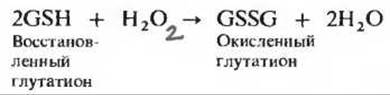

Fig. 10-27. Glutathione (GSH), a tripeptide containing L-glutamic acid, L-Cysteine, and Glycine. Note that the cysteine residue is attached to the γ-carboxyl group rather than the α-carboxyl group of glutamic acid. Glutathione is present in high concentrations in all animal cells. One of its Functions is the reduction of toxic peroxides mediated by glutathione peroxidase (see text). In several enzymatic reactions, it acts as a cofactor, though it cannot be classified as a coenzyme. It is also hypothesized that glutathione is involved in the Transport of Amino acids across Cell membranes.
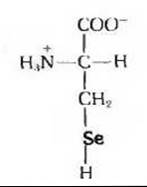
Fig. 10-28. Selenocysteine, a cysteine analog in which sulfur is replaced by selenium. A selenocysteine residue is present in the Active Site of glutathione peroxidase and other selenium-dependent enzymes.
The active site of glutathione peroxidase contains a residue of the Structure/68.html">Unusual amino acid selenocysteine (Fig. 10-28), in which the sulfur atom of cysteine is replaced by a selenium atom. It is likely that the —SeH group of this residue offers certain functional advantages over the —SH group in the Catalytic Mechanism of this and other selenium-containing enzymes.
Last update: 06/08/2026
Editorial and Educational Adaptation: This material has been compiled based on the primary/original source text. The project team performed an editorial review, corrected technical inaccuracies, structured sections, and adapted the content for an educational format.
What was processed:
- elimination of formatting defects (OCR errors, structural breaks, corrupted characters);
- editorial organization of content;
- standardization of terminology in accordance with academic sources;
- verification of factual statements against the original source text.
All mentions of the author, publication year, and origin of the primary text have been preserved in accordance with the source.