Principles of Biochemistry Volume 1 - A. Lehninger 1985
Biomolecules
Vitamins and trace elements: their role in enzyme functioning
Pyridoxine (vitamin B6) plays an essential role in amino acid metabolism
The vitamin B6 group comprises three related compounds: pyridoxine, pyridoxal, and pyridoxamine (Fig. 10-10), which are readily interconverted in biological systems. The active form of vitamin B6 is Pyridoxal phosphate or its amino counterpart, pyridoxamine phosphate. Pyridoxal phosphate acts as a tightly bound prosthetic group for a variety of Enzymes catalyzing amino acid transformations. The most prevalent and well-characterized reactions of this type are Transamination reactions, wherein the amino group of an α-amino acid is reversibly transferred to the α-carbon atom of an α-keto acid (Fig. 10-10). In transaminations catalyzed by transaminases, or aminotransferases, tightly bound pyridoxal phosphate Functions as an intermediate carrier of the amino group from its donor, the α-amino acid, to its acceptor, the α-keto acid. During the catalytic cycle of transaminases, the amino group of the incoming amino acid is first transferred to the enzyme-bound pyridoxal phosphate. The resulting amino derivative of the coenzyme, pyridoxamine phosphate, then transfers the amino group to the second substrate, the α-keto acid, and is regenerated into its original pyridoxal phosphate form. A wide variety of Amino Acids can participate in such transamination reactions along with α-ketoglutarate, which serves as a universal amino group acceptor, being converted during the reaction into glutamate, a key intermediate in Amino Group METABOLISM.
Class="center">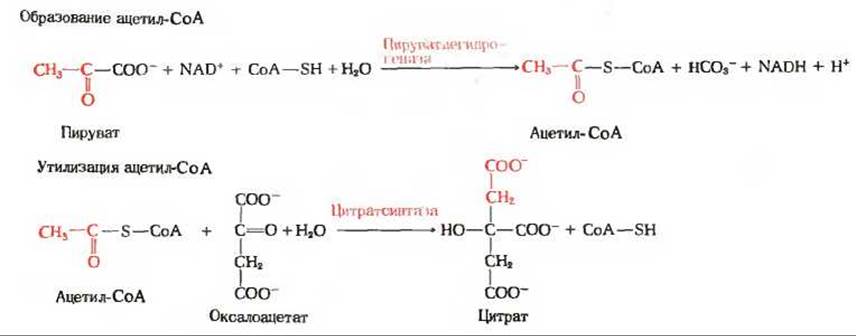
Fig. 10-9. The Role of coenzyme A in Reactions Catalyzed by Pyruvate dehydrogenase and citrate synthase. The transferred acetyl group is highlighted in red.
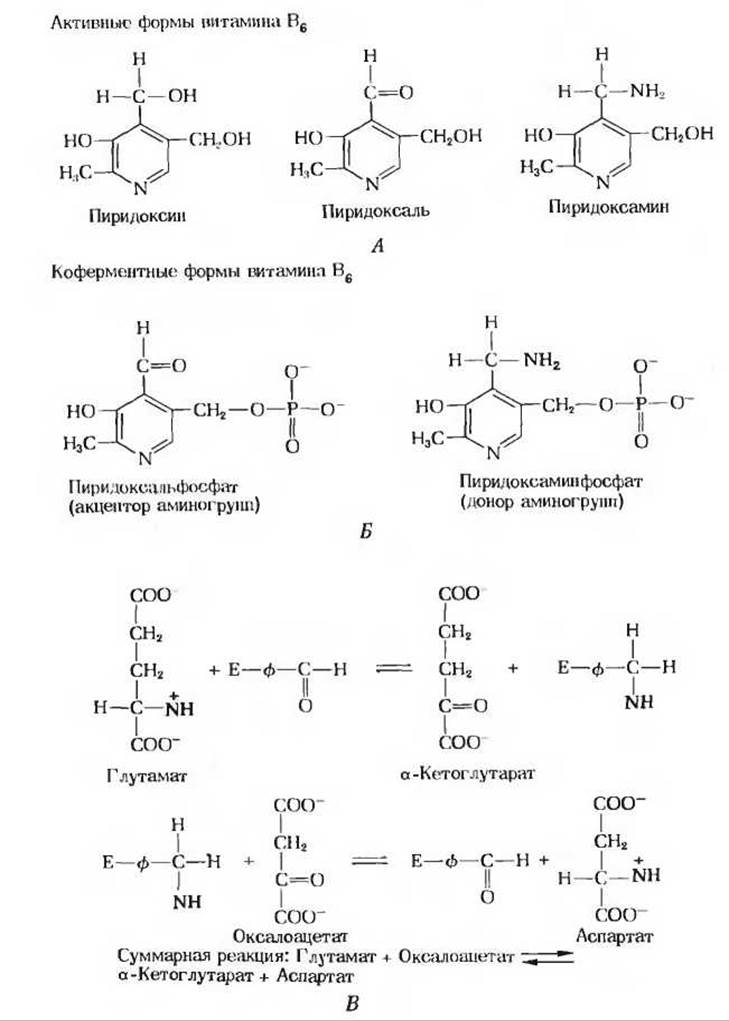
Fig. 10-10. Active forms of vitamin B6 (A), Coenzyme forms of this vitamin (B), and the transamination reaction (C). During this reaction, pyridoxal phosphate transfers the amino group to the Active Site of the enzyme. Two Stages of the reaction are shown. The transase with its prosthetic group is depicted in two forms:
E—φ—CHO and E—φ—C(NH2)—H2
Transaminases typically catalyze double-displacement reactions (ping-pong mechanisms; Section 9.8). In these reactions, the amino group is first transferred from the initial amino acid substrate to the coenzyme, followed by the release of the resulting α-keto acid from the enzyme; subsequently, the second substrate—the incoming α-keto acid—binds to the enzyme. The amino group is then transferred from pyridoxamine phosphate to this second substrate.
Last update: 06/08/2026
Editorial and Educational Adaptation: This material has been compiled based on the primary/original source text. The project team performed an editorial review, corrected technical inaccuracies, structured sections, and adapted the content for an educational format.
What was processed:
- elimination of formatting defects (OCR errors, structural breaks, corrupted characters);
- editorial organization of content;
- standardization of terminology in accordance with academic sources;
- verification of factual statements against the original source text.
All mentions of the author, publication year, and origin of the primary text have been preserved in accordance with the source.