Principles of Biochemistry Volume 1 - A. Lehninger 1985
Biomolecules
Vitamins and trace elements: their role in enzyme functioning
Vitamins are essential components of coenzymes and prosthetic groups of enzymes
The biochemical function of certain Vitamins was first elucidated in the 1930s through the convergence of two distinct lines of research: one aimed at determining the Chemical Structure of Coenzymes, and the other at investigating The structure of vitamins. In 1935, the German biochemist Otto Warburg successfully isolated and characterized a coenzyme (now known as nicotinamide adenine dinucleotide phosphate) required for the catalysis of specific cellular oxidation-reduction reactions. Warburg demonstrated that one of the components of this coenzyme is a simple organic compound, nicotinamide (Fig. 10-1), which had been first isolated from tobacco long before. Shortly thereafter, the American biochemists D. Wayne Woolley and Conrad A. Elvehjem set out to determine the chemical structure of a substance they had extracted from meat and other foods, which prevented or cured "black Tongue" in dogs—a deficiency disease analogous to human pellagra. Woolley and Elvehjem were struck by the resemblance between The chemical properties of their isolated substance and nicotinamide. Consequently, they tested pure nicotinamide as a Treatment for the dogs, and it proved successful. It was soon established that nicotinamide could also cure pellagra in humans. We now know that nicotinamide is a component of the coenzyme required for the Enzymatic Catalysis of several vital oxidation reactions. Despite the very simple STRUCTURE OF THE nicotinamide molecule, most Animals are unable to synthesize it in sufficient quantities and must therefore acquire it through their diet.
Class="center">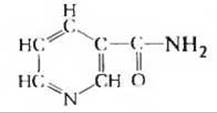
Fig. 10-1. Nicotinamide, the pellagra-preventing factor. It is a constituent of the coenzyme nicotinamide adenine dinucleotide (see Fig. 10-6).
Soon afterward, it became clear that other vitamins likewise function as components of coenzymes and enzyme prosthetic groups. The required Dietary intake of Vitamins can be extremely small because coenzymes, acting as catalysts, are needed by Cells in very low concentrations. For example, the minimum daily requirement of vitamin B6 for humans is approximately 2 mg, and that of vitamin B12 is less than 3 µg.
Around the same time, it was discovered that Animal diets must also include a variety of inorganic elements which, much like coenzymes, are essential for The activity of specific Enzymes. A prime example is zinc—an indispensable nutrient for humans and animals that serves as an essential component of numerous diverse enzymes.
In this chapter, we will provide An Overview of the Functions of various vitamins as coenzymes. In subsequent chapters, we will explore how vitamin deficiencies, and the resulting impairment of enzymatic activity, can lead to profound disruptions in key Metabolic pathways of CARBOHYDRATES, Lipids, and Proteins.
Last update: 06/08/2026
Editorial and Educational Adaptation: This material has been compiled based on the primary/original source text. The project team performed an editorial review, corrected technical inaccuracies, structured sections, and adapted the content for an educational format.
What was processed:
- elimination of formatting defects (OCR errors, structural breaks, corrupted characters);
- editorial organization of content;
- standardization of terminology in accordance with academic sources;
- verification of factual statements against the original source text.
All mentions of the author, publication year, and origin of the primary text have been preserved in accordance with the source.