Principles of Biochemistry Volume 1 - A. Lehninger 1985
Biomolecules
Vitamins and trace elements: their role in enzyme functioning
The biochemical function of vitamin C (ascorbic acid) is not known
Although as early as the 1790s it was known that citrus fruits contain a specific factor preventing scurvy in humans, it could not be isolated in pure form or identified until 1933, when American researchers C. Glen King and W. A. Waugh finally isolated this antiscorbutic factor from lemon juice. Shortly thereafter, its chemical Structure was determined (Fig. 10-17). Ascorbic acid is present in the Tissues of all animals and higher plants. Only humans and certain other vertebrates must obtain it from their diet; most animals, and presumably all plants, can synthesize this compound from glucose. Microorganisms do not contain ascorbic acid and do not require it.
Ascorbic acid apparently plays The Role of a cofactor in the enzymatic hydroxylation reaction by which Proline residues in vertebrate Connective Tissue Collagen are converted into 4-hydroxyproline residues (Fig. 5-7). Hydroxyproline residues are found exclusively in collagen (Section 7.15) and do not occur in any other animal protein. Thus, although ascorbic acid clearly participates in The formation of a major component of higher animal connective tissue, it remains unclear whether this is its sole or even its primary function.
Class="center">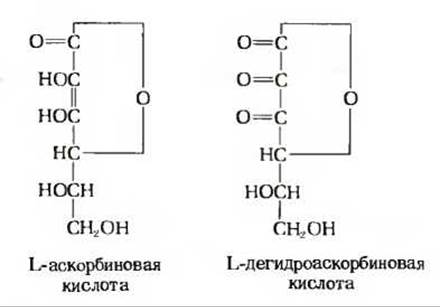
Fig. 10-17. Ascorbic acid (Vitamin C) and its oxidation product, dehydroascorbic acid. The latter, although biologically active, is highly unstable and readily decomposes.
Last update: 06/08/2026
Editorial and Educational Adaptation: This material has been compiled based on the primary/original source text. The project team performed an editorial review, corrected technical inaccuracies, structured sections, and adapted the content for an educational format.
What was processed:
- elimination of formatting defects (OCR errors, structural breaks, corrupted characters);
- editorial organization of content;
- standardization of terminology in accordance with academic sources;
- verification of factual statements against the original source text.
All mentions of the author, publication year, and origin of the primary text have been preserved in accordance with the source.