Principles of Biochemistry, Volume 1 - A. Lehninger 1985
Biomolecules
Vitamins and trace elements: their role in enzyme function
Fat-soluble vitamins are derivatives of isoprene
Four Fat-soluble Vitamins (A, D, E, and K) are formed in biological systems by the joining of five-carbon hydrocarbon residues of isoprene, also known as 2-methylbutadiene (Fig. 10-18), which serves as a building block for various plant-derived lipid- and rubber-like substances. Natural rubber and gutta-percha, used, for example, in the manufacture of golf balls, are polymers of isoprene. To demonstrate the isoprenoid origin of fat-soluble vitamins, their structural formulas are divided into individual isoprene units by dashed lines, as shown in Fig. 10-19 for the structural formula of vitamin A.
Class="center">
Fig. 10-18. Isoprene, the structural unit of isoprenoid compounds.
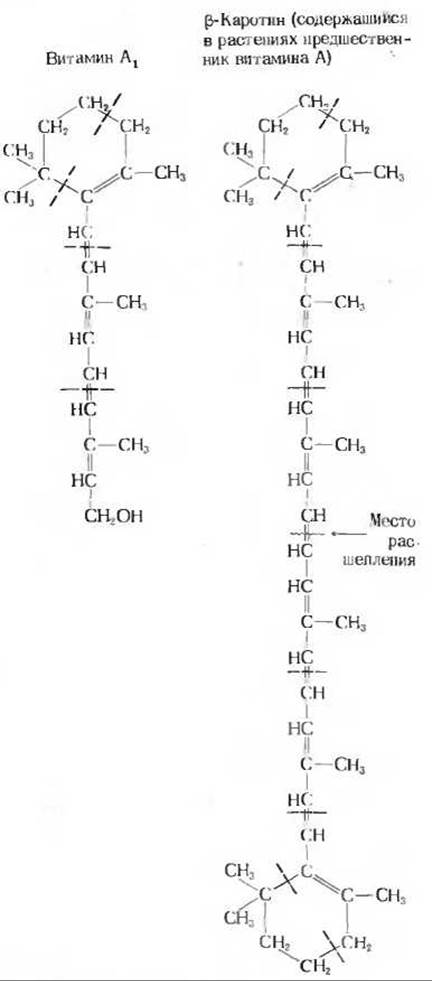
Fig. 10-19. Vitamin A and its precursor, ß-carotene. The isoprene structural units are separated from each other by red dashed lines. The Cleavage of ß-carotene yields two molecules of vitamin A1. This reaction takes place in the Small Intestine.
The precise biochemical or coenzymatic Functions of fat-soluble vitamins are not yet fully understood; however, significant progress has already been made in their study. One of the key properties of fat-soluble vitamins is that they can be stored in the body in large quantities. Consequently, their dietary deficiency may not manifest physiologically for many months.
Last update: 06/08/2026
Editorial and Educational Adaptation: This material has been compiled based on the primary/original source text. The project team performed an editorial review, corrected technical inaccuracies, structured sections, and adapted the content for an educational format.
What was processed:
- elimination of formatting defects (OCR errors, structural breaks, corrupted characters);
- editorial organization of content;
- standardization of terminology in accordance with academic sources;
- verification of factual statements against the original source text.
All mentions of the author, publication year, and origin of the primary text have been preserved in accordance with the source.