Principles of Biochemistry, Volume 1 - A. Lehninger 1985
Biomolecules
Vitamins and Trace Elements: Their Role in Enzyme Function
Vitamin B12 is a precursor of coenzyme B12
Vitamin B12, the most complex of all Vitamins, has a rather unusual history. In 1926, two American physicians, George Minot and William Murphy, discovered that including large amounts of semi-raw Liver in the diet had a therapeutic effect on pernicious anemia, a severe and frequently fatal disease. Animals do not develop a similar condition. Significant progress in isolating the anti-anemia factor from liver was not achieved until the late 1940s, when Mary Shorb discovered a bacterium whose growth depended on this factor. Thus, bacterial growth rates could be used as a simple and rapid assay to measure the active factor's concentration. In 1948, E. Lester Smith (England), along with Edward Rickes and Karl Folkers (USA), obtained vitamin B12 in crystalline form. However, it took another decade of X-ray crystallography to determine its Structure, which proved to be extremely complex (Fig. 10-15).
Vitamin B12 differs from all other vitamins not only in its structural complexity, but also in containing cobalt, a trace element essential for the Organism. The vitamin B12 derivative typically obtained during isolation is called cyanocobalamin because it contains a cyano group coordinated to the cobalt atom. The complex corrin ring system of vitamin B12 (Fig. 10-15), to which the cobalt atom is coordinated, is chemically similar to the porphyrin ring system of heme and Hemoproteins (Section 8.2). In the coenzyme form of vitamin B12, known as 5'-deoxyadenosylcobalamin, the cyano group is replaced by a 5'-deoxyadenosyl group (Fig. 10-15).
Vitamin B12 is not synthesized by either plants or animals; it is produced exclusively by certain microorganisms. The daily requirement of a healthy human for this vitamin is minuscule—about 3 µg. The Role of vitamin B12 in the Treatment of pernicious anemia is discussed in Chapter 26.
All Enzymes requiring coenzyme B12 catalyze an interchange between a hydrogen atom bound to a carbon atom and a group (such as an alkyl, carboxyl, hydroxyl, or amino group) attached to an adjacent carbon atom (Fig. 10-16). Figure 10-16 illustrates a typical reaction requiring coenzyme B12 (cobamide). Another coenzyme form of vitamin B12, methylcobalamin, participates in certain Reactions Involving the transfer of methyl groups.
Class="center">
Fig. 10-15. Vitamin B12 and its coenzyme form, known as adenosylcobalamin (or coenzyme B12). The cyano group (highlighted in red) is replaced in coenzyme B12 by the 5'-deoxyadenosyl group (shown at the top of the figure).
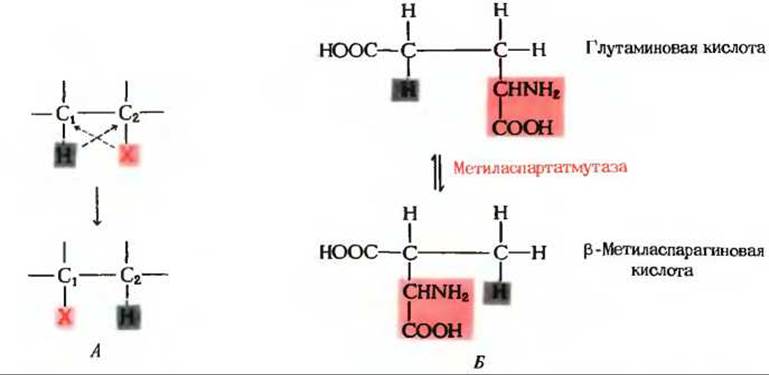
Fig. 10-16 Reactions involving Coenzyme forms of vitamin B12. A. Coenzyme B12-dependent enzymes catalyze The transfer of a hydrogen atom from C1 to C2 in exchange for group X. B. A coenzyme B12-dependent reaction catalyzed by methylaspartate mutase. Note that the H and X groups attached to adjacent carbon atoms exchange places with each other.
Last update: 06/08/2026
Editorial and Educational Adaptation: This material has been compiled based on the primary/original source text. The project team performed an editorial review, corrected technical inaccuracies, structured sections, and adapted the content for an educational format.
What was processed:
- elimination of formatting defects (OCR errors, structural breaks, corrupted characters);
- editorial organization of content;
- standardization of terminology in accordance with academic sources;
- verification of factual statements against the original source text.
All mentions of the author, publication year, and origin of the primary text have been preserved in accordance with the source.