Principles of Biochemistry Volume 1 - A. Lehninger 1985
Biomolecules
Vitamins and trace elements: their role in enzyme function
Folic acid serves as a precursor to the coenzyme tetrahydrofolic acid
Folic acid (from the Latin folium, meaning leaf) was first isolated from spinach leaves and is widely distributed in biological systems. The folic acid molecule consists of three main components: glutamic acid, p-aminobenzoic acid, and a heterocyclic condensed pteridine ring system (Fig. 10-12). A deficiency of folic acid, also known as pteroylglutamic acid, leads to anemia. Folic acid itself has no coenzyme activity; however, it is enzymatically reduced in Tissues to tetrahydrofolate (FH4), which serves as the active coenzyme. Tetrahydrofolate acts as an intermediate carrier of one-carbon groups in many complex enzymatic reactions, transferring them from one molecule to another (Fig. 10-12). A characteristic example of such a reaction is shown in Fig. 10-13.
Class="center">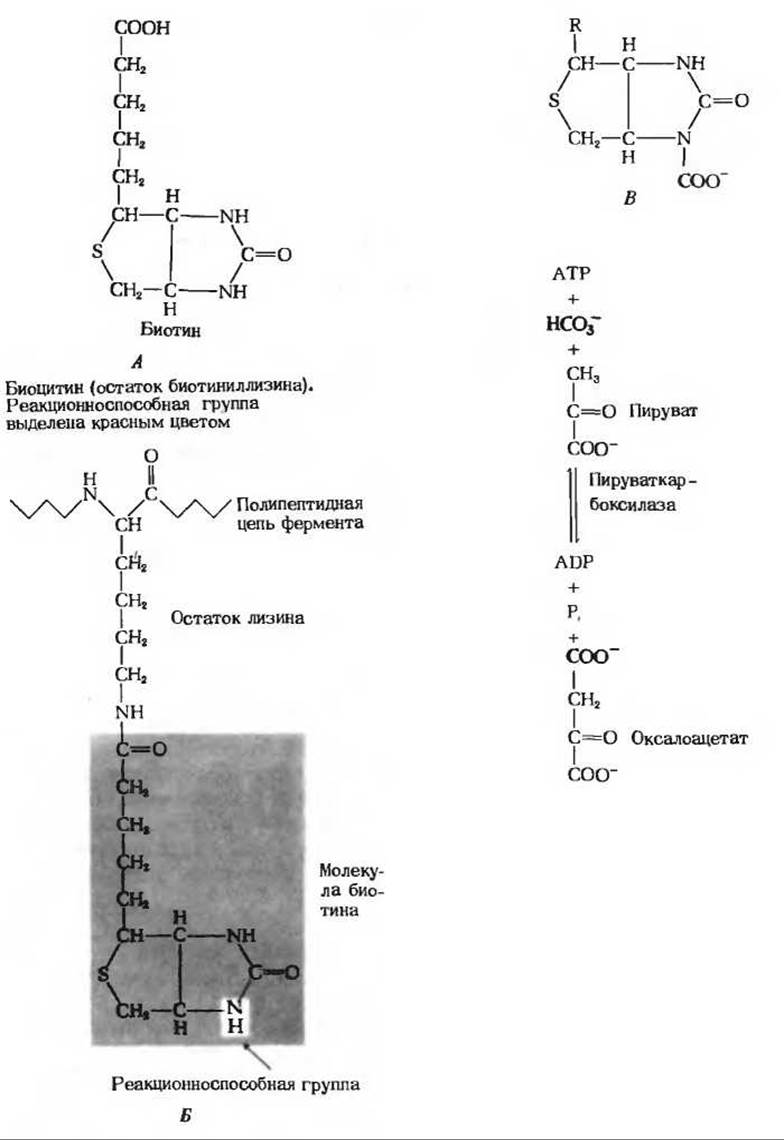
Fig. 10-11. Biotin (A) and its active form, biocytin (B), which acts as a prosthetic group for certain Enzymes catalyzing carboxylation reactions. C. In biotin-dependent carboxylation reactions, an N-carboxy derivative of biocytin is formed as an intermediate. Only the cyclic ring system of biocytin is shown. D. The carboxylation of Pyruvate to yield oxaloacetate is an essential step in the Biosynthesis OF GLUCOSE from pyruvate, catalyzed by the biotin-dependent enzyme pyruvate carboxylase.

Fig. 10-12. Folic acid, its coenzyme form tetrahydrofolate, and methylenetetrahydrofolate. The methylene group is one of five different one-carbon groups that can be carried by tetrahydrofolate, which include the methyl (—CH3), methylene (—CH2—), methenyl (—CH=), formyl (—CHO), and formimino (—CH=NH) groups.
The reduction of folic acid to its active form, tetrahydrofolate, occurs in two stages via the sequential addition of two pairs of hydrogen atoms to the molecule. The second step—a reaction catalyzed by Dihydrofolate Reductase—is potently inhibited by drugs used in the Treatment of certain forms of Cancer. Because dihydrofolate is required for The biosynthesis of thymidylate (one of the Building Blocks of DNA), these drugs inhibit METABOLISM/36.html">DNA Replication in rapidly dividing cancer Cells.

Fig. 10-13. The Role of N5,N10-methylenetetrahydrofolate (Fig. 10-12) as a methyl group donor in the enzymatic synthesis of thymidylate, a building block of DNA. The newly incorporated methyl group is highlighted in red.
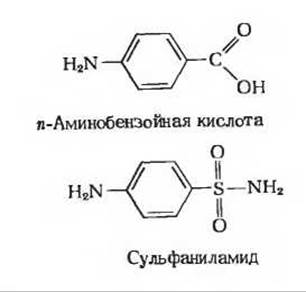
Fig. 10-14. Structural similarity between p-aminobenzoic acid and sulfanilamide, a competitive inhibitor of the enzyme system that incorporates p-aminobenzoate into folic acid.
Some Bacteria do not require exogenous folic acid as a growth factor because they can synthesize it themselves from p-aminobenzoic acid, a component of the folic acid molecule. Consequently, p-aminobenzoic acid acts as a vitamin for these bacteria. This discovery proved to be extremely valuable as it shed light on the MECHANISM OF ACTION of sulfanilamide, an important drug that inhibits the growth of pathogenic bacteria dependent on p-aminobenzoic acid. As shown in Fig. 10-14, p-aminobenzoic acid and sulfanilamide are remarkably similar in Structure. Due to this similarity, sulfanilamide can compete with p-aminobenzoate in the enzymatic synthesis of folic acid.
Last update: 06/08/2026
Editorial and Educational Adaptation: This material has been compiled based on the primary/original source text. The project team performed an editorial review, corrected technical inaccuracies, structured sections, and adapted the content for an educational format.
What was processed:
- elimination of formatting defects (OCR errors, structural breaks, corrupted characters);
- editorial organization of content;
- standardization of terminology in accordance with academic sources;
- verification of factual statements against the original source text.
All mentions of the author, publication year, and origin of the primary text have been preserved in accordance with the source.