Chemistry and Biology of Proteins - F. Haurowitz 1953
Proteins with Hormonal Activity
Thyroid hormone (thyroglobulin)
The hormonal activity of The Thyroid Gland has been known for a very long time; indeed, early studies already noted that this gland contains iodine, which is of great importance for its hormonal function. Oswald [7], working in Hofmeister's laboratory, isolated iodoglobulin from the thyroid gland by precipitating it with half-saturation of ammonium sulfate. The best method for isolating this protein, designated as thyroglobulin, is the extraction of the gland with a 1-percent sodium acetate solution, followed by precipitation of the extracted hormone with acetic acid at pH 5 and reprecipitation of the dissolved hormone upon half-saturation of the solution with sodium sulfate.
Of all the Hormones considered in this chapter, thyroglobulin is the only one whose active group is known. This group is thyroxine, which is incorporated into the peptide chain of the hormone. Thyroxine is a diiodophenyl ether of diiodotyrosine with the following formula:
Class="center">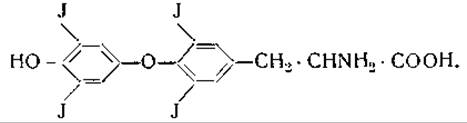
Harington [6], who established this formula, isolated thyroxine after hydrolyzing thyroglobulin with baryta. It was later discovered that not all the iodine present in thyroglobulin is located in thyroxine; part of the iodine is a component of diiodotyrosine (iodorgoic acid) [9, 10]. When thyroglobulin is hydrolyzed by Proteolytic Enzymes, 16% of the iodine is released as diiodotyrosine.
Thyroglobulin contains 0.6% iodine [10]. The Molecular Weight of thyroglobulin is 700,000 [11]. Consequently, each thyroglobulin molecule contains 32 iodine atoms, which form part of 2–3 thyroxine residues and 8–12 diiodotyrosine groups [11]. Thyroglobulin is stable only within specific pH ranges, and outside this zone thyroglobulin molecules dissociate into smaller subunits [12]. Thyroglobulin does not react with Antibodies formed upon the administration of iodinated Proteins into the Organism [13]. This indicates that thyroxine residues are located inside the large thyroglobulin molecule rather than on its surface, and are therefore inaccessible to specific complementary groups of the antibody molecule.
Thyroxine is readily formed in vitro when proteins are treated with iodine in a slightly alkaline solution [14]. For example, treating 100 g of casein with iodine yielded 0.4 g of crystalline thyroxine [15, 16]. Thyroxine can also be obtained by oxidizing diiodotyrosine with hydrogen peroxide in an alkaline medium [17]. All these data indicate that the initial stage of thyroxine formation is the Iodination of Tyrosine:
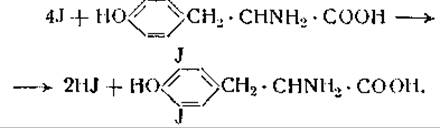
Part of the resulting diiodotyrosine is subsequently cleaved by the action of an alkaline iodine solution, and the resulting iodinated aromatic residue combines with diiodotyrosine to form thyroxine. While The Mechanism of these reactions in vitro is understood, as for The formation of thyroglobulin in the organism, we still do not know why the administered iodine combines preferentially with a specific globulin and why the resulting thyroglobulin accumulates in the thyroid gland. The fact that the METABOLISM of administered iodine proceeds via this pathway has been very convincingly demonstrated by experiments using a radioactive iodine isotope [18].
Proteins react with iodine in vitro, but not with iodine ions. Meanwhile, iodine introduced into an animal's organism is rapidly reduced in tissue fluids. This suggests that the thyroid gland contains an enzyme system capable of oxidizing iodide salts According to the reaction
О2 + 4HJ → 2Н2О + 2J2,
wherein the iodine liberated in this reaction combines with globulin to form thyroglobulin. The formation of thyroglobulin is inhibited by goitrogens. This term designates a group of recently discovered, highly important pharmacological substances [19]. Goitrogens (i.e., substances that induce goiter formation) are derivatives of thiourea, which also possesses some activity, although less pronounced than that of thiouracil and similar substances.
The MECHANISM OF ACTION of the thyroid hormone remains as elusive to us today as The process of the hormone's formation itself. This action is undoubtedly due to the thyroxine residue, since similar effects are produced by the administration of pure thyroxine. The hormone increases the basal metabolic rate and accelerates the maturation of tadpoles and other organisms. Despite the fact that The Effect of thyroglobulin has been studied by numerous researchers, nothing is yet known either about The Site of Action of the hormone or about the cause of the accelerated metabolism and development it induces1. A deficiency of the hormone produces the opposite effect, i.e., it causes a decrease in The rate of metabolism and development.
Last update: 06/08/2026
Editorial and Educational Adaptation: This material has been compiled based on the primary/original source text. The project team performed an editorial review, corrected technical inaccuracies, structured sections, and adapted the content for an educational format.
What was processed:
- elimination of formatting defects (OCR errors, structural breaks, corrupted characters);
- editorial organization of content;
- standardization of terminology in accordance with academic sources;
- verification of factual statements against the original source text.
All mentions of the author, publication year, and origin of the primary text have been preserved in accordance with the source.