Biochemical Engineering Fundamentals, Part 1 - Bailey J., Ollis D. 1989
Kinetics of Enzyme-Catalyzed Reactions
Enzyme Inactivation
Enzyme Denaturation Induced by Mechanical Factors
Mechanical stress can disrupt the intricate geometry of enzyme molecules, potentially leading to their complete Denaturation. Such stresses include hydraulic forces generated by fluid flow. Experiments designed to evaluate the effects of shear on enzymatic activity have typically involved capillary flow and coaxial cylinder viscometers.
Let us denote the duration of shear exposure and the shear rate by θ and y, respectively (in the case of capillary flow, y represents the velocity averaged across the capillary cross-section). Investigations into shear-induced denaturation of catalase and urease have demonstrated that the loss of activity is determined by the product of the parameters θy (Fig. 3.30, a). These findings further confirm that the degree of Enzyme inactivation depends on a combination of the denaturing intensity and the duration of its action. Conversely, studies on Lactate dehydrogenase have revealed that the inactivation of this enzyme in a fluid flow is governed by shear stress rather than the shear rate.
The data presented in Fig. 3.30, b clearly indicate the partial reversibility of shear-induced urease inactivation. Curve A represents The rate of substrate (urea) conversion in a quiescent urease solution, whereas curve B was obtained by measuring the rate of the same reaction in a coaxial cylinder viscometer at a shear rate of 1717 s-1. Evidently, fluid motion is accompanied by a decrease in enzyme activity. The remaining points in Fig. 3.30, b were recorded after removing the hydraulic stress of varying durations. In these cases, enzymatic activity immediately begins to recover upon the cessation of shear, though it fails to reach its initial level. This residual difference in activity has been attributed to partial irreversible inactivation.
Class="center">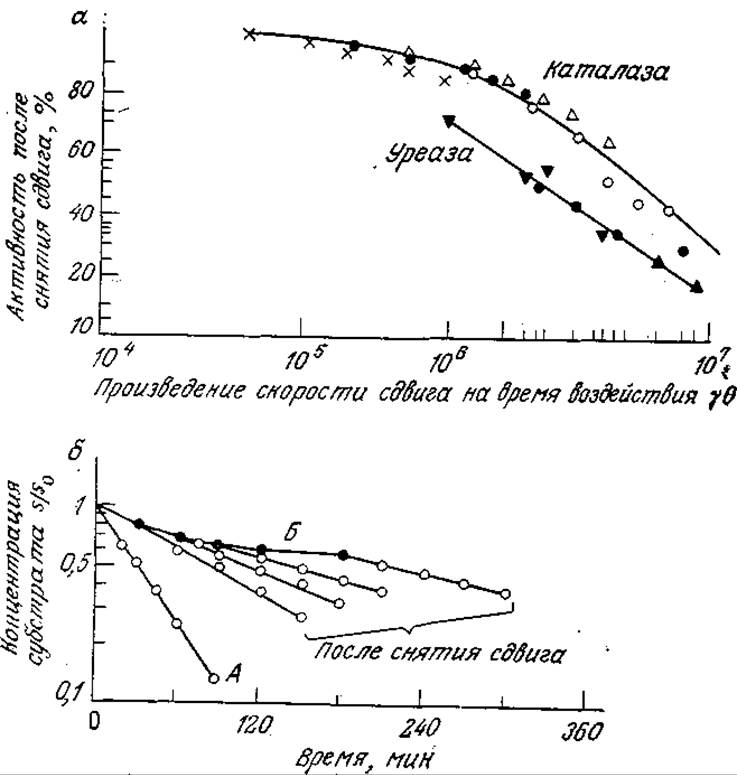
FIG. 3.30. a — inactivation of catalase and urease under shear (various symbols denote different shear rates); b — conversion of urea by a urease solution under quiescent conditions (A), under shear (shear rate 1717 cm-1) (B), and at various time intervals following the removal of shear (0.4 units of urease per 1 ml of solution, pH 6.75, 23 °C). [Data on catalase reproduced with permission from: Charm S. E., Wong B. L., Enzyme Inactivation with Shearing, Biotech. Bioeng., 12, 1103 (1970). Data on urease reproduced from: Tirrell M., Middleman S., Shear Modification of Enzyme Kinetics, Biotech. Bioeng., 17, 299 (1975).]
The inherent sensitivity of Enzymes to mechanical stress can impose specific limitations on allowable hydraulic forces in enzyme reactors—where agitation is employed to enhance substrate mass transfer rates—or in ultrafiltration systems for enzyme solutions, where increasing membrane permeability leads to elevated shear and extensional stress immediately upstream and downstream of the membrane.
Protein Denaturation, and consequently enzyme inactivation, is frequently triggered by another mechanical factor: surface tension. Since the surface tension at the air-Water interface is approximately 80 dyn/cm, foaming typically induces the denaturation of Proteins adsorbed at the phase boundary. The interfacial tension between two liquid phases is substantially lower; for instance, Cell/30.html">The Plasma Membrane of a cell is estimated to have a surface tension on the order of 1 dyn/cm or even less. Obviously, low surface tensions do not inactivate enzymes, given that numerous active proteins are known to exist within such Plasma Membranes. Foam fractionation is a Separation technique based on concentrating a target substance at the surfactant-air interface; under these conditions, proteins do not denature because Surfactants reduce the surface tension of the water-air system to values around 1 dyn/cm.
In Industrial processes and occasionally in laboratory experiments, the rate of enzyme inactivation is simultaneously influenced by various mechanical and Chemical factors, such as oxidation. The complex interplay of these interdependent factors is thoroughly examined in a study by Thomas and Dunnill*, where a meticulous investigation of shear effects on the same enzymes (see Fig. 3.30) yielded different Conclusions, indicating that shear alone causes only minor enzyme inactivation. In addition to the factors mentioned above, enzyme inactivation can be affected by expanding flows, cavitation, localized adiabatic heating, trace metals, and surface denaturation at cavity walls. Readers seeking more detailed information on denaturation are referred to the literature listed at the end of the chapter. However, a general rule of thumb is sufficient for our purposes: if an enzyme in vitro resides in an environment and under conditions substantially identical to those in vivo, it will remain active. Altering any of the parameters characteristic of the enzyme's natural habitat introduces the probability of its inactivation.
* Thomas C. R., Dunnill P., Action of Shear on Enzymes: Studies with Catalase and Urease, Biotechn. Bioeng., 21, 2279 (1979).
This principle finds numerous Applications in biochemical engineering. For example, if we require an enzyme that remains active at extreme pH or Temperature values, a logical first step is to search for an Organism for which these extremes are standard operating conditions. Such organisms frequently harbor enzymes capable of functioning efficiently under precisely these unusual environments. A prime example is the discovery of microbial alkaline-stable enzymes, which are successfully utilized as additives in laundry detergents, where solutions typically maintain a pH of 9.0–9.5.
Last update: 06/08/2026
Editorial and Educational Adaptation: This material has been compiled based on the primary/original source text. The project team performed an editorial review, corrected technical inaccuracies, structured sections, and adapted the content for an educational format.
What was processed:
- elimination of formatting defects (OCR errors, structural breaks, corrupted characters);
- editorial organization of content;
- standardization of terminology in accordance with academic sources;
- verification of factual statements against the original source text.
All mentions of the author, publication year, and origin of the primary text have been preserved in accordance with the source.