Biochemistry and Molecular Biology - Belyasova N.A. 2002
Structure and Functions of Cellular Components
Proteins. Organizational Features and Enzyme Functions
Enzyme Specificity
One of the remarkable METABOLISM/8.html">Properties of Enzymes is their high degree of Specificity. Two main types are distinguished: substrate specificity (The ability to bind to a specific substrate or a group of substrates) and reaction specificity (the ability to catalyze reactions of a particular type).
Substrate specificity varies significantly among enzymes: some can catalyze a reaction involving only a single substrate, whereas others act on several chemically related compounds. For instance, formamidase hydrolyzes only formamide, whereas amidase hydrolyzes any aliphatic amide. Accordingly, these are referred to as narrow and broad Enzyme Specificity.
Previously, enzyme substrate specificity was commonly explained by the lock-and-key theory, which posits that only a specific substrate (the key) fits into the enzyme (the lock). However, this theory has since evolved into Koshland's induced-fit hypothesis, which is now widely accepted. According to this hypothesis, the spatial complementarity between the structures of the enzyme's Active Site and the substrate is shaped at the moment of their interaction. During this process, minor conformational changes are induced in the enzyme molecule, orienting the functional groups within the catalytic site in the most favorable manner for the reaction to proceed. Conformational changes also occur in the substrate (often referred to as substrate strain), rendering it more reactive. This hypothesis explains why molecules structurally very similar to the true substrate can bind to the enzyme yet fail to be converted into a product, thus acting as inhibitors.
Enzyme substrate specificity is so pronounced that most enzymes can recognize THE POSITION OF substituents at the anomeric carbon atom, binding and catalyzing the transformation of only one group of anomers. For example, mammalian D-Amino Acid Oxidase catalyzes The oxidation of various D-Amino Acids while being inactive toward L-amino acids. Nevertheless, this rule is not absolute, and certain enzymes catalyze the transformations of both enantiomers. For instance, Glutamine Synthetase from sheep Brain utilizes both D- and L-glutamic acid as substrates.
Reaction specificity is also highly pronounced and reflects the ability of enzymes to catalyze a single specific chemical reaction or a few Reactions of the same type. Often, substrate transformation can follow multiple pathways; in uncatalyzed reactions or those driven by inorganic catalysts, The conversion of Organic compounds yields a multitude of byproducts. This does not occur in Enzymatic Catalysis, yielding a reaction product free from impurities.
Furthermore, certain enzymes exhibit stereochemical specificity—that is, the ability to distinguish between the right and left sides of a substrate and recognize the spatial arrangement of atoms. For example, enzymes that cleave $\alpha$- and $\beta$-methylglucosides recognize these spatial isomers and display high specificity toward them. Alcohol dehydrogenase, which catalyzes the oxidation of ethanol, specifically recognizes and abstracts one of the two hydrogen atoms in the CH2 group of ethanol—specifically the one positioned pro-R relative to the prochiral center:
Class="center">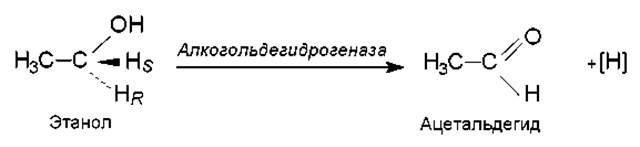
Last update: 06/08/2026
Editorial and Educational Adaptation: This material has been compiled based on the primary/original source text. The project team performed an editorial review, corrected technical inaccuracies, structured sections, and adapted the content for an educational format.
What was processed:
- elimination of formatting defects (OCR errors, structural breaks, corrupted characters);
- editorial organization of content;
- standardization of terminology in accordance with academic sources;
- verification of factual statements against the original source text.
All mentions of the author, publication year, and origin of the primary text have been preserved in accordance with the source.