Practical Protein Chemistry - A. Darbre 1989
Determination of the C-terminal amino acid sequence
Determination of C-terminal groups
Hydrazinolysis
Hydrazinolysis was first introduced in 1952 for the identification of C-terminal Amino Acids; however, in practice, this straightforward method often yields unsatisfactory results even after introducing numerous corrections [1, 2, 11 —13, 45, 46, 62, 65, 66].
When a protein (or peptide) is heated with hydrazine, the peptide bonds are cleaved, and the carbonyl group of the peptide bond is converted into a hydrazide. Only the C-terminal residue remains as a free acid (Fig. 18.5). This amino acid is then separated from all hydrazides and identified.
The original Procedure has been modified repeatedly by altering the reaction conditions, the method of separating hydrazides from the free acid, or the techniques used for the identification and quantitative Analysis of the C-terminal amino acid.
Initially, the protocol involved heating the protein with hydrazine at 100 °C for 10 h [1]. Under these conditions, cystine and Cysteine (though not cysteic acid, 5-carboxymethylcysteine, or S-aminoethylcysteine) are completely degraded [11]; Arg is destroyed and partially converted into Orn and guanidine [65]. Many other residues undergo partial degradation due to the high reaction Temperature [11, 12]. It has been reported that adding an acidic catalyst (hydrazine sulfate) to anhydrous hydrazine allows the reaction to proceed under much milder conditions (60–80 °C) [46], thereby increasing the recovery of C-terminal amino acids. To improve yields, the H+-form of the Amberlite CG-50 ion-exchange resin was employed [12]. It has been shown that the rates of Cleavage of various C-terminal amino acids, as well as their stability under hydrazinolysis conditions, vary significantly. Consequently, it is impossible to provide universal recommendations regarding reaction time, which is normally highly desirable. Therefore, a series of experiments with varying heating times should be performed.
Class="center">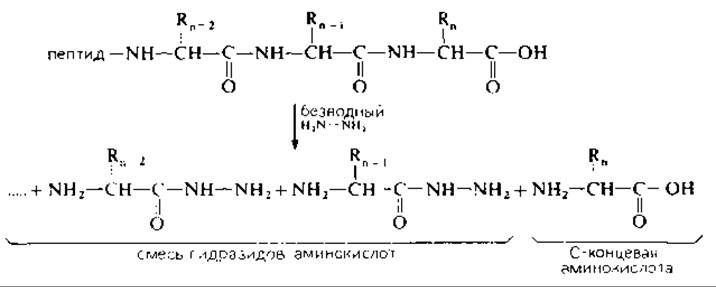
FIG. 18.5. Hydrazinolysis of a peptide with the release of the C-terminal amino acid.
The Separation of free C-terminal amino acids from the mixture of amino acid hydrazides must be carried out promptly, as hydrazides are unstable and readily convert into free amino acids in the Presence of Water. The sensitivity of the assay depends on the separation method and detector sensitivity. In the original procedure, freshly distilled benzaldehyde was added to an aqueous solution of amino acid hydrazides, converting them into oily dibenzyl derivatives that could be easily separated from free amino acids by centrifugation [1]. However, a single Treatment with benzaldehyde failed to achieve complete separation of The amino acid hydrazides. Modifications involving The Use of isoamyl aldehyde [2], enanthic (heptyl) aldehyde [9], and p-nitrobenzaldehyde [66] did not yield any notable improvements. Treatment of the hydrazinolate with 2,4-dinitrofluorobenzene (DNFB) resulted in The formation of neutral di- and tri-DNP derivatives, which are easily separated from the acidic mono-DNP C-terminal amino acid by extraction with ethyl acetate and diethyl ether [46]. The acidic DNP derivatives were identified by two-dimensional paper Chromatography [53]. Alternatively, the hydrazides can be treated first with benzaldehyde, then with DNP-benzene, followed by extraction [65]. The C-terminal DNP-amino acid was determined by paper chromatography.
As noted in a previous study [7], many of these complex modifications were proposed before the advent of modern amino acid analyzers and are now obsolete. Although the hydrazinolate, after the removal of excess hydrazine, can be applied directly to the Column of an amino acid analyzer, this is not recommended because hydrazides are very difficult to wash off the column, requiring up to five column volumes of standard sodium hydroxide washes for resin regeneration. It is preferable to separate the hydrazides from the free C-terminal amino acid by passing the solution through a cation-exchange column, such as phosphocellulose or Amberlite IR-120, as described below.
18.3.2.1. Hydrazinolysis Procedure [12].
Preparation of anhydrous hydrazine. Hydrazine is distilled over sodium hydroxide under a nitrogen atmosphere using a standard Glass distillation apparatus. In a 250-mL round-bottom flask, 100 mL of commercial “anhydrous” hydrazine (95%) and 40 g of sodium hydroxide are placed, and the system is purged with dry nitrogen that has been passed through concentrated sulfuric acid. The hydrazine is heated under nitrogen at atmospheric pressure to its boiling point, then cooled to room temperature. It is then distilled under vacuum (using an oil pump) in a stream of nitrogen delivered through a capillary, collecting the fraction boiling at 16–18 °C in a 100-mL round-bottom receiving flask cooled with dry ice. The distilled hydrazine is stored in a stoppered flask over phosphorus pentoxide at 2 °C, or preferably in sealed ampoules (in 5-mL portions). Hydrazine rapidly absorbs atmospheric moisture and quickly becomes unfit for hydrazinolysis.
Hydrazinolysis reaction. The resin (Amberlite CG-50, <200 mesh) is washed successively with 1 M sodium hydroxide, water, 2 M Hydrochloric acid, and finally with water until negative to chloride ions. The resin is dried in an oven at 80 °C and stored in a vacuum desiccator over phosphorus pentoxide.
Dry Amberlite CG-50 (50 mg) is placed in a thick-walled Pyrex test tube (15 × 125 mm). The lyophilized protein (~250 nmol) is added, a constriction is made in the upper third of the tube, and hydrazine (2 mL) is introduced. The hydrazine is drawn into the tube through the narrow constriction after cooling the lower part of the tube in an ethanol–dry ice bath. It is crucial to prevent atmospheric carbon dioxide from being absorbed by the hydrazine, as this leads to the formation of a large amount of ninhydrin-positive material that interferes with subsequent chromatography. The frozen sample is sealed under vacuum and placed in an incubator at 80 °C for 10–100 h. During hydrazinolysis, the sample should be gently agitated (3–4 times a day). If for any reason the sample cannot be analyzed immediately after hydrazinolysis, the solution can be stored in the unopened ampoule at —20 °C.
Following hydrazinolysis, the reaction mixture is transferred to a dry 25-mL round-bottom flask, taking precautions to prevent exposure to atmospheric moisture. Whenever possible, this procedure should be carried out in a dry box. The test tube is rinsed with hydrazine (two 1-mL portions), and the combined solution is lyophilized; within 3 h, the hydrazine is completely removed from the frozen mixture.
Chromatographic separation of hydrazides from the cleaved C-terminal amino acid. In the original procedure [12], three cation-exchange resins (Amberlite IR-120, Amberlite CG-50, and phosphocellulose) were used for the chromatographic separation of the free C-terminal amino acid from amino acid hydrazides. Chromatography on Amberlite IR-120 requires two volatile buffers (pH 3.1 and 5.2) and a column thermostatted at 30 °C, with an analysis time of ~8 h. Phosphocellulose chromatography is experimentally simpler, takes only 4 h, uses a single buffer at room temperature, and successfully resolves all Amino acids as well as the mono-hydrazides of Asp and Glu in a single run. However, phosphocellulose has a lower capacity, and no more than 10 mg of protein should be loaded onto a 10 × 300 mm column. The use of Amberlite CG-50 offers no particular advantages. Fractionation using phosphocellulose is described below.

FIG. 18.6. Structure of hydrazides of internal Asp and Glu residues and C-terminal Asn and Gln residues.
Immediately prior to fractionation, the lyophilizate containing hydrazides, free amino acids, and the catalyst resin is suspended in 3.0 mL of water, centrifuged, and the resin is washed twice with 1 mL of water. The mother liquor and washings (pH 8.5–9.0) are combined, and a few drops of 2 M hydrochloric acid are added until the pH reaches 2. The solution is applied to a phosphocellulose column (10 × 300 mm, Whatman P-70, unfractionated), equilibrated with 0.4 M pyridine-formate buffer (pH 3.2; 32.2 mL of pyridine + 47 mL of 98% formic acid, diluted with water to 1 L), and chromatographed at room temperature in pH 3.2 buffer at a flow rate of 30 mL/h. Fractions of 2 mL are collected and tested with ninhydrin for the presence of amino acids. Acidic and neutral amino acids elute in the volume between 20 and 37 mL of the eluate; Lys, ammonia, and the mono-hydrazides of Asp and Glu elute between 42 and 75 mL; His between 80 and 90 mL; and Arg between 93 and 112 mL. Amino acid hydrazides are tightly retained on the column, which is therefore used only once. The appropriate fractions are pooled, dried, and analyzed. Before determining Asp and Glu, their mono-hydrazides must be hydrolyzed.
Concluding remarks. Due to variations in both the cleavage rate and the stability of C-terminal amino acids, it is impossible to provide definitive guidelines regarding the optimal duration of the hydrazinolysis reaction. The best approach is to analyze a series of samples heated at 100 °C for 10–100 h. This technique allows for the Quantitative determination of all C-terminal amino acids except Arg, Asn, Gln, and possibly Lys. During hydrazinolysis, C-terminal Asn and Gln are released as mono-hydrazides (via Substitution at the side-chain amide groups). These mono-hydrazides closely resemble, in structure and chromatographic properties, the mono-hydrazides derived from internal Asp and Glu residues (Fig. 18.6). Their determination is complicated by the fact that, according to some reports, the two Asp mono-hydrazides can spontaneously interconvert [62].
Last update: 06/08/2026
Editorial and Educational Adaptation: This material has been compiled based on the primary/original source text. The project team performed an editorial review, corrected technical inaccuracies, structured sections, and adapted the content for an educational format.
What was processed:
- elimination of formatting defects (OCR errors, structural breaks, corrupted characters);
- editorial organization of content;
- standardization of terminology in accordance with academic sources;
- verification of factual statements against the original source text.
All mentions of the author, publication year, and origin of the primary text have been preserved in accordance with the source.