Protein Chemistry - Part 1 - General Protein Chemistry - Ashmarin I. P. 1968
Chemical reactions of proteins, determination of terminal and functional groups in proteins
Chemical reactions of proteins
Reactions involving aliphatic hydroxyl groups
Phosphorylation. Phosphorylation of Proteins at aliphatic hydroxyl groups is one of the harshest Methods of Protein modification. To obtain synthetic Phosphoproteins, the protein is treated with phosphorus pentoxide dissolved in 100% orthophosphoric acid. The reaction takes several days at room Temperature.
Class="center">
Under these conditions, most proteins naturally undergo Denaturation. Exceptions are ovomucoid (a Trypsin inhibitor) and Insulin, although the inhibitory activity of ovomucoid is partially lost; insulin, meanwhile, retains its hormonal activity.
The resulting synthetic phosphorylated proteins differ from natural phosphoproteins in that their phosphorus is attached via extremely labile bonds. For instance, phosphorylated albumin spontaneously cleaves off its phosphorus even during cold storage.
Reaction with diisopropyl fluorophosphate. Diisopropyl fluorophosphate is an ester of fluorophosphoric acid. It is a highly specific reagent that reacts exclusively with certain Enzymes exhibiting esterase activity (trypsin, Chymotrypsin, acetylcholinesterase, etc.) and inhibits them. Using P32-labeled diisopropyl fluorophosphate (P32-DFP), it was demonstrated that this inhibitor does not react with other proteins, denatured esterases, or their inactive precursors—chymotrypsinogen and trypsinogen—nor with the constituent Amino Acids. By contrast, native enzymes rapidly interact with DFP, and complete inhibition is achieved when 1 mole of enzyme combines with 1 mole of DFP. This indicates that DFP evidently reacts with a specific region of the molecule formed by the participation of several groups. Denaturation disrupts the spatial arrangement of these groups, and the reactivity of the protein toward DFP is lost.
The phosphoryl group is irreversibly attached to the enzyme and cannot be removed by dialysis, denaturation, or Hydrolysis. By obtaining a DFP-protein derivative and subjecting it to hydrolysis, one can subsequently isolate the peptide to which DFP is attached. This task is facilitated by using DFP labeled with a phosphorus isotope—in this case, the radioactive peptide is selected from a chromatographically separated mixture of Peptides. Subsequent complete hydrolysis of this peptide allows Determination of the Amino Acid Composition of the enzyme's Active Site. Using this approach, originally applied to chymotrypsin, it was shown that DFP reacts with the OH group of a specific Serine residue:
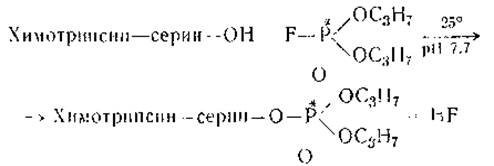
Subsequent studies revealed that DFP does not react with just any serine residue in the enzyme (and there are about 30 of them), but exclusively with the one occupying a unique position determined by adjacent amino acid residues:
—Gly — Asp — Ser — Gly — Gly —
There are no other such regions in the chymotrypsin molecule, and this sequence was identified as part of the active site. Analogous studies demonstrated that the exact same region is present in the trypsin molecule, and a similar sequence was found in other esterases. Consequently, this entire group of enzymes shares identical or highly similar active centers, of which serine is an obligatory component.
Last update: 06/08/2026
Editorial and Educational Adaptation: This material has been compiled based on the primary/original source text. The project team performed an editorial review, corrected technical inaccuracies, structured sections, and adapted the content for an educational format.
What was processed:
- elimination of formatting defects (OCR errors, structural breaks, corrupted characters);
- editorial organization of content;
- standardization of terminology in accordance with academic sources;
- verification of factual statements against the original source text.
All mentions of the author, publication year, and origin of the primary text have been preserved in accordance with the source.