Protein Chemistry - Part 1 - General Protein Chemistry - Ashmarin I. P. 1968
Chemical reactions of proteins, determination of terminal and functional groups in proteins
Chemical reactions of proteins
Some other chemical reactions of proteins
Coupling with diazo compounds. The coupling of Proteins with diazo compounds was first employed by Landsteiner to produce synthetic Antigens and to study The Mechanism of the antigen–antibody reaction. The advantages of this method lie in the fact that diazo compounds allow the Introduction of various additional functional groups into the protein molecule. Since the reaction proceeds in a weakly alkaline medium at low temperatures, Denaturation generally does not occur. The coupling reaction primarily involves the imidazole and phenolic groups of the protein:
Class="center">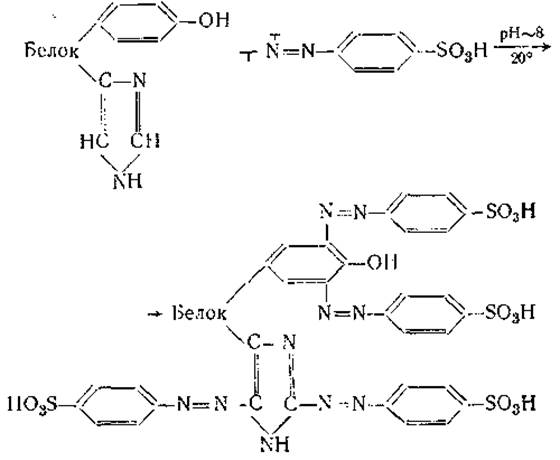
Proteins modified in this manner induce antibody formation and specific immunological reactions, i.e., they act as antigens. Comparing the antibody–antigen reaction with the antibody–azo derivative of that antigen has yielded extensive data regarding The Nature of antibody-binding groups and the factors determining antigen Specificity. In particular, it has been demonstrated that the decisive influence on antigenic specificity is exerted not by the protein itself, but by the attached radical R.
Interaction with N-carboxyanhydrides of Amino Acids.
The reaction with amino acid N-carboxyanhydrides is widely used to attach corresponding amino acids to proteins. The reaction proceeds in a neutral medium at 0° and is not accompanied by Protein Denaturation:

The free amino group can re-enter this reaction, making it possible to obtain protein derivatives with longer polypeptide chains and an increased molecular weight. In this way, derivatives of serum albumin and Chymotrypsin with Glycine were obtained, with the molecular weight increasing by nearly 12%. Furthermore, the modified chymotrypsin retained its initial enzymatic activity, and the polyglycyl albumin retained its serological specificity.
Last update: 06/08/2026
Editorial and Educational Adaptation: This material has been compiled based on the primary/original source text. The project team performed an editorial review, corrected technical inaccuracies, structured sections, and adapted the content for an educational format.
What was processed:
- elimination of formatting defects (OCR errors, structural breaks, corrupted characters);
- editorial organization of content;
- standardization of terminology in accordance with academic sources;
- verification of factual statements against the original source text.
All mentions of the author, publication year, and origin of the primary text have been preserved in accordance with the source.