Vertebrate Zoology - V. M. Konstantinov 2011
Chordates
Terrestrial, or Tetrapod, Vertebrates
Class Amphibia - Subclass Lepospondyli - Order Urodela
Urodeles, or tailed amphibians, are relatively primitive. They possess an elongated, cylindrical body divided into distinct HEAD, trunk, and tail regions. In cross-section, the tail is either round or laterally compressed, sometimes featuring a fin-like dermal fringe. Limbs are well developed in most species, with the front and hind pairs typically of equal length. Some species lack hind limbs entirely (such as sirens).
The vertebrae are amphicoelous or opisthocoelous. Rudimentary upper Ribs articulate with the trunk vertebrae. The bony Skull is more differentiated than that of anurans: the frontal and parietal bones are not fused, and paired orbitosphenoid bones are present. Clavicles are absent. Unlike anurans, the forearm and lower leg have a typical Structure consisting of two bones (the radius and ulna, and the Tibia and Fibula, respectively).
The Circulatory system is relatively simple in Organization. A complete interatrial septum is found only in the most advanced urodeles. All four aortic arches are retained (Fig. 77). Along with the posterior vena cava, cardinal Veins also persist. Some species retain gills throughout life—most commonly external, and more rarely internal. Cutaneous Respiration is exceptionally well developed.
While a well-developed stapes is present, the tympanic cavity and tympanum are absent. Unlike most other amphibians, many urodeles retain lateral line Organs throughout their lives.
Class="center">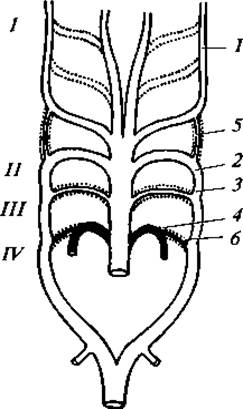
Fig. 77. Arterial arches of a tailed amphibian:
1 — carotid Arteries (I arterial arch); 2 — systemic arches (II arterial arch); 3 — III arterial arch; 4 — pulmonary arteries (IV arterial arch); 5 — carotid ducts; 6 — ductus arteriosus
Fertilization is internal in the majority of species within this order. Reproduction occurs through the deposition of fertilized eggs, larvae, or via viviparity. A number of species are capable of reproducing at the larval stage (neoteny).
The total number of extant urodele species is approximately 400. They are distributed primarily across the temperate Zones of the Western and Eastern Hemispheres, and are virtually absent in the Southern Hemisphere.
The largest number of species belongs to the family Salamandridae (true salamanders). Their body form is lizard-like, with a long, round, or laterally compressed tail. The two pairs of limbs are relatively well developed. Larvae respire via external gills, whereas adults lack gills, breathing instead through Lungs and their Skin.
Common representatives of this family include various newts found throughout Europe and the Caucasus. The smooth newt and the warty newt (Triturus vulgaris and Triturus cristatus) inhabit small standing and slow-flowing Water bodies with lush vegetation during the summer months. These sites serve as areas for reproduction and larval development.
By the end of summer, newts leave the water and take shelter under fallen tree trunks, beneath stones, or in soil crevices. They overwinter on land beneath tree stumps, inside hollow logs, or in leaf litter. In spring, sometimes while snow is still on the ground, the newts migrate back to the water. They feed on animal prey.
Several species of the genus Salamandra occur in Central and Southern Europe, the Western Caucasus, Asia Minor, and North Africa. These salamanders are characterized by a stout build, a large unkeeled tail, and typically spotted coloration.
The fire salamander (S. salamandra) inhabits damp, dark forests of Europe, North Africa, and Asia Minor. By day, it hides beneath tree roots, under rocks, or in burrows. It is generally nocturnal, emerging by day only following rain. It is less dependent on water than newts. Fertilization is internal.
The fire salamander typically gives birth to gilled larvae, which complete their metamorphosis in water bodies.
Species of the family Ambystomatidae are widespread in North America. These are relatively slender animals with smooth skin marked by vertical grooves that give the trunk a segmented appearance. The tail is thick, lacking a dermal fringe.
The general body coloration is brownish with small light spots. The body length ranges from 15 to 23 cm. The larvae of ambystomatids, known as axolotls, are capable of reproduction (neoteny) and serve as important subjects for scientific research.
The family Plethodontidae (lungless salamanders), comprising about 215 species, is distributed predominantly in North America. Some species live in Central and South America, while one or two species occur in Southern Europe. All species have lost their lungs in connection with a transition to a strictly aquatic lifestyle. However, many species—particularly those inhabiting the tropics and caves—have secondarily returned to a terrestrial existence; in all species, respiration is cutaneous and partly through the pharyngeal mucosa.
Terrestrial species frequently lay their eggs outside of water: in burrows, under roots, or in tree cavities. The female coils around the egg mass and remains with it until the young hatch.
The family Amphiumidae includes three species, which rank among the largest living amphibians. The body length of some species reaches 1 m. Their limbs are weakly developed and nearly useless for locomotion. In addition to lungs, internal gills—accessed via gill slits (one on each side)—serve as respiratory organs.
The two-toed amphiuma (Amphiuma means) is distributed in the lakes and swamps of the southeastern United States. Its body is eel-like, measuring 70–100 cm in length. The limbs are vestigial and entirely unfit for terrestrial locomotion. Amphiumas spend the majority of their lives in water. Eggs are laid on land in damp places near the water's edge. The female coils spirally around the egg mass and remains there for almost the entire developmental period.
The family Proteidae comprises two genera and six extant species. One of these inhabits the subterranean waters of the Balkan Peninsula, while the others are found in shallow, overgrown water bodies of North America. The olm (Proteus anguinus) retains external tufted gills throughout its life. Its eyes are covered by skin. The limbs are very small and useless for terrestrial locomotion. Olms inhabit underground waters; their skin lacks pigment and has a flesh-red color. Those living in open North American waters have a gray or brown coloration with dark spots and lead a nocturnal lifestyle. Body length ranges from 25 to 35 cm. They reproduce by laying fertilized eggs. Instances of viviparity have been observed in the Balkan olm when water temperatures drop (below 15°C).
The family Sirenidae includes three species distributed across the southeastern United States. Like proteids, they retain external gills throughout life and possess vestigial gill slits. The forelimbs are weakly developed, and hind limbs are absent. The eyes are covered by skin. The overall body shape is eel-like, with a length of 60–70 cm. They inhabit swamps, where they shelter beneath tussocks and tree stumps.
The family Hynobiidae includes quite primitive species (about 36) characterized by amphicoelous vertebrae and external fertilization. This family is distributed primarily throughout the taiga zone of East Asia. A typical representative, the Siberian salamander (Hynobius keyserlingi), ranges from Kamchatka west to the Komi Republic and Nizhny Novgorod Oblast. It lives in water bodies only during the breeding season. It is remarkably tolerant of low temperatures: hynobiids remain active even at temperatures of 2–4°C.
The family Cryptobranchidae includes three species of the most primitive living tailed amphibians. As an example, the Japanese giant salamander (Andrias japonicus) reaches a body length of about 150 cm and a weight of up to 70 kg.
It inhabits the mountain rivers of the island of Nippon (Japan), and a closely related species lives in the rivers of Central China. It stays under stones and overhanging undercut banks. It feeds on fish, frogs, and worms. Fertilization is external. Eggs are laid in water, in burrows, in areas with a slow current. All species are rare and are listed in the IUCN Red List.
Last update: 13/08/2026
Editorial and Educational Adaptation: This material has been compiled based on the primary/original source text. The project team performed an editorial review, corrected technical inaccuracies, structured sections, and adapted the content for an educational format.
What was processed:
- elimination of formatting defects (OCR errors, structural breaks, corrupted characters);
- editorial organization of content;
- standardization of terminology in accordance with academic sources;
- verification of factual statements against the original source text.
All mentions of the author, publication year, and origin of the primary text have been preserved in accordance with the source.