Vertebrate Zoology - V. M. Konstantinov 2011
Chordates
Terrestrial Vertebrates, or Tetrapods
Class Amphibia, or Amphibians — Subclass Lepospondyli — Order Apoda (Gymnophiona)
Apodans are a unique group of highly specialized yet primitive amphibians. Their specialization is linked to a subterranean, fossorial lifestyle. The general body shape is worm-like, with many species featuring external annular constrictions that give these animals a striking resemblance to earthworms. Limbs are completely absent. The Skin is smooth and exceptionally rich in glands, and the body is heavily coated in mucus. The tail is very short, and the cloacal opening is situated almost at the very tip of the body. The eyes are rudimentary, the auditory nerves are poorly developed, and there is no tympanic membrane. A copulatory organ is present, formed by an eversion of the cloacal wall.
The skin of apodans contains patches of Bone tissue, which are considered remnants of the stegocephalian dermal armor. The Skull roofing bones are considerably more developed than in other amphibians, a feature that also aligns apodans with armored amphibians. The vertebrae are amphicoelous. True Ribs are present. The auditory ossicle—the stapes—still articulates with the quadrate bone. The interatrial septum is underdeveloped.
The order comprises six families (165 species): Common Caecilians (Caecilidae), Fish Caecilians (Ichthyophiidae), and Aquatic Caecilians (Typhlonectidae). Members of the family Caecilidae are distributed primarily in South America, partly in tropical Africa, and in South Asia. The ringed caecilian (Siphonops annulatus), found in South America, reaches a length of about 40 cm. It inhabits damp environments and burrows into the soil to a depth of up to 50 cm.
The family Ichthyophiidae includes 44 species. The Ceylon caecilian (Ichthyophis glutinosus) is distributed in Hindustan, Indochina, Sri Lanka, and the Greater Sunda Islands. It is about 40 cm long and lives in the soil at a depth of 20 to 30 cm along the banks of rivers and lakes.
Class="center">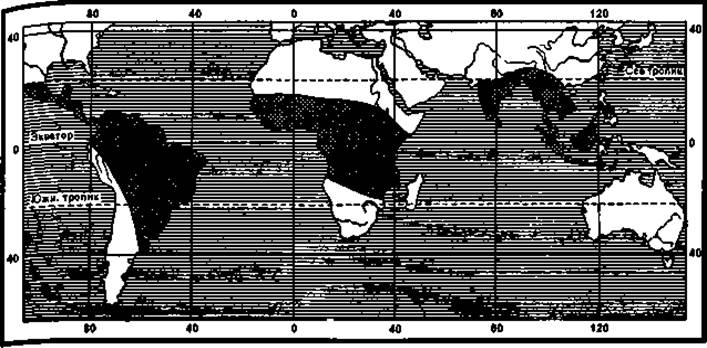
Fig. 78. Distribution of apodous amphibians
Freshwater bodies of South America are inhabited by Representatives of the genus Aquatic Caecilians (Typhlonectes).
The distribution of apodous amphibians is shown in Fig. 78.
Apodous amphibians reproduce by laying 20 to 30 eggs, which they deposit in subterranean burrows or under tree stumps near Water. Females coil around the eggs, and abundant secretions from their Skin glands protect the eggs from drying out (Fig. 79).
The hatched larvae migrate into the water, where they complete their development. Larvae lose their external gills while still inside the egg, and their aquatic phase is short. Some species are viviparous. Fertilization is internal in all species. They feed on soil invertebrates. Some species inhabit ant nests, feeding on their larvae.
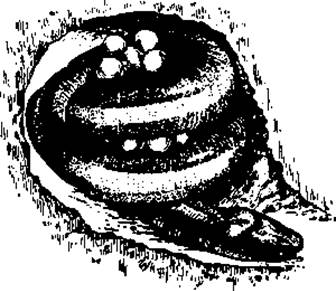
Fig. 79. A female Ceylon caecilian coiled around a clutch of eggs laid in a specially excavated burrow
Last update: 13/08/2026
Editorial and Educational Adaptation: This material has been compiled based on the primary/original source text. The project team performed an editorial review, corrected technical inaccuracies, structured sections, and adapted the content for an educational format.
What was processed:
- elimination of formatting defects (OCR errors, structural breaks, corrupted characters);
- editorial organization of content;
- standardization of terminology in accordance with academic sources;
- verification of factual statements against the original source text.
All mentions of the author, publication year, and origin of the primary text have been preserved in accordance with the source.