INVERTEBRATE ZOOLOGY IN THREE VOLUMES - VOLUME 3 - G.Y. Shcherbak - 1997
PHYLUM MOLLUSCA (MOLLUSCS)
CLASS GASTROPODA
SUBCLASS PULMONATA
Pulmonates have adapted to life on land or in freshwater habitats, with only a few species found in heavily brackish marine areas. Most possess a spirally coiled shell, which in some forms is rudimentary or covered by the mantle. The mantle complex of Organs is asymmetrical. Instead of gills, the respiratory organ is a lung, which has evolved from the mantle cavity. The pneumostome (mantle opening) is located anteriorly on the right side of the body. The atrium and Kidney are single. In the most primitive forms, The Nervous system features long connectives and chiasmony; in higher representatives, the nervous system becomes concentrated around the Pharynx, and chiasmony disappears. Pulmonate Molluscs are hermaphrodites with internal Fertilization and develop without a planktonic larva.
The subclass Pulmonata comprises two orders: Basommatophora and Stylommatophora.
Order Basommatophora. This order includes predominantly freshwater molluscs, with only a few species inhabiting terrestrial environments. A characteristic feature of this group is the placement of the eyes at the Base of the primary tentacles.
The most widespread family globally is the Lymnaeidae (pond snails), which are common inhabitants of ponds, lakes, and oxbow lakes. The best known among them is the great pond snail (Limnaea stagnalis). Also very common, including in Ukraine, are snails of the families Planorbidae (Fig. 85) and Physidae, while Representatives of the family Ancylidae are less numerous.
Class="center">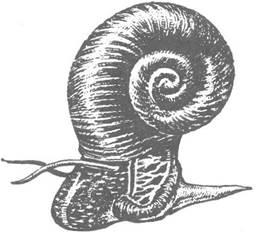
Fig. 85. Order Basommatophora: great ramshorn snail (Planorbis corneus)
Order Stylommatophora. This order encompasses predominantly terrestrial gastropods. They bear two pairs of tentacles on the HEAD: the eyes are located at the tips of the upper, longer pair, while the lower labial tentacles are shorter. In most species, the shell is well-developed, protecting the mollusc's body not only from mechanical damage but also from Water evaporation. The large (up to 47 mm) Roman snail or edible snail (see Fig. 57) is widely known and consumed as food in Eastern European countries.
In some species, the shell is reduced or entirely absent; this group of pulmonates is commonly referred to as slugs (Fig. 86). These are mostly herbivorous animals inhabiting environments with high humidity; some species are pests of cultivated plants.
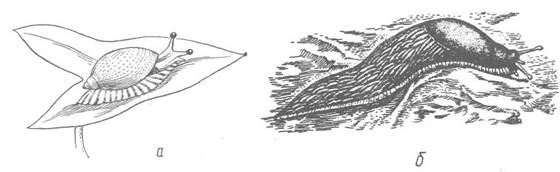
Fig. 86. Order Stylommatophora:
a — amber snail (Succinea putris); b — black slug (Arion ater)
Last update: 13/08/2026
Editorial and Educational Adaptation: This material has been compiled based on the primary/original source text. The project team performed an editorial review, corrected technical inaccuracies, structured sections, and adapted the content for an educational format.
What was processed:
- elimination of formatting defects (OCR errors, structural breaks, corrupted characters);
- editorial organization of content;
- standardization of terminology in accordance with academic sources;
- verification of factual statements against the original source text.
All mentions of the author, publication year, and origin of the primary text have been preserved in accordance with the source.