INVERTEBRATE ZOOLOGY IN THREE VOLUMES - BOOK 3 - H.Y. Shcherbak - 1997
PHYLUM MOLLUSCA
CLASS GASTROPODA
SUBCLASS OPISTHOBRANCHIA
This subclass comprises exclusively marine gastropods. In most species, the shell undergoes reduction. The mantle cavity is small, situated on the right side of the body, or is completely reduced. The mantle organ complex is asymmetric. The ctenidium, osphradium, atrium, and Kidney are unpaired, with the ctenidium and osphradium often disappearing entirely. A single atrium lies posterior to the ventricle, and the ctenidium lies posterior to The Heart, which gives the Opisthobranchia their name (meaning "hind-gilled"). In many species, the shell is overgrown by the mantle. In some forms, only a small plate remains of the shell, while in others it disappears completely. An operculum is present only in certain species.
The FOOT undergoes significant modifications. In some forms, it is reduced; in others, conversely, the lateral margins of the foot expand into broad, wing-like lobes known as parapodia, which assist in swimming.
The ctenidium frequently disappears, and epidermal outgrowths—secondary (adaptive) gills—develop across various PARTS OF THE body to function in place of the lost ctenidia. The external body shape of opisthobranchs acquires bilateral Symmetry: the secondary gills are arranged symmetrically, and the anus often lies on the mid-dorsal line. However, the internal anatomy of these Mollusks retains features of Asymmetry (THE POSITION OF the mantle cavity, Liver, Reproductive System, and chiasmolyph or chiastoneury preserved in some forms). A well-developed radula is characteristic of most opisthobranchs, while in some the Mouth is armed with a ring of small spines or numerous hooks. Opisthobranchs are hermaphrodites, and their reproductive system has a more complex Structure than that of prosobranchs.
Representatives of this subclass are widespread in the oceans, with the majority of species concentrated in warm and temperate zones.
The subclass Opisthobranchia includes the following orders: Tectibranchia, Acochlidiacea (Asoeia), Nudibranchia, Pteropoda, and Saccoglossa.
Order Tectibranchia. Most tectibranchs possess a shell and a mantle cavity located on the right side of the body.
In members of the family Actaeonidae, the shell is large, spirally coiled, turriculate, and provided with an operculum. The best-known species is Actaeon tornalis (Fig. 80, a), found along the Atlantic coast of Europe and in the Mediterranean Sea.
Class="center">
Fig. 80. Order Tectibranchia:
a — Actaeon tornalis; b — sea hare (Aplysia depilans)
The family Aceridae is characterized by a reduced, thin shell that does not cover the entire body, and a large foot with broad lateral lobes folded over the back. This family includes the largest of the tectibranchs—sea hares (genus Aplysia). Some specimens reach a mass of 400 g or more. Numerous species of this genus inhabit warm seas. Their shell is thin and rudimentary. The lateral expansions of the foot—the parapodia—fold over the back, covering most of it (Fig. 80, b). The narrow central part of the foot serves for crawling. By making undulating movements with the parapodia, they are able to swim. Sea hares are brightly colored: they are dark violet or ochre-yellow with white spots. They are herbivorous, feeding on red and brown Algae by grasping and tearing off pieces with the Teeth of their radula. A large muscular Stomach is lined internally with hard cuticular plates that grind down the food.
Order Acochlidiacea (Asoeia). This is a small group of tropical opisthobranchs; most possess a cap-shaped or ear-shaped shell, though in some species it is partially or completely covered by dorsal integuments containing calcareous corpuscles. In A number of forms, the shell is entirely reduced. The mantle cavity is either extremely small or absent altogether. A feathery ctenidium is located on the right side of the body between the mantle edge and the foot.
In the large mollusk known as the umbrella slug (Umbrella botanicum), which grows up to 19 cm in length, a nearly flat, rounded shell with a small pointed apex sits on the back, while the rest of the body surface is covered with Skin bearing wart-like outgrowths (Fig. 81). In another representative of this order, Pleurobranchus testudinalis, which externally resembles a turtle, the shell is entirely covered by the mantle.

Fig. 81. Order Asoeia: umbrella slug (Umbrella botanicum)
Order Nudibranchia. Representatives of this order lack a shell, and the ctenidium has disappeared, replaced by adaptive gills arranged symmetrically around the anus or on the back. Externally, the body is bilaterally symmetrical. In some forms, gills are absent entirely, and Respiration occurs across the entire surface of the skin. These are predominantly benthic animals, though some are capable of swimming.
This order comprises about 40 families. In some, such as members of the family Dorididae, the secondary gills form a circle around the anus, which is situated on the mid-dorsal line near the posterior end of the body (Fig. 82). The genital and excretory openings are shifted to the right side.

Fig. 82. Order Nudibranchia: Acanthodoris
In others, such as members of the family Aeolidae, the anus is located on the right side, and the gills lie in rows along the sides of the back (see Fig. 56, c). The liver in these mollusks consists of three branched lobes, the branches of which extend into the interior of the gills. At the tip of each gill lies a special sac that connects with the lumen of the hepatic outgrowth and opens externally via a small pore. These sacs accumulate stinging Cells (nematocysts) from the hydroid polyps upon which these animals feed. In members of the family Dendronotidae, the gills are treelike and branching. Many nudibranchs exhibit bright warning coloration to deter predators.
Nudibranchs inhabit the littoral zones of both cold and tropical seas, though the greatest species diversity is observed in the tropics. They are predominantly small animals, the largest being species of the genus Tethys (family Dendronotidae) from the Mediterranean Sea, which reach several centimeters in length. More than 10 species live in the Black Sea, and a single species, Tenellia adspersa, inhabits the Sea of Azov.
Order Pteropoda (pteropods). This order comprises actively swimming opisthobranchs. Their defining characteristic is the strong development of a pair of parapodia that function as fins. A shell is present only in Representatives of the suborder Thecosomata, which feed on microplankton. A typical representative of this group is the sea butterfly (Limacina helicina, Fig. 83), widely distributed in Arctic and Antarctic waters. It possesses a thin, transparent shell coiled to the left, which can be closed with an operculum. An adaptation for feeding on small planktonic organisms consists of areas of ciliated epithelium that originate at the posterior margins of the parapodia and extend toward the mouth; the beating of the cilia drives planktonic organisms toward the oral opening.
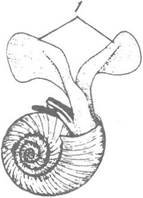
Fig. 83. Order Pteropoda: sea butterfly (Limacina helicina): 1 — parapodia
The suborder Gymnosomata includes shell-less species that feed on larger planktonic items; they feature a well-developed radula and jaws armed with sharp teeth. Their larvae initially possess a saucer-shaped shell, which later becomes tube-shaped and is eventually shed. The sea angel (Clione limacina, see Fig. 56, b) is common in the cold waters of the Northern Hemisphere. It is a voracious predator whose primary food source is the aforementioned Limacina helicina. It is equipped with a catching apparatus consisting of six oral appendages surrounding the mouth, which are covered in glands secreting a sticky substance used to hold captured prey.
Pteropods are absent in the Black and Azov seas.
Order Saccoglossa. This order comprises only about 15 genera with a small number of species. Some possess a thin shell, while others are shell-less. They are characterized by a significant simplification of the radula, the anterior end of which lies in a blind, sac-like depression, hence the name of the order. Most of them inhabit warm seas, with only a few species occurring along European coasts.
Of particular interest are species of the genus Berthelinia, found in tropical seas (Fig. 84). Instead of a continuous shell, they possess a bivalved shell whose Valves are connected by a ligament, much like bivalves; they even feature two adductor Muscles. Despite their superficial resemblance to bivalves, berthelinias are true gastropods: they possess a well-developed HEAD with tentacles, a typical gastropod foot structure, a single gill, a radula, and other Organs characteristic of gastropods. The larva has a cap-shaped shell that subsequently transforms into a bivalved one, although the spiral embryonic whorl is retained at the apex of one of the valves.
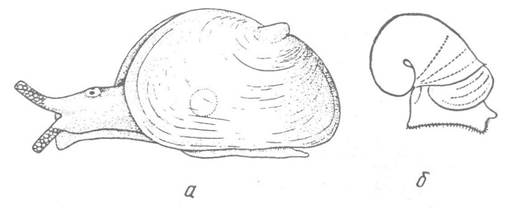
Fig. 84. Order Saccoglossa:
a — Berthelinia limax with a bivalved shell; b — its larva
Last update: 13/08/2026
Editorial and Educational Adaptation: This material has been compiled based on the primary/original source text. The project team performed an editorial review, corrected technical inaccuracies, structured sections, and adapted the content for an educational format.
What was processed:
- elimination of formatting defects (OCR errors, structural breaks, corrupted characters);
- editorial organization of content;
- standardization of terminology in accordance with academic sources;
- verification of factual statements against the original source text.
All mentions of the author, publication year, and origin of the primary text have been preserved in accordance with the source.