INVERTEBRATE ZOOLOGY IN THREE VOLUMES - BOOK 2 - H.Y. Shcherbak - 1996
PHYLUM ARTHROPODA
SUBPHYLUM BRANCHIATA, OR CRUSTACEA
CLASS OSTRACODA
These are small (1–30 mm) marine or freshwater crustaceans inhabiting all types of Water bodies, ranging from small puddles to the greatest depths of the World Ocean. Crustaceans of the genus Potamocypris, capable of normal physiological activity at +54° C, have been found in a warm stream in the USA, making them one of the most heat-resistant Multicellular animals. However, many high-latitude ostracod species constantly live at temperatures barely exceeding zero. Most ostracods lead a benthic lifestyle, crawling using their antennules and thoracic limbs, primarily the second pair. Some forms (freshwater Cypridae) can both crawl and swim; there are specialized planktonic marine forms with well-developed compound eyes. Some are able to hang upside down from the surface tension film and move along it (Notodromas et al.). Many species can burrow into silt to a depth of up to 7 cm. Some live as commensals on the body surface of other animals, such as Isopoda, crayfish, etc. Among them, there are even seven terrestrial species (genera Mesocypris and Scotia) inhabiting the litter of damp forests in southern Africa, Madagascar, Australia, and New Zealand.
There are 2 thousand extant and 12 thousand fossil species known. In the fauna of Ukraine, 90 species have been found in freshwaters, and 110 species in the Black and Azov seas.
The body of ostracods is greatly shortened, laterally compressed, and has completely lost segmentation. It is entirely covered by a bivalve shell corresponding to the carapace of other crustaceans (Fig. 82). The Valves of the shell are connected on the dorsal side by an elastic organic ligament, and there is also a powerful adductor Muscle.
Class="center">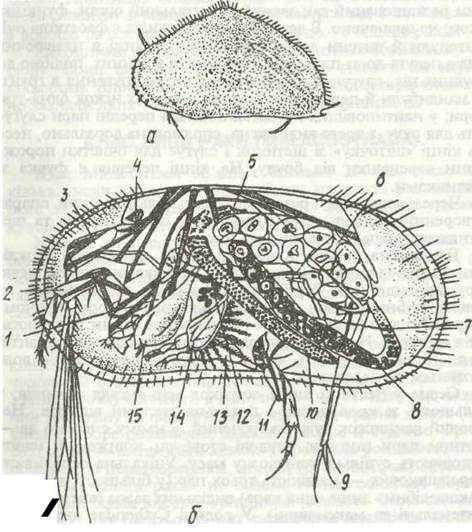
Fig. 82. Ostracods
The shell consists of an inner cuticular layer of a Chitin-like substance and a more or less developed outer calcareous layer. In terrestrial ostracods, the shell valves bear dense setae that help retain moisture.
The HEAD typically bears only a naupliar eye. Alongside it lies the so-called frontal organ, whose function remains undetermined. Some marine species possess facet eyes. Antennules and antennae are well developed. The latter bear long swimming setae in swimming forms, while in benthic forms, similar to thoracic legs, they serve for crawling or burrowing into the substrate. Mandibles and the first pair of maxillae are present. There are one to three pairs of thoracic legs; in typical representatives, the two anterior pairs serve for locomotion, while the third is elongated, directed dorsally, bears a "brush" of setae at the end, and serves to clean the shell cavity from debris. At the end of the abdomen, There is a furca with setae.
Water moves through the shell; the filtration apparatus is formed by special outgrowths of the maxillary bases and the setae of the first pair of thoracic legs.
The vast majority of ostracods feed on unicellular Algae, detritus, and animal remains; some marine species (genus Cypridina) are predators hunting other small crustaceans. There are also true filter feeders, with marine species of the genera Asterope and Cyclasterope burying themselves completely in the substrate. Only the tips of the antennules protrude above its surface. They form an opening in the sediment through which water moves toward the shell.
In some ostracod species, The Heart appears as a vesicle; in most, however, the circulatory and respiratory systems are absent. The nerve cord is greatly shortened, containing only two to four pairs of ganglia; the nerve trunks are closely appressed and even form a continuous ganglionic mass. A unique feature of ostracods is the presence of three pairs of excretory glands (antennal, antennular, and maxillary), whereas most adult crustaceans have only one pair. In the family Cytheridae, the antennal glands are transformed into silk glands; the silk helps them attach to the substrate while crawling.
All ostracods are dioecious; Sexual Dimorphism in The Structure of THE EYE AND antennae is sometimes observed. In many freshwater species, females reproduce parthenogenetically, and males are completely unknown. Interestingly, in some species, reproduction is parthenogenetic in the northern part of the range, while both males and females are present in the southern part, resulting in bisexual reproduction.
Females mostly lay eggs on the substrate, though in some species, eggs are brooded under the shell until the larvae hatch. The nauplius has a bivalve shell; after six to seven molts, the crustacean reaches maturity, after which it never molts again. Interestingly, ostracod spermatozoa reach gigantic sizes: in Pontocypris, which is 0.7 mm long, the sperm length reaches 6 mm (compared to just 0.067 mm in humans) and exceeds the body length of the crustacean by almost 9 times. The reason for such sperm gigantism remains unexplained. The duration of development in various species ranges from 1 to 4 months, while adult crustaceans live from 4 months to 3 years or more.
Fossil ostracods are known from the beginning of the Cambrian period. They are widely used in geology as index fossils. Throughout their geological history, Ostracoda have not undergone any significant changes in their body Organization.
Last update: 13/08/2026
Editorial and Educational Adaptation: This material has been compiled based on the primary/original source text. The project team performed an editorial review, corrected technical inaccuracies, structured sections, and adapted the content for an educational format.
What was processed:
- elimination of formatting defects (OCR errors, structural breaks, corrupted characters);
- editorial organization of content;
- standardization of terminology in accordance with academic sources;
- verification of factual statements against the original source text.
All mentions of the author, publication year, and origin of the primary text have been preserved in accordance with the source.