IMMUNOLOGY - Roitt I. - Mir 2000
Chapter 28. Autoimmune Processes and Autoimmune Diseases
GENETIC FACTORS
Autoimmune diseases can run in families
The existence of familial cases of autoimmune diseases is a well-established fact, a clear example of which is shown in Fig. 28.6. Studies on monozygotic and dizygotic twins, as well as data on the association of thyroid autoantibodies with X-chromosome aberrations, strongly indicate that genetic factors, rather than environmental influences, underlie these familial cases.
Class="center">
Fig. 28.6. This diagram presents data for a family in which all members were found to have organ-specific autoimmune disorders of The Thyroid Gland and Stomach. (By the time of the examination, the father had died, and it is unknown whether he possessed any particular Antibodies.) All siblings showed autoimmune gastric involvement, whereas the mother suffered from primary Myxedema. However, thyroid autoantibodies were also present in the siblings' serum, although Clinical symptoms of thyroid involvement were not observed. The frequency of autoantibodies increased with the age of family members (the age at which autoantibodies were detected is indicated).
Familial autoimmune diseases are most often organ-specific. Furthermore, genetic factors determine not only the general predisposition to the appearance of organ-specific antibodies, but also the specific organ against whose tissue components they are primarily directed. Characteristically, in relatives of patients with Hashimoto's thyroiditis or pernicious anemia, the detection frequency and titers of thyroid autoantibodies are higher than normal, while relatives of patients with pernicious anemia much more frequently harbor autoantibodies against gastric tissue components. Thus, genetic factors exist that determine the selective involvement of The Stomach in this group of organ-specific autoimmune diseases.
Susceptibility to autoimmune diseases is associated with specific HLA haplotypes
Further Evidence for the role of genetic factors in autoimmune diseases is the association of such disorders with specific HLA haplotypes (Fig. 28.7). For instance, rheumatoid Arthritis is not associated with HLA-A and HLA-B locus haplotypes, but develops more frequently in the presence of a nucleotide sequence shared by DR1 and the major subtypes of DR4 (encoding amino acid residues 70–74 of the DR β-chain). This sequence is also present in dnaJ heat Shock Proteins of various Bacteria and the gp110 protein of the Epstein–Barr virus, creating a clinically significant possibility of inducing autoimmune diseases via cross-reacting microbial epitopes (see below). Moreover, HLA-DR molecules bearing this sequence can bind another bacterial heat shock protein, dnaK, as well as its human counterpart, the heat shock protein hsp73, which targets individual proteins to Lysosomes for antigen Processing. The B8, DR3 haplotype is particularly common in organ-specific diseases, although Hashimoto's thyroiditis is more frequently associated with DR5. It should be noted that in DQ2/8 heterozygotes, the risk of developing Insulin-dependent (type I) Diabetes Mellitus is dramatically increased (Fig. 28.7). This Supports the concept that multiple genetic factors are involved in The Development of autoimmune diseases: first, genes determining a general predisposition to autoimmune pathology, whether organ-specific or non-organ-specific, and second, other genes that determine the specific target—the Antigens against which the autoimmune reaction is directed.
Confirmation of these views has been obtained from EXPERIMENTAL MODELS OF autoimmune diseases; such studies are discussed in the next section.
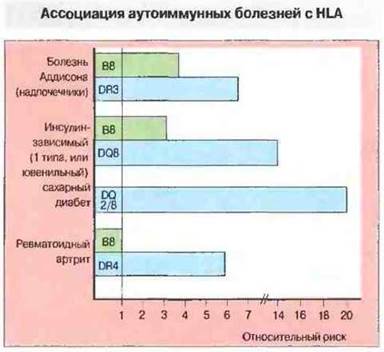
Fig. 28.7. The relative risk value reflects the probability of developing a given disease in individuals possessing a specific HLA antigen relative to the probability of developing the same disease in individuals lacking this antigen. Virtually all autoimmune diseases studied are associated with one or another HLA haplotype. The greater risk of Addison's disease in individuals with the HLA-DR3 haplotype compared to carriers of the HLA-B8 haplotype indicates that the HLA-DR3 haplotype is more closely linked to, or even identical with, the "disease predisposition Gene." The fact that the relative risk in B8 carriers exceeds unity should not be surprising, since it is known that in the general population, B8 occurs together with DR3 more frequently than would be expected by chance alone. This phenomenon is termed linkage disequilibrium. Type 1 diabetes mellitus is associated with DQ2 and DQ8, and when genes for both of these molecules are present (in DQ2/8 heterozygotes), the risk of diabetes increases sharply, confirming METABOLISM/2.html">THE CONCEPT OF an additive effect of multiple genetic factors. Rheumatoid arthritis is associated with a specific sequence in DR1 and several DR4 subtypes, but not with any particular HLA-A or HLA-B allele.
Last update: 13/08/2026
Editorial and Educational Adaptation: This material has been compiled based on the primary/original source text. The project team performed an editorial review, corrected technical inaccuracies, structured sections, and adapted the content for an educational format.
What was processed:
- elimination of formatting defects (OCR errors, structural breaks, corrupted characters);
- editorial organization of content;
- standardization of terminology in accordance with academic sources;
- verification of factual statements against the original source text.
All mentions of the author, publication year, and origin of the primary text have been preserved in accordance with the source.