Molecular Biology: Protein Structure and Functions - Stepanov V.M. 2005
Peptides
Enzymatic Peptide Synthesis
Under normal conditions, Proteolytic Enzymes catalyze the Hydrolysis of peptide bonds. However, conditions can be adjusted to shift the equilibrium toward peptide bond formation. For instance, in concentrated solutions of benzyloxycarbonyl-L-aspartic acid and L-phenylalanine methyl ester, metalloproteinases such as Thermolysin catalyze The formation of a peptide bond between them. The reaction product (benzyloxycarbonyl-L-aspartyl-L-phenylalanine methyl ester), being sparingly soluble, precipitates as a salt with another molecule of Z-phenylalanine methyl ester. It is precisely this low solubility of the product, which removes it from the reaction medium, that drives the equilibrium toward synthesis. Subsequent deprotection via catalytic hydrogenation yields L-aspartyl-L-phenylalanine methyl ester—aspartame—a compound 200 times sweeter than sucrose. This process is utilized for the industrial production of aspartame:
Class="center">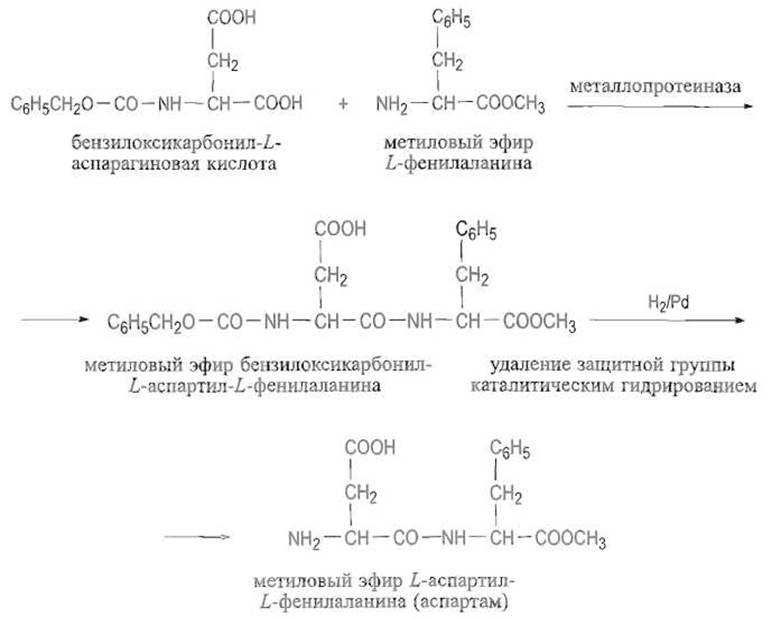
Another approach to shifting the equilibrium toward synthesis is to carry out the proteinase-catalyzed Peptide Synthesis reaction in an organic solvent in the presence of trace amounts of Water, just sufficient to hydrate the enzyme. Pre-activation of one of the components is also employed in enzymatic synthesis. Thus, esters of acylated Peptides in the presence of Serine proteinases react rapidly with amino components—amino acid or peptide derivatives—to form longer peptides. The shift in equilibrium toward synthesis in this case is driven by the activation of the acylating peptide through its conversion into an ester; The rate of the enzyme-catalyzed peptide bond synthesis from the peptide ester significantly exceeds the rate of hydrolysis of the same peptide bond by the enzyme.
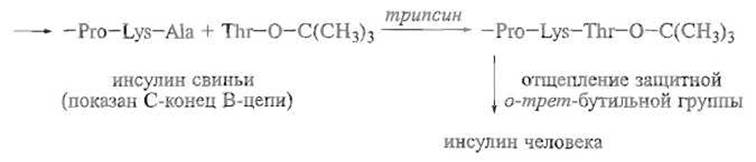
Enzyme-catalyzed partial transformations of peptides have also been described, such as The conversion of porcine Insulin into human insulin, which differs from the former solely by the replacement of the C-terminal Alanine residue in the B-chain with Threonine. This is achieved through enzyme-catalyzed Cleavage of alanine followed by The addition of a carboxyl-protected threonine residue present in large excess in the reaction mixture:
Last update: 13/08/2026
Editorial and Educational Adaptation: This material has been compiled based on the primary/original source text. The project team performed an editorial review, corrected technical inaccuracies, structured sections, and adapted the content for an educational format.
What was processed:
- elimination of formatting defects (OCR errors, structural breaks, corrupted characters);
- editorial organization of content;
- standardization of terminology in accordance with academic sources;
- verification of factual statements against the original source text.
All mentions of the author, publication year, and origin of the primary text have been preserved in accordance with the source.