Biological Membranes - A. N. Ogurtsov 2012
Structure and Functions of Biomembranes
Intracellular Protein Transport
Protein Transport Across the Nuclear Membrane
The Nucleus is the largest organelle in a Introduction/5.html">Eukaryotic Cell, with a diameter of about 10 µm, clearly visible under a Light Microscope. It is separated from the rest of The Cell by an envelope consisting of inner and outer nuclear membranes (Figure 13). The space between the two nuclear membranes is called the perinuclear space. The outer nuclear membrane is studded with Ribosomes and is continuous with the rough Endoplasmic reticulum.
The inner nuclear membrane is lined with specialized Proteins that serve to anchor nuclear structures, known as the nuclear lamina. The nucleus contains almost all of the cell's DNA, and it is the site where METABOLISM/36.html">DNA Replication and expression take place.
These processes are supported by numerous protein factors which, like all proteins, are synthesized in the cell Cytosol and then imported into the nucleus. Conversely, Messenger RNA—the product of DNA Transcription—exits the nucleus into the cytosol following Processing, just as ribosomal subunits are transported from the nucleolus into the cell cytosol after assembly.
This intensive molecular exchange between the cytosol and the nucleoplasm is mediated and regulated by nuclear pores—complex multiprotein assemblies consisting of more than 50 distinct proteins called nucleoporins, which form a ring composed of eight identical subunits (Figure 78).
A side-section diagram (Figure 78(b)) shows that the proteins within the nuclear pore are arranged in a stack of three rings and are anchored to the nuclear membrane via transmembrane proteins. Radial "spokes" extend from the inner ring toward the center of the pore channel. At the very center lies a central transporter protein, known as the plug, which acts as a gate controlling passage through the pore.
Class="center">
Figure 78 - Cytology/cytology/92.html">SCHEMATIC Structure OF the nuclear pore: (a) frontal view; (b) cross-section
The Ran GTPase plays a decisive role in regulating controlled transport through the nuclear pore. Like all GTPase switch proteins, the Ran protein exists in two forms (Figure 79):
(1) an active ("on") form with a bound GTP molecule;
(2) an inactive ("off") form with a bound GDP molecule.
The intrinsic GTPase activity of such switch proteins leads to the slow Hydrolysis of GTP to GDP, thereby "turning off" the protein. The subsequent replacement of GDP with GTP, which restores the active form, occurs even more slowly.
The cycling of the GTPase between these two Conformations is regulated by accessory proteins: Ran-GAP (GTPase-Accelerating Protein), which accelerates GTP hydrolysis, and Ran-GEF (Guanine nucleotide Exchange factor), which stimulates the replacement of GDP with GTP.
In the context of nuclear pore transport, Ran-GEF proteins are concentrated in the nucleus, whereas Ran-GAP proteins reside in the cytosol. Consequently, within the nucleoplasm, Ran GTPase is predominantly in the active (Ran:GTP) state, whereas in the cytosol, it is in the inactive (Ran:GDP) state.

Figure 79 - Cycling of the Ran GTPase protein between active and inactive states
The pathway of protein import into the nucleus, regulated by Ran proteins, is illustrated in Figure 80. The transport receptor recognizes and binds to the nuclear localization signal (NLS) of the cargo protein.
This binary protein complex diffuses through the nuclear pore into the nucleoplasm, where active Ran GTPases are abundant. The active GTPase displaces the cargo protein and binds directly to the transport receptor, leaving the cargo released inside the nucleus.
The complex of the transport receptor and the active GTPase then diffuses outward through the nuclear pore into the Cytoplasm, where Ran-GAP proteins are located. Ran-GAP "turns off" the GTPase, causing it to dissociate from the transport protein, which is now free to reload and transport another cargo protein into the nucleus.
The inactive GTPase diffuses back into the nucleus, where the Ran-GEF protein reactivates it by exchanging GDP for GTP.

Figure 80 - Protein import into the nucleus
Protein export proceeds in a similarly orchestrated manner (Figure 81), with the key difference that the transport receptor can recognize the targeting signal on the cargo protein only if the receptor itself has previously formed a dual complex with the GTPase. Only the trimeric complex (GTPase:Receptor:Cargo) can exit outward through the pore. In the cytosol, the accessory protein Ran-GAP stimulates GTP hydrolysis, the GTPase is "turned off," the trimeric complex dissociates, and the cargo protein is released into the cytosol.
Subsequently, the transport receptor and the inactive Ran protein diffuse back into the nucleoplasm, where Ran-GEF reactivates the GTPase, allowing the cycle to begin anew.
Although Ran regulates both the nuclear import and export of proteins, in each case only the active form (Ran:GTP) binds to the transporter. The Ran:GDP form is inactive and incapable of binding to the transport protein.
Certain proteins are capable of shuttling back and forth between the cytosol and the nucleoplasm by exposing or masking their targeting sequences.
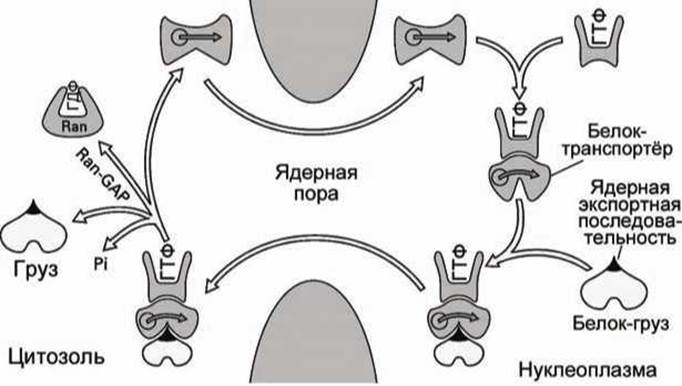
Figure 81 - Nuclear protein export
Last update: 13/08/2026
Editorial and Educational Adaptation: This material has been compiled based on the primary/original source text. The project team performed an editorial review, corrected technical inaccuracies, structured sections, and adapted the content for an educational format.
What was processed:
- elimination of formatting defects (OCR errors, structural breaks, corrupted characters);
- editorial organization of content;
- standardization of terminology in accordance with academic sources;
- verification of factual statements against the original source text.
All mentions of the author, publication year, and origin of the primary text have been preserved in accordance with the source.