General Microbiology - Schlegel, H. 1987
Types of Fermentation
As mentioned above, energy generation is a prerequisite for cellular activity. Among the three fundamentally possible ways of ATP regeneration (Respiration, Fermentation, and Photosynthesis), fermentation is the simplest one.
Fermentation is a metabolic process in which ATP is regenerated, and the breakdown products of the organic substrate can simultaneously serve as both hydrogen Donors and acceptors. The reactions leading to ADP phosphorylation are oxidation reactions. The Cell gets rid of oxidized carbon by releasing CO2. Individual oxidation steps involve dehydrogenation, where hydrogen is transferred to NAD. The hydrogen bound in NADH2 is accepted by the intermediate products of substrate breakdown. During NAD regeneration, the latter are reduced, and the reduction products are excreted from the cell.
Class="center">
The fermentation of CARBOHYDRATES and various other substances yields products (either individually or in mixtures) such as ethanol, lactate, propionate, formate, butyrate, succinate, caproate, acetate, n-butanol, 2,3-butanediol, acetone, 2-propanol, CO2, and H2. Depending on which products predominate or are particularly characteristic, one distinguishes alcoholic, lactic acid, propionic acid, formic acid, butyric acid, and acetic acid fermentation. Molecular oxygen is not involved in fermentation processes: "Fermentation is life without air" (L. Pasteur). Many fermenting microorganisms are obligate anaerobes, while some are facultative anaerobes capable of growing both in the presence and absence of oxygen; in the latter case, oxygen inhibits fermentation, and it is replaced by respiration.
ATP regeneration during fermentation. The microbial fermentation of glucose yields from 1 to 4 moles of ATP:

Given the large number of possible fermentation products, it seems surprising that energy conversion via substrate-level phosphorylation involves only a few reactions, three of the most important of which are presented here:
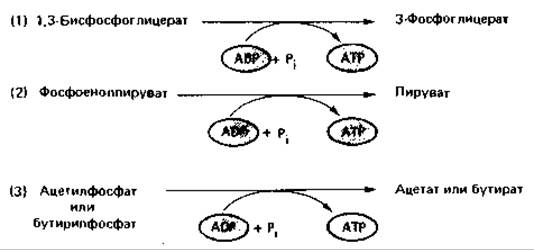
In most fermenting microorganisms, only Reactions Catalyzed by phosphoglycerate kinase (1) or Pyruvate kinase (2) are utilized, while the required hydrogen acceptors are formed from pyruvate and acetyl-CoA. The fermentation of one mole of glucose yields only two to three moles of ATP, with lactate, ethanol, acetone, butyrate, n-butanol, 2-propanol, 2,3-butanediol, caproate, acetate, CO2, and molecular hydrogen acting as the products.
By utilizing acetate kinase [reaction (3)], Bacteria obtain additional ATP. Acetyl phosphate is formed from acetyl-CoA and inorganic phosphate with the aid of phosphotransacetylase:
Acetyl-CoA + Pi → Acetyl phosphate + CoA
Furthermore, acetyl phosphate can be formed from phosphorylated sugars (xylulose-5-phosphate, fructose-6-phosphate) with the participation of phosphoketolase.
The ability of bacteria to use the reaction catalyzed by acetate kinase (3) depends on whether they can evolve molecular hydrogen (H2). When reducing equivalents (electrons) are transferred to protons, they can be released as molecular hydrogen; therefore, the cell does not need to synthesize hydrogen acceptors. To understand this, one must examine the mechanisms of H2 release.
Anaerobic bacteria oxidize pyruvate to acetyl-CoA in two ways (see reactions (2) and (3) at the beginning of Section 7.2.4). In the reaction catalyzed by pyruvate : ferredoxin oxidoreductase (which is characteristic of clostridia, in particular), ferredoxin (Fd) is reduced. Its redox potential is very low (E0' = -420 mV); therefore, gaseous hydrogen can be released with the help of a special Hydrogenase—ferredoxin : H2 oxidoreductase:

In the reaction catalyzed by pyruvate : formate lyase (as in enterobacteria), formate is produced alongside acetyl-CoA. It can be cleaved by the hydrogen-lyase system:

Both H2-evolving mechanisms share the feature that their precursors (FdH and formate) have very low redox potentials. Consequently, it is easy for the cell to get rid of the reducing equivalents generated during the Oxidation of Pyruvate to acetyl-CoA.
In contrast, the hydrogen generated during the dehydrogenation of glyceraldehyde-3-phosphate and bound as NADH2 is subsequently transferred to organic acceptors in most anaerobic bacteria. However, many bacteria possess The ability to release these reducing equivalents as H2 as well, owing to the enzyme NADH2 : ferredoxin oxidoreductase, which catalyzes the reaction

Hydrogen can be cleaved from FdH with the aid of hydrogenase. Since these reactions are associated with an increase in potential (from E0' = -320 mV for NADH2 to E0' = -420 mV for ferredoxin) and their equilibrium is unfavorable for H2 evolution, they proceed only when the molecular hydrogen produced and released is continuously removed. Therefore, organisms capable of producing H2 from NADH2 can utilize this elegant way of disposing of hydrogen in the form of H2 only when living together with other species that continuously consume H2. This is typically the case in nature. Such a phenomenon is referred to as interspecies hydrogen transfer, representing a special form of Symbiosis in microbial communities.
Bacteria capable of ridding themselves of NAD-bound hydrogen in this manner by releasing it as H2 can, naturally, dispense with The conversion of acetyl-CoA into acceptors for NADH2. Consequently, they can convert acetyl-CoA into acetyl phosphate and regenerate ATP via the acetate kinase reaction. They primarily excrete acetate and, when fermenting one mole of glucose, are able to regenerate up to four moles of ATP (as, for example, Ruminococcus albus; see p. 299).
The Role of fermentation processes in the balance of nature. Fermenting species play a vital role in the natural cycle of matter. Most of the Cellulose ingested by herbivores is excreted undigested in feces. When this cellulose-containing detritus enters the anaerobic layers of soil or aquatic sediments, it is fermented by cellulose-degrading clostridia and certain other strictly anaerobic bacteria. This yields the aforementioned fermentation products, almost always including molecular hydrogen. Hydrogen occupies the beginning of the anaerobic food chain, whose main products are methane and (or) hydrogen sulfide:
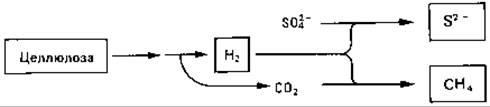
In the sediments of freshwater lakes and in the rumen of ruminants, H2 is converted into methane by methanogenic bacteria, whereas in marine anaerobic ecosystems, sulfate-reducing bacteria convert H2 and sulfate into hydrogen sulfide.
Last update: 13/08/2026
Editorial and Educational Adaptation: This material has been compiled based on the primary/original source text. The project team performed an editorial review, corrected technical inaccuracies, structured sections, and adapted the content for an educational format.
What was processed:
- elimination of formatting defects (OCR errors, structural breaks, corrupted characters);
- editorial organization of content;
- standardization of terminology in accordance with academic sources;
- verification of factual statements against the original source text.
All mentions of the author, publication year, and origin of the primary text have been preserved in accordance with the source.