GENERAL MICROBIOLOGY - T.P. Pyrog - 2004
11. MAIN METABOLIC PATHWAYS AND ENERGY TRANSFORMATION IN MICROORGANISMS
11.7. SUBSTRATE UPTAKE MECHANISMS
11.7.3. Active Transport
The higher efficiency of Active Transport compared to diffusion processes is illustrated in Fig. 11.12. Active transport leads to Cell saturation with a substrate at a significantly lower concentration of this substrate in the medium than in diffusion processes. Substance concentration by several hundred-fold has been observed. Consequently, active transport enables Cells to grow in media with low substrate concentrations—a common situation in nature.
Class="center">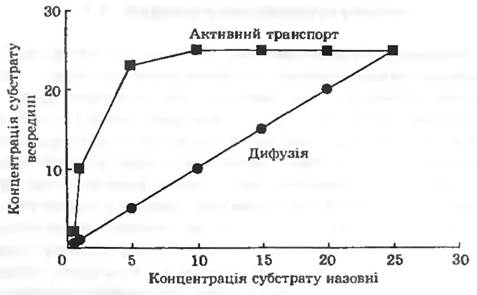
Fig. 11.12. Saturation curves for active transport and diffusion
The KEY FEATURES OF active transport are as follows:
substrate Specificity; formation of a carrier-substrate complex outside the membrane; requirement for metabolic energy;
substrate transport against a concentration gradient; release of the unmodified substrate into the Cytoplasm (unlike group translocation).
The energy source for active transport processes is predominantly the proton-motive force generated during electron Transport Across the membrane.
Another energy source that drives active transport is ATP Hydrolysis (The energy released during ATP hydrolysis). Strictly speaking, ATP hydrolysis performed by the ATP synthase enzyme complex is accompanied by the translocation of protons from the inner side of the membrane to the outside, which also generates a proton-motive force. During ATP synthesis and hydrolysis, an interconversion of two energy forms takes place: proton-motive force energy is converted into ATP energy (ATP synthesis), and ATP energy is converted into proton-motive force energy (ATP hydrolysis). Therefore, it is correct to state that the energy source for active transport processes is the proton-motive force, which can be generated through Electron Transport and ATP hydrolysis.
According to literature data, ATP-dependent active transport utilizes energy (ATP) produced at the level of substrate-level phosphorylation. Thus, There are two Energy Sources for active transport processes: the energy of the proton-motive force and ATP energy. Accordingly, a distinction is made between ΔμΗ-dependent and ATP-dependent active transport mechanisms.
The ΔμΗ-dependent active transport mechanism is also referred to as the "chemiosmotic mechanism". Bacterial cells maintain a proton motive force by continuously pumping out protons and other ions (Na ) from The Cell. Specific transport Proteins in the membrane serve this purpose. There are several variants of this mechanism (Fig. 11.13):
symport—the simultaneous and unidirectional transport of two substances, such as the substrate (A or B) and an ion (H or Na ), as shown in Fig. 11.13;
antiport—the simultaneous counter-transport of two ions (e.g., H and Na , or a proton and an organic acid anion);
uniport—The transport of a single ion (K in Fig. 11.13).
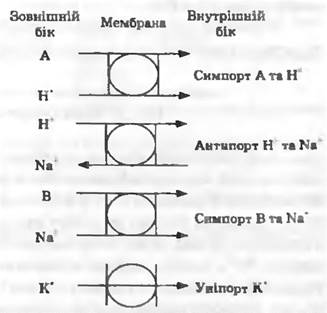
Fig. 11.13. Various types of active transport driven by the proton-motive force
Prokaryotes predominantly utilize proton symport, whereas eukaryotes rely on Na symport.
How can one distinguish between ΔμН- and ATP-dependent active transport mechanisms? ΔμН-dependent mechanisms are insensitive to osmotic Shock, yet sensitive to protonophores (which collapse the proton motive force across the membrane by dissipating both its components—the pH gradient and the electrical potential gradient), and resistant to arsenate (which depletes intracellular ATP pools).
Last update: 12/08/2026
Editorial and Educational Adaptation: This material has been compiled based on the primary/original source text. The project team performed an editorial review, corrected technical inaccuracies, structured sections, and adapted the content for an educational format.
What was processed:
- elimination of formatting defects (OCR errors, structural breaks, corrupted characters);
- editorial organization of content;
- standardization of terminology in accordance with academic sources;
- verification of factual statements against the original source text.
All mentions of the author, publication year, and origin of the primary text have been preserved in accordance with the source.