GENERAL MICROBIOLOGY - T.P. Pyrog - 2004
9. YEASTS
9.4. REPRODUCTION OF YEASTS
9.4.1. Asexual reproduction
Three types of Vegetative Reproduction in Yeasts are distinguished: budding, fission, and budding combined with fission. The mode of vegetative reproduction serves as an important taxonomic criterion for dividing yeasts of the family Saccharomycetaceae into subfamilies.
In yeasts of the subfamily Saccharomycetoideae, vegetative reproduction occurs via multilateral budding (Fig. 9.2, a), which involves The formation of buds on various sides of the mother Cell.
Class="center">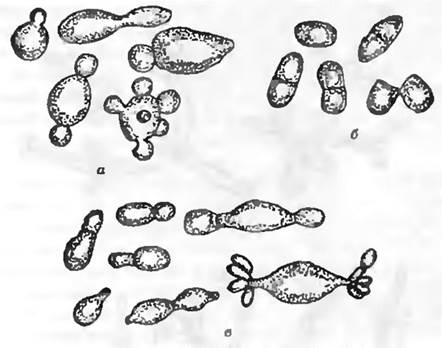
Fig. 9.2. Types of vegetative reproduction in yeasts: a — multilateral budding; b — fission; c — bipolar and monopolar budding
Representatives of the subfamily Schizosaccharomycetoideae are characterized by reproduction through fission — elongation of The Cell from one end followed by the formation of a transverse septum without constriction (Fig. 9.2, b).
During budding that terminates in fission, or bipolar budding (subfamily Nadsonioideac), the formation of daughter Cells begins with a bud arising on a narrower base than in Schizosaccharomycetoideae, and ends with the appearance of a septum at the Base of the bud (Fig. 9.2, c).
The mode of Cell wall formation during budding can also be considered a taxonomic feature. Ascomycetous yeasts exhibit holoblastic budding, where all layers of the mother cell wall are involved in forming the new cell wall of the bud. In heteroblastic (enteroblastic) budding, which occurs in basidiomycetous yeasts, The cell wall of the young bud is formed solely by the stretching of the inner layer of the mother cell wall.
Formation of true mycelium and pseudomycelium. During the budding process, mature buds may fail to separate from the mother cell, forming clusters or chains of cells. This leads to The Development of pseudomycelium (Fig. 9.3, a, b).
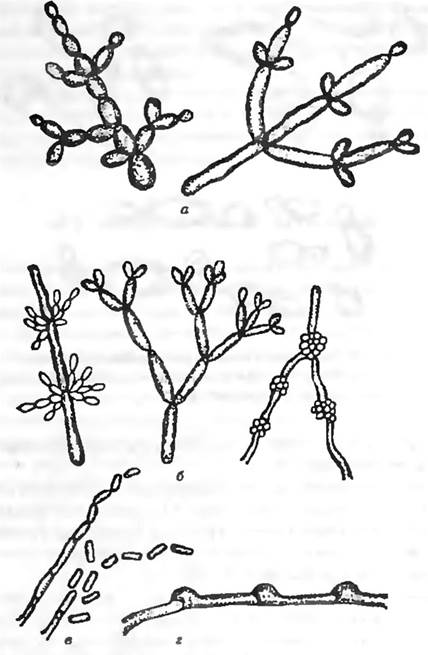
Fig. 9.3. Types of mycelium in yeasts: a — primitive pseudomycelium; b — differentiated pseudomycelium; c — true mycelium and arthrospores; d — clamp-bearing mycelium
True mycelium is formed only in yeasts capable of reproduction by fission. In this case, branches of various sizes develop As a result of continuous apical growth of the hypha, and the transverse septum between cells is formed without constriction. The mycelium can break apart, resulting in the formation of unicellular arthrospores, or oidia (Fig. 9.3, c). The formation of clamp-bearing mycelium (Fig. 9.3, d) is characteristic of basidiomycetous yeasts.
Formation of asexual spores. Endospores are vegetative cells that form inside a cell or hypha (Fig. 9.4, a). They can be observed in old Yeast cultures grown on wort Agar, potato agar, or malt-yeast agar. They are formed in yeasts of the genera Candida, Trichosporon, Cryptococcus, and Oosporidium.
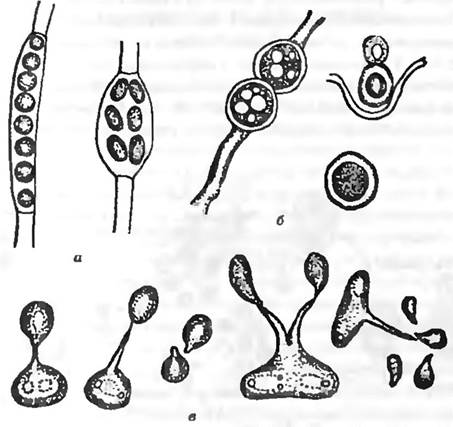
Fig. 9.4. Some modes of asexual reproduction in yeasts: a — endospores; b — chlamydospores; c — ballistospores (symmetric and asymmetric)
In some yeast species (Candida albicans, C. tropicalis, members of the genus Metschnikowia, and occasionally Trichosporon and Cryptococcus), chlamydospores are formed (Fig. 9.4, b). These are thick-walled, asexually derived spores that form terminally or intercalary as a result of cell rounding. They contain an Abundance of Lipids.
The formation of ballistospores is one of the modes of asexual reproduction characteristic of yeasts of the genera Sporobolomyces, Bullera, and Sporidiobolus. These spores form on specialized pointed outgrowths of vegetative cells known as sterigmata and are forcefully discharged into the air upon maturation. They feature a characteristic shape — spherical, Kidney-shaped, lemon-shaped, or ovoid (Fig. 9.4, c).
Last update: 12/08/2026
Editorial and Educational Adaptation: This material has been compiled based on the primary/original source text. The project team performed an editorial review, corrected technical inaccuracies, structured sections, and adapted the content for an educational format.
What was processed:
- elimination of formatting defects (OCR errors, structural breaks, corrupted characters);
- editorial organization of content;
- standardization of terminology in accordance with academic sources;
- verification of factual statements against the original source text.
All mentions of the author, publication year, and origin of the primary text have been preserved in accordance with the source.