BIOTECHNOLOGY - Inshyna N.M. - 2009
CHAPTER 1. GENETIC ENGINEERING
Vectors for Plant Cell Transformation
Depending on the method of delivering transgenes into plant Cells, Two Types of vector systems are distinguished:
1) direct Introduction of the transgene into cells or protoplasts lacking a Cell wall (electroporation, particle bombardment, Ca2+-dependent transformation in the presence of Ethylene glycol);
2) vectors based on Ti-Plasmids from the soil bacterium Agrobacterium tumefaciens, which mediates plant cell transformation under natural conditions.
Agrobacterium tumefaciens is a phytopathogen that induces The formation of tumors (crown galls) that disrupt normal plant growth (Fig. 1.3). This bacterium infects dicotyledonous plants, including grapevines, fruit trees, and roses. Agrobacterium is often referred to as a natural genetic engineer due to its ability to transfer a portion of its own genes into plant cells. Virulent strains of agrobacteria harbor Ti-plasmids with a size of 200–250 kb. The DNA segment within Ti-plasmids is known as T-DNA (transferred DNA), which integrates into The plant cell genome.
Upon plant infection, a specific signaling molecule (acetosyringone) is synthesized, which activates virulence genes (vir genes) localized within the agrobacterial Ti-plasmids. The products of vir genes are essential for the transport and integration of T-DNA into the plant cell genome.
Class="center">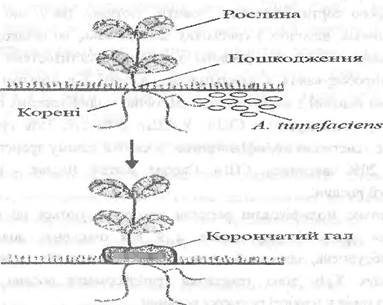
Fig. 1.3. Infection of plants by Agrobacterium tumefaciens
T-DNA contains genes, most of which are activated only after integration into the plant genome. These genes encode Enzymes for the synthesis of phytohormones—Auxins and Cytokinins—which cause plant cell enlargement and proliferation. An excess of phytohormones leads to tumor formation. In addition to phytohormone genes, T-DNA contains genes encoding opines. Opines are Condensation products of amino and keto acids. For example, the condensation of Arginine and Pyruvate yields octopine, while arginine and α-ketoglutarate yield nopaline.

Opines serve as a source of carbon and nitrogen for agrobacteria. Thus, Evolutionary Processes have shaped a mechanism that transforms the plant cell into a "biological factory" producing opines to meet the metabolic needs of Agrobacterium tumefaciens.
Vectors for plant cell transformation have been engineered based on Agrobacterium tumefaciens Ti-plasmids. To introduce genes into plants, the T-DNA region of Agrobacterium tumefaciens is utilized. Phytohormone genes and opine METABOLISM genes are removed from the T-DNA and replaced with the Gene targeted for transport into the Nucleus of the recipient cell.
Using Agrobacterium tumefaciens Ti-plasmids, researchers at the Institute of Plant Physiology and Biochemistry of the Siberian Branch of the Russian Academy of Sciences successfully developed transgenic aspen. Trees harboring the introduced ugt and acb genes exhibit a 5- to 10-fold increase in growth rate compared to wild-type trees.
In addition to Ti-plasmids, particle bombardment is employed to deliver genes into plant cells by utilizing microparticles coated with adsorbed DNA. Gold or tungsten particles, 0.4–1.2 µm in diameter, propelled at velocities of 300–600 m/s, penetrate the plant cell wall and membranes, delivering DNA directly into The Nucleus. This bombardment method enables the transformation of monocots and conifers, which are otherwise recalcitrant to Agrobacterium tumefaciens-mediated transformation.
Plants carrying transgenes within their Chloroplasts are environmentally safer, as this minimizes the risk of transgene escape to related wild species. Methods have been developed to integrate genes into chloroplast or Mitochondrial DNA, ensuring that the target protein is synthesized within these Organelles.
Plant chloroplasts contain 1–10% of the total cellular DNA. The Chloroplast Genome (plastome) is characterized by a high level of polyploidy (103–105 copies per cell). A single cell with transformed chloroplasts contains thousands of transgene copies, enabling high levels of RECOMBINANT PROTEIN EXPRESSION (up to 25% of total soluble protein). Chloroplast transformation vectors are circular DNA molecules capable of introducing DNA fragments larger than 50 kb (20–30 genes) into the plastome. Vector delivery into chloroplasts is achieved via particle bombardment or polyethylene glycol-mediated transformation.
A comparative Overview of various plant cell transformation methods is presented in Table 1.3.
Table 1.3
Methods for DNA delivery into plant cells
Method |
Characteristics |
Ti-plasmid usage |
Highly efficient system, but not applicable to all plant species |
Simple and cost-effective method, applicable to a wide range of plants and Tissues |
|
Viral vector systems |
Inefficient method for DNA delivery into plant cells |
Microinjection |
Limited application, as injection delivers genes into only a single cell at a time |
Direct gene transfer into plant protoplasts |
Used to introduce genes into protoplasts capable of regenerating viable plants |
Electroporation |
Used for gene introduction exclusively into protoplasts |
Liposome fusion |
Used to introduce genes into protoplasts capable of regenerating viable plants |
Last update: 11/08/2026
Editorial and Educational Adaptation: This material has been compiled based on the primary/original source text. The project team performed an editorial review, corrected technical inaccuracies, structured sections, and adapted the content for an educational format.
What was processed:
- elimination of formatting defects (OCR errors, structural breaks, corrupted characters);
- editorial organization of content;
- standardization of terminology in accordance with academic sources;
- verification of factual statements against the original source text.
All mentions of the author, publication year, and origin of the primary text have been preserved in accordance with the source.