BIOTECHNOLOGY - V. H. Gerasymenko - 2006
Part II. Special Biotechnologies
CHAPTER 10. APPLICATION OF IMMOBILIZED ENZYMES IN BIOTECHNOLOGY
10.2. BIOTECHNOLOGY OF HIGH-FRUCTOSE SYRUP PRODUCTION
Fructose (fruit sugar or honey sugar) is widely distributed in nature and found in many fruits and berries. It is particularly abundant in apples and bee honey, which consists of nearly 50% fructose. Compared to conventional sugar (which also contains fructose in its molecular Structure, chemically bound to less sweet glucose), fructose has a more pleasant taste; professionally speaking, the taste of fructose is described as "honey-like," whereas that of regular sugar is cloyingly sweet.
Fructose is 1.65 times sweeter than sucrose and more than 2.2 times sweeter than glucose, which correspondingly reduces the required consumption and, in turn, lowers the caloric content of the product. This is of great importance for dietary Nutrition. Furthermore, unlike glucose or regular table sugar, fructose can be consumed by diabetes patients. A mixture of fructose and glucose does not crystallize (sugar), which is essential for The production of ice cream, confectionery, and other goods.
High-fructose syrups are used in the production of tonic and acidophilus beverages, ice cream, confectionery, canned fruits, and other products. Therefore, increasing the sweetness of syrups by raising their fructose content—with glucose serving as a potential source—is of significant practical importance. Worldwide efforts have been initiated to find efficient Methods for obtaining this product.
Sweet fructose syrups can be obtained from sucrose via acid Hydrolysis (using sulfuric, citric, or, less frequently, Hydrochloric acid at elevated temperatures) or through a more efficient enzymatic method: inversion using the enzyme invertase (sucrase). Under the action of invertase, a mixture of D-glucose and D-fructose is formed from sucrose.
Many microorganisms are capable of synthesizing invertase, with Yeasts—particularly Saccharomyces cerevisiae—being the most thoroughly studied group. Recent findings indicate that the Yeast K. marxianus synthesizes invertase with an activity 2–3 times higher than that of S. cerevisiae (Zherebtsov N.A. et al., 2003).
In the biotechnological production of invert sugar, invertase immobilized on various organic and inorganic carriers is employed.
The biocatalyst used in the Snam Progetti pilot plant for the continuous inversion of sucrose is yeast invertase immobilized by entrapment in Cellulose triacetate hollow fibers. The biocatalyst exhibits high stability. Over 10 years of operation at a Temperature of 25 oC, it lost only 20% of its initial activity.
Entrapment of invertase in a polyacrylamide gel makes it possible to obtain a biocatalyst with high stability at 30oC: over 450 days of continuous operation, The activity of the invertase decreased by only 10%.
The Indian National Research Development Corporation (NRDC) has developed an industrial process for sugar inversion using yeast Cells immobilized on an inorganic support as a biocatalyst.
Kovalenko G.A. et al. (2003) obtained a highly stable heterogeneous biocatalyst for sugar inversion through the adsorption immobilization of invertase on ceramic Supports coated with catalytic fibrous carbon (CFC).
Invert sugar crystallizes more slowly compared to sucrose, which makes it valuable in the manufacture of products where sugar crystallization is undesirable, such as semi-liquid candy fillings, liqueurs, artificial honey, and syrups.
A more promising approach is the production of fructose from glucose generated via starch hydrolysis.
It is well known that glucose can be enzymatically converted into fructose using either soluble or immobilized glucose isomerase. In industry, glucose isomerase is used exclusively in its immobilized form. Commercial preparations of immobilized glucose isomerase are obtained through various immobilization methods: adsorption of the enzyme onto various supports (ion-exchange resins and porous inorganic supports); drying of whole producer cells while keeping the intracellular enzyme bound to The Cell; covalent binding of glucose isomerase to organic and inorganic supports; entrapment in gels and fibers; entrapment in gels followed by
cross-linking. Table 10.2 outlines the immobilization methods used for the most common industrial glucose isomerase preparations.
Class="center">Table 10.2.
Industrial preparations of immobilized glucose isomerase
(according to Nakhapetyan L.A., Menyaylova I.I., 1988)
Form (Country) |
Preparation Name |
Producer |
Immobilization Method |
Novo Industri (Denmark) |
Sweet-zymer |
Bacilks coaqufaris |
Cell Disruption, cross-linking with glutaraldehyde |
Gist Brocades (Netherlands) |
Maxa-xyme |
Actinoplancs missounonsis |
Cross-linking of cells mixed with gelatin using glutaraldehyde |
Miles Kali-Chemie (USA-Germany) |
Optis-weet 22 |
Streptomyces rubglnosus |
Covalent binding of the soluble enzyme to a silica support |
ICM (UK) |
Immobilase |
Arthobactor species |
Entrapment of whole cells in a polycation and polyanion mesh |
Nagase (Japan) |
Sweetase |
Streptomyces phacochromogenes |
Drying of whole cells |
Roquette· Freres (France) |
Lysase |
Streptomyces viola-ceoniger |
Cross-linking of cells mixed with gelatin using glutaraldehyde |
Suomen Sokeri (Finland) |
Spezyme |
Streptomyces rubіgsnosus |
Binding of the soluble enzyme via ion-exchange adsorption on a composite support made of DEAE-cellulose, polystyrene, and titanium dioxide |
Despite all the advantages of fructose over sucrose, its global production was virtually nonexistent until the mid-1960s.
In 1966, a soluble glucose isomerase preparation was used for the first time in Japan to produce high-fructose syrup. The resulting product contained 12% fructose, 50% glucose, and 8% other sugars.
In 1973, Clinton Corn Processing Company in the USA initiated the first industrial production of high-fructose syrups; however, instead of using soluble glucose isomerase like the Japanese, they employed an enzyme immobilized on a cellulosic ion exchanger in a fixed-bed Reactor.
The scientific principles underlying the process are as follows. The enzyme glucose isomerase catalyzes the single-step conversion (isomerization) of glucose to fructose, with the reaction proceeding until the amounts of glucose and fructose in the reaction system are nearly equal. At this point, the reaction reaches equilibrium, and the resulting mixture can either be used directly as a glucose-fructose syrup or processed to separate the fructose, while the remaining glucose is subjected to isomerization once again.
The biotechnological process of glucose isomerization is carried out in Column-type reactors up to 5 m in height, which are pre-packed with an immobilized enzyme in the form of granules, hollow filaments, gel pieces, and the like. A glucose solution (obtained beforehand through the hydrolysis of corn or potato starch) is continuously fed into the column from top to bottom, and glucose-fructose syrup emerges from the outlet.
The efficiency of this technology is demonstrated by the following data: 1 kg of immobilized enzyme yields 4 tons of fructose (calculated on a dry matter basis) over 100 days of operation. The half-life of the enzyme (the time required for its activity to decrease by half) ranges from 20 to 50 days. The catalyst (immobilized enzyme) needs to be replaced only once every 2–3 months, making the process highly cost-effective. Furthermore, the cost of production using the immobilized enzyme is only 61% of that associated with the soluble enzyme.
To maintain high plant productivity over extended periods, The Use of high-purity feedstock is recommended. A. A. Klesov cites data from Denki Kagaku showing that when crystalline glucose is used, the reactor productivity reaches 4,000 kg of dry fructose per 1 kg of immobilized enzyme, with a catalyst half-life of 50 days. Conversely, when lower-quality glucose is used, reactor productivity drops to 1,500 kg of product per 1 kg of immobilized enzyme, and the half-life decreases to 20 days.
To produce high-fructose syrup, the Japanese company Kyowa Hakko employs glucose isomerase immobilized by adsorption onto Duolite A7 phenol-formaldehyde resin. A 40% glucose solution at 60 оС (pH 8.2) serves as the feedstock; it is passed through a column packed with Duolite A7 (Fig. 10.2), and the finished product is subsequently passed through a cation exchanger and an anion exchanger to remove salts. Due to the elevated operating temperature (60 оС), no microbial contamination of the system was observed during 40 days of continuous operation. The half-life of the immobilized glucose isomerase is 6 days. The production cost using the immobilized enzyme amounted to 61.5% of the cost of product manufactured with the soluble enzyme.
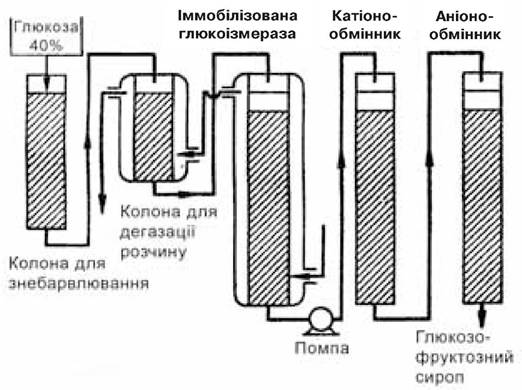
Fig. 10.2. Schematic diagram of the isomerization of glucose to fructose using glucose isomerase immobilized on a phenol-formaldehyde resin
(after A. A. Klesov, 1982)
Last update: 11/08/2026
Editorial and Educational Adaptation: This material has been compiled based on the primary/original source text. The project team performed an editorial review, corrected technical inaccuracies, structured sections, and adapted the content for an educational format.
What was processed:
- elimination of formatting defects (OCR errors, structural breaks, corrupted characters);
- editorial organization of content;
- standardization of terminology in accordance with academic sources;
- verification of factual statements against the original source text.
All mentions of the author, publication year, and origin of the primary text have been preserved in accordance with the source.