Fundamentals of Bioinformatics - Ourtsov A.N. 2013
Foundations of Bioinformatics
Biological Sequences
Biological Sequence Alignment
Sequence alignment of nitrogenous bases in Nucleic Acids or Amino Acids in protein polypeptide chains refers to the Determination of the mutual correspondence of residues (nucleic bases or amino acid residues, respectively) in two or more sequences, such that the original order of residues within the sequences is preserved.
Sequence alignment is a fundamental tool in bioinformatics, performed to establish structural, functional, and evolutionary relationships between sequences.
Biological macromolecules are the product of molecular evolution. Therefore, if two such Biomacromolecules share a common ancestor—and consequently, their monomer sequences share a common ancestral sequence—they generally exhibit similarities in monomer composition, Structure, and biological function.
For example, if a novel sequence with an unknown function is discovered, but similar sequences with previously established structures and Functions can be found in Databases, the results of aligning (comparing) this new sequence with already investigated ones can provide a basis for predicting the function or STRUCTURE OF THE novel sequence.
One of the goals of sequence alignment is to determine the degree of similarity between two sequences and, if it is sufficiently high, to draw a plausible Conclusion about their Homology.
When Genetic information is transmitted from a previous generation to the next, it undergoes certain alterations during the copying process. These changes, which occur as lineages diverge from a common ancestor, are of three types: substitutions, insertions, and deletions (gaps).
Such alterations can accumulate from generation to generation. Over thousands of generations, a significant number of discrepancies may accumulate within the sequences. Comparing two putatively homologous sequences reveals the extent of their divergence, reflecting the magnitude of evolutionary change.
Sequence alignment is the Procedure of comparing two (pairwise alignment) or multiple (multiple alignment) sequences by searching for runs of individual elements or characteristic combinations of elements that are arranged in the same relative order across the aligned sequences.
When aligning two sequences, they are placed in two rows, one above the other, represented by letters of the alphabet.
Identical or similar "letters" (elements) of these rows (sequences) are shifted horizontally within their row (without altering the original order of the "characters") so that they line up vertically in corresponding columns.
Non-identical or distinct characters are either placed in the same columns as mismatches or aligned opposite gaps inserted into the second sequence.
Let us consider two example rows:
1) abcde 2) acdef
A reasonable alignment would look like this:
Class="center">
To find the optimal (or best) alignment, it is necessary to define an alignment quality criterion. For instance, for The nucleotide sequences gctgaacg and ctataatc, the following alignments are possible:
1. Uninformative alignment 
2. Alignment without gaps 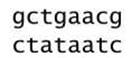
3. Alignment with gaps 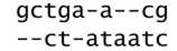
4. Another alignment 
Intuitively, the last alignment appears to be the best, as it yields the maximum number of nucleotide matches between the two sequences while utilizing the minimum number of insertions.
To determine whether it is indeed the best of all possible alternatives, one must have a method for systematically checking all potential alignments, along with a quantitative criterion ("weight" or "score") by which the quality of different alignments can be compared to identify the one with the optimal weight (score).
Moreover, the outcome of the comparison may depend heavily on the specific scoring system chosen; even minor adjustments to the scoring scheme can alter the ranking of alignments, causing a different alignment to emerge as the best.
Several types of sequence alignment are distinguished.
✵ Global alignment involves aligning an entire sequence against another entire sequence.

Here, the symbol " | " denotes matches, "spaces" denote mismatches, and " - " indicates the insertions and deletions that must be made in both sequences to achieve the maximum number of matches.
✵ Local alignment is the search for a subsequence that matches a portion of another sequence.

For local matches, protruding ends are not treated as gaps (deletions). In addition to mismatches, insertions and deletions are also possible within the matching region.
✵ Motif finding is the search for matches of a short sequence within one or more segments of a long sequence. In this case, a single-character mismatch is allowed. Alternatively, an exact match can be required, or a greater number of mismatches and even gaps can be permitted.
For example, let's find the matching motifs "I love" for the strings

✵ Multiple alignment is the simultaneous alignment of multiple sequences. For example, let's align four strings:

The final, fifth row, which displays the characters conserved across all aligned sequences, is called the consensus.
Last update: 11/08/2026
Editorial and Educational Adaptation: This material has been compiled based on the primary/original source text. The project team performed an editorial review, corrected technical inaccuracies, structured sections, and adapted the content for an educational format.
What was processed:
- elimination of formatting defects (OCR errors, structural breaks, corrupted characters);
- editorial organization of content;
- standardization of terminology in accordance with academic sources;
- verification of factual statements against the original source text.
All mentions of the author, publication year, and origin of the primary text have been preserved in accordance with the source.