Fundamentals of Bioinformatics - Ogurtsov A.N. 2013
Foundations of Bioinformatics
Bioinformatics Infrastructure
Bioinformatic Data, Networks, and Databases
Computers store sequence information as strings—simple rows of sequential characters. Each character is expressed as a binary code and represented by the smallest unit of information called a byte. Each byte consists of 8 bits, and each bit can take a value of 0 or 1, yielding 255 different bit combinations, which means a single byte can encode 255 characters.
DNA sequences are typically stored and processed in a computer as a series of 8-bit words in the aforementioned binary format. Protein sequences are represented as a series of 8-bit words consisting of single-letter amino acid codes in binary form.
Sequence information for DNA or Proteins is usually written to a text file in standard ASCII format or in FASTA format (FAST Alignment).
A FASTA data file includes a title line (header) and sequence data lines. The sequence description follows the title line, which begins with a ">" symbol. The first word in this line is the sequence name, followed by the sequence description. The remaining lines contain the sequence itself. When reading a data file, the FASTA program ignores blank lines, as well as any spaces or gap characters within the sequence. A file combining multiple sequences is structured on the same principle—lines containing sequence descriptions follow one another sequentially.
Structure of a sequence in FASTA format:
✵ Begins with a simple description line. The first Column must contain ">". The rest of the header line is arbitrary, but must be informative.
✵ The subsequent lines contain the sequence, with one character per residue.
✵ Single-letter codes for NUCLEOTIDES and Amino Acids are used, as designated by the International Union of Biochemistry and the International Union of Pure and Applied Chemistry (IUB/IUPAC).
http://www.chem.qmw.ac.uk/iupac/misc/naabb.html
http://www.ehern.qmw.ас.uk/iupac/AminoAcid/
✵ The designations Sec and U are used as the three-letter and single-letter codes for selenocysteine:
http://www.chem.qmw.ac.uk/iubmb/newsletter/1999/item3.html
✵ Lines can vary in length, resulting in a ragged right margin.
✵ Typically, nucleotides are written in lowercase and amino acids in uppercase.
Example of FASTA format for the bovine enzyme Glutathione peroxidase:
Class="center">>gi 1121664 IspIР004В5IGSHC_BOVIN GLUTATHIONE PEROXIDASE
MCAAQRSAAALAAAAPRTVYAFSARPLAGGEPFNLSSLRGKVLLIENVASLUGTTVRDYTQ
MNDLQRRLGPRGLWLGFPCNQFGHQENAKNEEILNCLKYVRPGGGFEPNFMLFEKCEVNGE
KAHPLFAFLREVLPTPSDDATALMTDPKFITWSPVCRNDVSWNFEKFLVGPDGVPVRRYSR
RFLTIDIEPDIETLLSQGASA
The header line contains the following fields:
> is the mandatory first character of the first line;
gi | 121664 is the geninfo identifier (GI), a unique accession number assigned by the US National Center for Biotechnology Information (NCBI). Every sequence in the database has a unique GI identifier. NCBI gathers sequences from various sources, including primary data archives and patent Applications. Its GI numbers provide a common, consistent umbrella identifier that overlays the different conventions of source Databases. If a source database updates its information, NCBI creates a new record with a new GI number if the changes affect the sequence, but updates and retains the existing record if the changes affect only non-sequence data, such as literature citations.
The entry sp | P00435 indicates that Swiss-Prot is the source of the information, and that P00435 is the Swiss-Prot accession number.
GSHC_BOVIN GLUTATHIONE PEROXIDASE is the Swiss-Prot identifier for the sequence and species (GSHC BOVIN), followed by the molecule name.
EMBnet - European Molecular Biology Network. The network was established in 1988 to connect European molecular biology laboratories that applied bioinformatics and computational biology Methods in their research. Designed to provide information and educational services to researchers in various European countries, EMBnet operated through dedicated nodes communicating in local languages.
Consequently, this network infrastructure spared individual institutions from having to maintain periodically updated copies of numerous biological databases, install search software, purchase expensive commercial software packages, and so on.
Today, EMBnet serves 34 nodes, 20 of which are specifically designated as National Nodes. These nations are responsible for maintaining databases, providing software and network services (such as sequence analysis, protein modeling, and genetic mapping), offering user support and training, and conducting scientific research and development.
Eight EMBnet nodes have special Functions as educational, industrial, or research centers dedicated to advanced expertise in specific, narrow fields of bioinformatics. They are primarily responsible for database maintenance and software development tailored for biological applications.
The remaining six nodes have been integrated into EMBnet as Associated Nodes. These are computational biology centers in non-European countries that provide their users with the same types of services as a typical National Node. Almost all of these nodes offer state-of-the-art access to databases and sequence analysis programs, along with diverse tools for molecular modeling, Genome Analysis, Gene mapping, and more.
The Sequence Retrieval System (SRS) serves as a network browser for molecular biology databases. It was developed to provide additional services to EMBnet users. The SRS website is located at http://srs.ebi.ac.uk/ (Figure 4). SRS allows users to index any single-tier database against any other database.
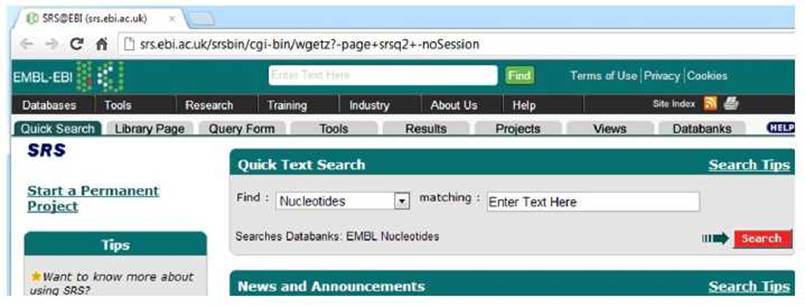
Figure 4 - SRS@EBI web page
The advantage of this system is that derived indexes can be quickly located, allowing operators to select, link, and access records across all resources integrated within the system. SRS users can easily customize the list of connected databases at will. The Sequence Retrieval System links nucleic acid databases, Expressed Sequence Tags (EST), protein sequences, protein fold samples, protein structures, and specialized bibliographic databases.
Thus, SRS is a highly powerful system that enables users to query various types of databases through a single unified interface, eliminating the need to worry about internal data structures, query languages, and the like.
SRS is an integrated information retrieval system operating across multiple heterogeneous sequence databases and facilitating The transfer of selected sequences to analytical tools, such as sequence comparison and alignment programs.
In total, SRS can perform searches across more than 140 databases covering protein and nucleotide sequences, metabolic pathways, spatial structures and Functions of Proteins, genomes, as well as disease descriptions and phenotypes.
This also includes smaller databases, such as the Prosite (http://prosite.expasy.org/) and Blocks (http://blocks.fhcrc.org/) protein structural motif databases, METABOLISM/31.html">Transcription factor databases, and specialized pathogen databases.
In addition to direct access to a vast number of databases, SRS provides close cross-links between databases and facilitates the effortless launching of applications.
Searches within a single database can be expanded into a network-wide search; that is, all records related to a specific protein can be easily retrieved across all databases containing them. Similarity search and alignment programs can be launched directly without having to save query results in an intermediate file.
The National Center for Biotechnology Information (NCBI) was established in 1988 in the USA as a division of the National Library of Medicine and is located on the campus of the National Institutes of Health (NIH) in Bethesda, Maryland (http://www.ncbi.nlm.nih.gov/).
The mission of the NCBI is to develop new information technologies for studying Molecular and genetic processes in health and disease.
Specific goals include creating automated systems for storing and analyzing biological information, advancing machine-Processing technologies, facilitating user access to databases and software, and coordinating efforts to gather biotechnology information globally.
Additionally, the NCBI maintains GenBank, a DNA sequence database (http://www.ncbi.nlm.nih.gov/genbank/) established under the auspices of the NIH.
Annotation groups create records of sequenced structures based both on literature data and submissions from researchers, and exchange these records with international nucleotide databases such as the European Molecular Biology Laboratory (EMBL) and the DNA Data Bank of Japan (DDBJ).
Entrez. Much like SRS for the EMBnet network, the NCBI developed the Entrez browser (http://www.ncbi.nlm.nih.gov/sites/gquery) to facilitate the retrieval of molecular biology data (as well as cross-References to bibliographic sources) from databases integrated within the NCBI (Figure 5).
Entrez allows users to link related records from different databases, regardless of whether explicit cross-references exist between them. Entrez provides access to:
✵ DNA sequence databases - GenBank, EMBL, and DDBJ;
✵ protein sequence databases —
Swiss-Prot (http://www.expasy.org/sprot/),
PIR (http://pir.georgetown.edu/),
PRF (http://www.genome.jp/dbget-bin/www_bfind7prf),
SeqDB, PDB, protein sequences obtained by translating DNA sequences;
✵ genome and chromosome mapping databases, and 3D protein structures from the PDB;
✵ the PubMed bibliographic database.
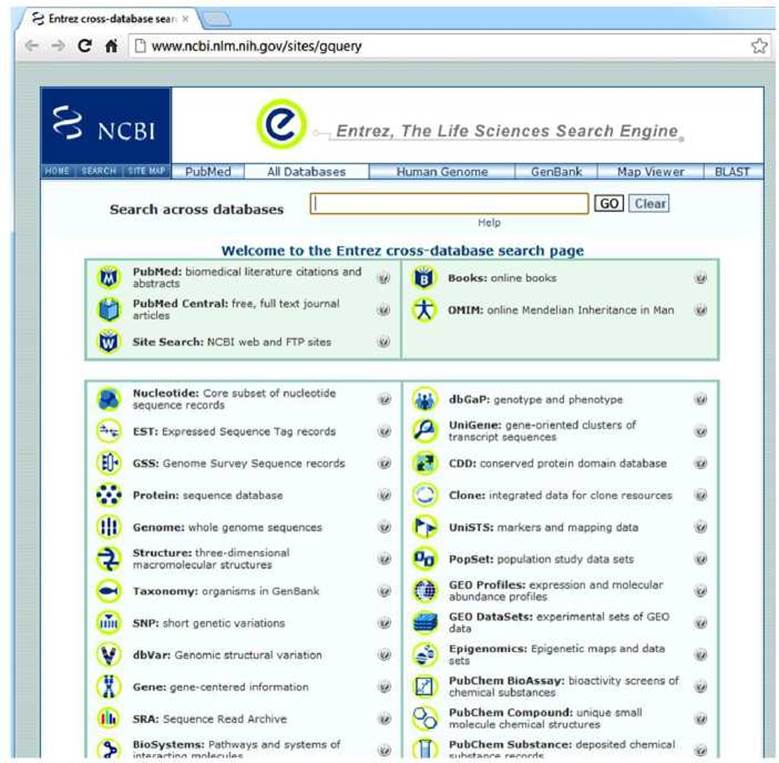
Figure 5 - Entrez web page
This seamless connection between various databases is a key strength of the system. Entrez can be considered a starting point for retrieving sequences and structures from NCBI resources.
Entrez is an online information retrieval system that integrates information from all NCBI databases. It serves as a unified, highly user-friendly external interface for all databases supported by NCBI.
In total, Entrez is linked to 11 databases. NCBI has developed a relational data model for heterogeneous sequence data, which has spurred the rapid growth of software and the integration of databases managed by the popular Entrez search and retrieval system. The GenBank database is also built upon this same model.
The advantages of this model include the ease of navigating between DNA sequence descriptions and their encoded proteins, genetic chromosome maps, spatial structures of corresponding proteins, and bibliographic lists containing relevant information on these objects.
The NCBI data model works directly with DNA and protein sequences. The Translation process is represented as a direct link between these two sequences rather than mutual annotations.
Annotations describing a protein (such as peptide degradation products) are presented as features annotated directly onto the protein sequence.
This principle makes it exceptionally convenient to analyze protein sequences obtained through translation and the features of coding DNA sequences using BLAST or any other sequence retrieval tool (without losing feedback to the original gene). A set comprising a DNA sequence and its translation products is referred to as a NucProt set. The data model developed at NCBI defines the sequence type as a "segmented sequence".
GenBank, EMBL, and DDBJ represent reconstructed assemblies of segmented sequences as contiguous regions (or contigs). Entrez displays such an assembly as a line connecting all its constituent sequences.
A contig (from contiguous) is (1) a set of cloned DNA fragments that overlap continuously in a known order to cover part or all of a genome; (2) a type of physical map in which the markers are cloned fragments (see also section 6.2).
Mirrors and Intranet. Mirrors are duplicate servers that provide services and information from a primary server that may be inaccessible for some reason. To access the required website, simply enter its URL into the browser's address bar.
Many educational institutions have an "Intranet", which is a corporate local network accessible only from the computers within that Organization.
It is the sprawling web (WWW) that makes the World Wide Web so powerful. For initial familiarization, the following main gateway websites are recommended:
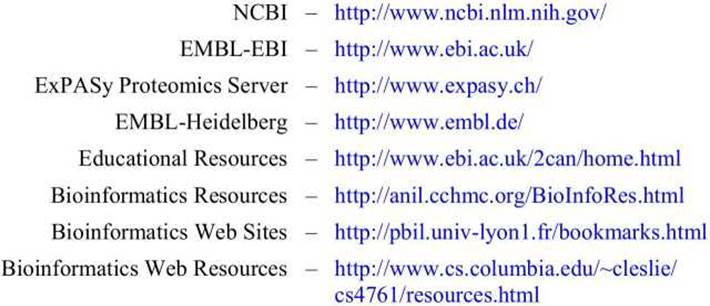
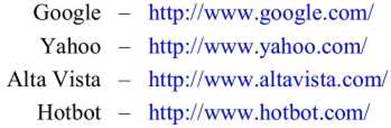
In addition to the aforementioned websites, there are numerous specialized resources related in one way or another to biology. Universal search engines can be helpful in locating these resources:
Selection/41.html">Review Questions and Assignments
1. What is the World Wide Web?
2. What is the difference between system and application software? Provide Examples.
3. What is the difference between download and upload? What are three ways to download information from the Internet?
4. What are the Similarities and differences between a computer's IP address and its text name within the hierarchical domain name system?
5. What is the difference between a webpage and a website?
6. What is an internet browser? Which browsers do you know?
7. WHAT IS A hyperlink?
8. What is a URL and what is its format?
9. How is a protein sequence written in FASTA format?
10. What is a GI number?
11. What is EMBnet and which browser is used in this network?
12. What is SRS (Sequence Retrieval System) and in which network is it used?
13. What is NCBI and which browser is used within the NCBI network?
14. What is Entrez and in which network is it used?
15. What is a contig?
16. What are internet mirrors?
17. What is an Intranet?
18. Which universal search engines do you know?
Last update: 11/08/2026
Editorial and Educational Adaptation: This material has been compiled based on the primary/original source text. The project team performed an editorial review, corrected technical inaccuracies, structured sections, and adapted the content for an educational format.
What was processed:
- elimination of formatting defects (OCR errors, structural breaks, corrupted characters);
- editorial organization of content;
- standardization of terminology in accordance with academic sources;
- verification of factual statements against the original source text.
All mentions of the author, publication year, and origin of the primary text have been preserved in accordance with the source.