Medical Genetics - V. M. Zaporozhan 2005
Chromosomal Diseases
The Concept of Microcytogenetic Syndromes
This group of Chromosomal Disorders includes syndromes caused by deletions or duplications of very small chromosomal regions, appropriately termed microdeletion and microduplication syndromes. Basic information on microcytogenetic syndromes is summarized in Table 5.7.
Microcytogenetic syndromes are characterized by the following features:
1. They present with a distinct clinical picture because the microdeletion or microduplication affects a very small chromosomal segment (often a single Gene).
2. Occasionally, these syndromes can result not only from a chromosomal aberration but also from Gene Mutations affecting the specific gene in question. For example, retinoblastoma may be caused by a deletion in the long arm of chromosome 13 (q14) or by a point mutation within the affected gene.
3. Some syndromes may be caused not only by microdeletions but also by uniparental disomy and disruptions in Genomic Imprinting (such as Angelman and Prader–Willi syndromes).
4. They are rare (typically occurring in 1:50,000 to 1:100,000 newborns).
5. Molecular cytogenetic techniques (such as FISH) are required for Diagnosis, as standard karyotyping proves ineffective.
Angelman Syndrome (Happy Puppet Syndrome)
This syndrome was first described by H. Angelman (1965).
Minimum diagnostic criteria: severe intellectual disability, profound speech delay, seizures, characteristic gait, and unmotivated laughter.
Population frequency: 1:50,000.
The syndrome is caused by a microdeletion of the long arm of chromosome 15 (q11-q13) of maternal origin (Fig. 5.20). It can also result from uniparental disomy (inheritance of both chromosome 15 homologs from the father, meaning maternal genes are absent). Genomic imprinting plays a significant role in the Clinical presentation.
Table 5.7. Microcytogenetic syndromes
|
Syndrome or Disorder Name |
Involved Chromosomal Region (deletion or duplication) |
Key Symptoms |
|
Microdeletion Syndromes |
||
|
Retinoblastoma |
13q14.1-q14.2 |
Retinal tumor (unilateral or bilateral) in early childhood |
|
DiGeorge Syndrome |
22q11.21 |
Seizures (hypocalcemic), thymic aplasia or hypoplasia, facial dysmorphism, Congenital Heart defects |
|
Angelman Syndrome |
15q11-q13 maternal chromosome |
Dysmorphic facial features, ataxia, hypotonia, Epilepsy, bouts of laughter, microcephaly, absence of speech |
|
Prader–Willi Syndrome |
15q11-q13 paternal chromosome |
Truncal and proximal limb obesity, facial dysmorphism, hypotonia, hypogonadism, intellectual disability, small hands and feet |
|
11 р 13 |
Nephroblastoma |
|
|
Microduplication Syndromes |
||
|
Beckwith–Wiedemann Syndrome |
11 р 15 |
Omphalocele, macroglossia, gigantism, hypoglycemia, microcephaly, Congenital Malformations of Internal Organs |
Class="center">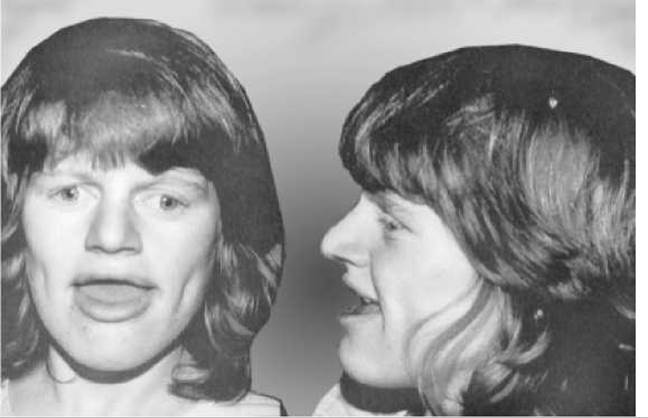
Fig. 5.20. Angelman syndrome (elongated face, strabismus, macrostomia, smiling grimace)
Karyotype in deletion form: 46,XX,dеl 15q- or 46,XY,del 15q-.
Characteristic features include microbrachycephaly, an elongated face, and macrostomia. Psychomotor retardation, profound intellectual disability, and severe speech delay are observed in 100% of cases. Ataxia, an unusual gait resembling the movements of a mechanical doll, and easily provoked or spontaneous bursts of laughter (hence the name "happy puppet syndrome") are typical. Patients frequently protrude their tongues. Life expectancy is unaffected.
Prader–Willi Syndrome
This syndrome was first described by A. Prader and H. Willi (1956).
Minimum diagnostic criteria: muscular hypotonia, hypogonadism, obesity, intellectual disability, small hands and feet.
Population frequency: 1:25,000–1:50,000.
The syndrome is caused by a microdeletion of the long arm of chromosome 15 (q11-q13) of paternal origin (Fig. 5.21). It can also result from uniparental disomy (inheritance of both chromosome 15 homologs from the mother, meaning paternal genes are absent). Genomic imprinting plays a critical role in the clinical presentation.
Karyotype in deletion form: 46,XX,dеl 15q- or 46,XY,del 15q-.
Two Phases of the syndrome are distinguished (Fig. 5.22). In infants (first phase), floppy infant syndrome is diagnosed (marked by pronounced muscular hypotonia and hyporeflexia).
The second phase occurs a few weeks or months later. Polyphagia develops, and patients constantly feel hungry. Obesity sets in. Hypogonadism is observed (hypoplasia of the Penis and Scrotum, cryptorchidism in boys; in girls — hypoplasia of the labia, and in 50% of cases — hypoplasia of the Uterus).

Fig. 5.21. Deletion of the long arm of chromosome 15 in Prader–Willi syndrome (the deletion is indicated by the arrow)
Patients exhibit microcephaly, small hands, and small feet (acromicria).
Mental retardation is a characteristic feature.

Fig. 5.22. Prader–Willi syndrome (obesity, small hands, and feet)
Last update: 11/08/2026
Editorial and Educational Adaptation: This material has been compiled based on the primary/original source text. The project team performed an editorial review, corrected technical inaccuracies, structured sections, and adapted the content for an educational format.
What was processed:
- elimination of formatting defects (OCR errors, structural breaks, corrupted characters);
- editorial organization of content;
- standardization of terminology in accordance with academic sources;
- verification of factual statements against the original source text.
All mentions of the author, publication year, and origin of the primary text have been preserved in accordance with the source.