Medical Genetics - V. M. Zaporozhan 2005
Etiology of Hereditary Diseases
Types of Mutations Caused by Changes in Chromosome Number and Structure
Genomic Mutations - Polyploidy
Genomic Mutations refer to changes in chromosome number. There are two MAIN TYPES OF genomic mutations: polyploidy and heteroploidy (aneuploidy).
Polyploidy is an increase in the chromosome number by a multiple of the haploid set (3n, 4n, ...). In humans, both triploidy (3n = 69 Chromosomes) and tetraploidy (4n = 92 chromosomes) have been documented.
Potential causes of polyploidy
1. Polyploidy may result from the nondisjunction of all chromosomes during Meiosis in one of the parents, producing a diploid germ Cell (2n). Subsequent Fertilization by a normal gamete yields a triploid (3n).
2. Fertilization of the oocyte (Fig. 2.13) by two spermatozoa (dispermy).
3. Another possibility is the fusion of a diploid zygote with a polar body, leading to The formation of a triploid zygote.
4. Somatic mutation may also occur due to the nondisjunction of all chromosomes during embryonic Cell Division (mitotic failure). This results in a tetraploid (4n) condition, either complete or in a mosaic form.
Triploidy (Fig. 2.14) is a frequent cause of spontaneous abortions. It is extremely rare in live births, and most triploid infants die shortly after birth.
Class="center">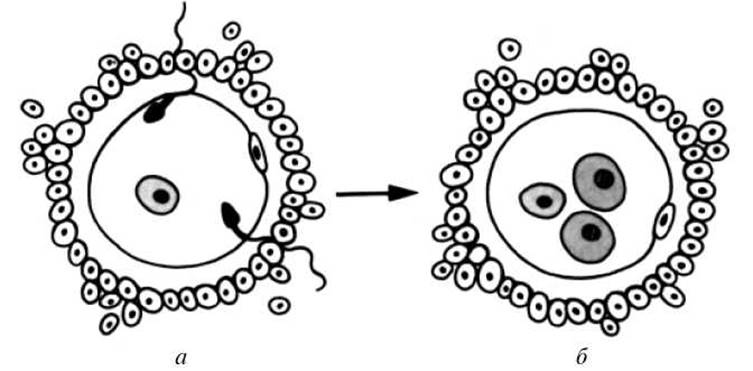
Fig. 2.13. Fertilization of an oocyte by two spermatozoa: a — two spermatozoa fertilize the oocyte; b — one female and two male pronuclei fuse to form a triploid nucleus
Triploids inheriting two chromosome sets from the father and one from the mother typically develop a Hydatidiform Mole. In this condition, extraembryonic structures (chorion, Placenta, amnion) develop, whereas the embryoblast remains practically undeveloped. Hydatidiform moles are typically aborted. Malignant transformation of the chorion into Choriocarcinoma is also possible. In rare instances, the embryoblast does develop, resulting in the birth of a nonviable triploid infant with multiple Congenital Malformations. Such cases are characterized by placental enlargement and cystic degeneration of the chorionic villi.
In triploids with two maternal chromosome sets and one paternal set, embryoblast development predominates, while extraembryonic development is impaired. Consequently, these triploids undergo early Spontaneous Abortion.
Triploidy provides a clear example of the differing functional activities of the paternal and maternal genomes during embryonic development—a phenomenon known as Genomic Imprinting. Overall, both maternal and paternal genomes are strictly required for normal Human embryonic development. Parthenogenetic development is impossible in humans and other mammals.
Tetraploidy (4n) is an extremely rare condition in humans, identified primarily in spontaneous abortion specimens.
Last update: 11/08/2026
Editorial and Educational Adaptation: This material has been compiled based on the primary/original source text. The project team performed an editorial review, corrected technical inaccuracies, structured sections, and adapted the content for an educational format.
What was processed:
- elimination of formatting defects (OCR errors, structural breaks, corrupted characters);
- editorial organization of content;
- standardization of terminology in accordance with academic sources;
- verification of factual statements against the original source text.
All mentions of the author, publication year, and origin of the primary text have been preserved in accordance with the source.