Genetics - A. V. Sivolob 2008
Genetics of Bacteria, Viruses, and Unicellular Eukaryotes
Exchange of Genetic Material Between Bacteria
Although Bacteria reproduce through Cell Division, they also exhibit a peculiar "sexual process" involving The transfer of genetic material from one cell to another. This transfer occurs during conjugation, which implies direct cell-to-cell contact. Conjugation depends on the presence of a specific plasmid within one of the Cells—the F-factor (fertility factor)—which, much like many other Plasmids, can exist autonomously or integrate into the bacterial chromosome via Site-Specific Recombination. In E. coli, There are two "sexual" cell types designated as F+ and F-, with conjugation being accompanied by DNA transfer from the F+ to the F- cell.
The F-factor contains several genes, including those responsible for The formation of so-called pili—tubular surface extensions of The Cell. Pili bind to the receptors of F- cells, establishing a cytoplasmic bridge between the two cell types (Fig. 5.2). A specific nuclease makes a single-stranded cut in the F-factor DNA, and the intact strand serves as a template for extending the 3' end left at the Cleavage site; thus, Replication of the circular F-factor DNA proceeds via the rolling-circle mechanism (this replication mode is also utilized to copy the DNA of many Bacteriophages). The elongation of the 3' end displaces the 5'-terminal single-stranded region, which penetrates the F- cell, where it acts as a template for the Synthesis of the second DNA strand. As a result, the F- cell is converted into an F+ cell (Fig. 5.3).
The frequency of conjugation, as well as the duplication and transfer of the F-factor, is rather low (~10-5) when the F-factor exists autonomously from the bacterial chromosome (as shown in Fig. 5.2). Once the F-factor integrates into the bacterial chromosome, the frequency increases to 10-2–10-1—such F+ cell strains are designated as Hfr (high frequency recombination). During the conjugation of F- and Hfr cells, the integrated F-factor initiates rolling-circle replication of the entire bacterial chromosome (Fig. 5.3): the chromosome is restored in the Hfr cell, while its copy is transferred into the F- cell. In reality, however, an entire chromosome rarely ends up inside the F- cell; typically, the conjugation tube breaks and the transferred chromosome is sheared (as seen in Fig. 5.3, this does not disrupt the original chromosome in the Hfr cell, which always retains an intact DNA strand that can serve as a template for restoring the integrity of the double-stranded molecule). Since only a portion of the F-factor enters the F- cell at the onset of the process, and for it to be transferred completely, the parental chromosome must complete a full "revolution" (Fig. 5.3), an F- cell generally does not convert into an F+ cell upon conjugation with an Hfr cell.
Class="center">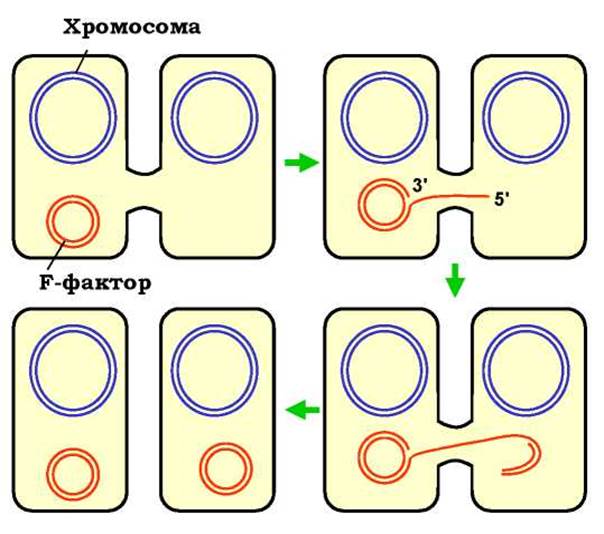
Fig. 5.2. Transfer of the F-factor from an F+ to an F- cell

Fig. 5.3. DNA transfer from an Hfr to an F- cell; the DNA of the integrated F-factor is marked in red
Once a segment of homologous DNA from another bacterium enters the F- cell, Homologous Recombination—described in Chapter 1—takes place, involving the exchange of segments between the donor DNA and the recipient cell's DNA. The resulting recipient cell remains haploid; "extra" DNA that failed to be incorporated into the host chromosome is degraded by Nucleases because it is not circular. Thus, a peculiar partial cross occurs between the two bacterial strains, which can be investigated using standard genetic analysis Methods. Let us consider, for example, a cross between a wild-type Hfr strain for the thr+ and leu+ genes (which determine The ability to synthesize the corresponding Amino Acids), also carrying the streptomycin sensitivity Gene StrS, and an F- strain bearing the streptomycin resistance gene StrR and mutant thr- and leu- genes (an auxotrophic strain requiring the presence of the corresponding amino acids in the growth medium):
Hfr, thr+ leu+ StrS X F-, thr- leu- StrR.
With a certain frequency, such a cross yields wild-type recombinant F- bacteria, thr+ leu+ StrR, which can be selected by culturing them on a medium containing streptomycin.
Because gene transfer from an Hfr to an F- cell occurs sequentially, starting from the F-factor integration site (Fig. 5.3), the relative positions of genes on the bacterial chromosome can be mapped (in the order of their entry into the F- cell). To achieve this, conjugation (after mixing the two cell types in a liquid medium) is interrupted by agitating the test tube at specific time intervals. Historically, this approach made it possible to obtain detailed Genetic Maps of the bacterial chromosome (with distances measured in minutes) and to prove its circularity.
An F-factor integrated into the chromosome can also excise from it to regenerate an autonomous plasmid. Such excision is occasionally imprecise: a segment of the F-factor remains in the chromosome while being replaced by a chromosomal segment carried within the plasmid. This generates a so-called F'-factor, which is capable of transferring bacterial genes into other cells independently of the bacterial chromosome (a phenomenon known as sexduction). Following such transfer, partially diploid cells can be obtained for the genes residing within the F'-factor. Homologous recombination can occur between the latter and the recipient cell chromosome, leading either to the formation of Hfr cells and Gene Duplication (single crossover—insertion of the F'-factor into the chromosome) or to an exchange of segments between the chromosome and the F'-factor (double crossover).
Last update: 11/08/2026
Editorial and Educational Adaptation: This material has been compiled based on the primary/original source text. The project team performed an editorial review, corrected technical inaccuracies, structured sections, and adapted the content for an educational format.
What was processed:
- elimination of formatting defects (OCR errors, structural breaks, corrupted characters);
- editorial organization of content;
- standardization of terminology in accordance with academic sources;
- verification of factual statements against the original source text.
All mentions of the author, publication year, and origin of the primary text have been preserved in accordance with the source.